

Preface
The world’s largest solar car parks prove we’re not short on space—we’ve been wasting it.
Every car park on Earth should be a power plant.
No exceptions.
Not because it’s ambitious.
Because it’s obvious.
We already built the space.
We just never used it.
The Breakthrough Hiding in Plain Sight
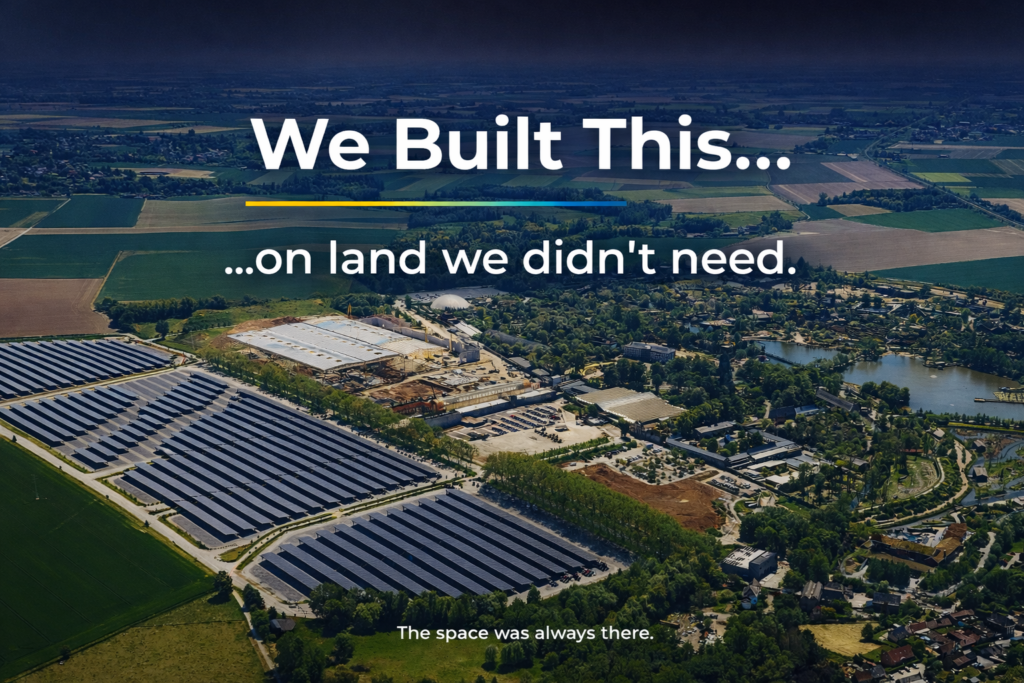
In Belgium, Pairi Daiza has built the largest solar-covered car park on Earth—already operational.
Not in a desert.
Not on cleared land.
Not far from demand.
Exactly where cars already sit.
The Specs That Matter
This isn’t a concept. It’s scale.
- 93,000 solar panels
- ~40 MW capacity
- ~39,899 MWh/year generation
- ~200,000 m² covered parking
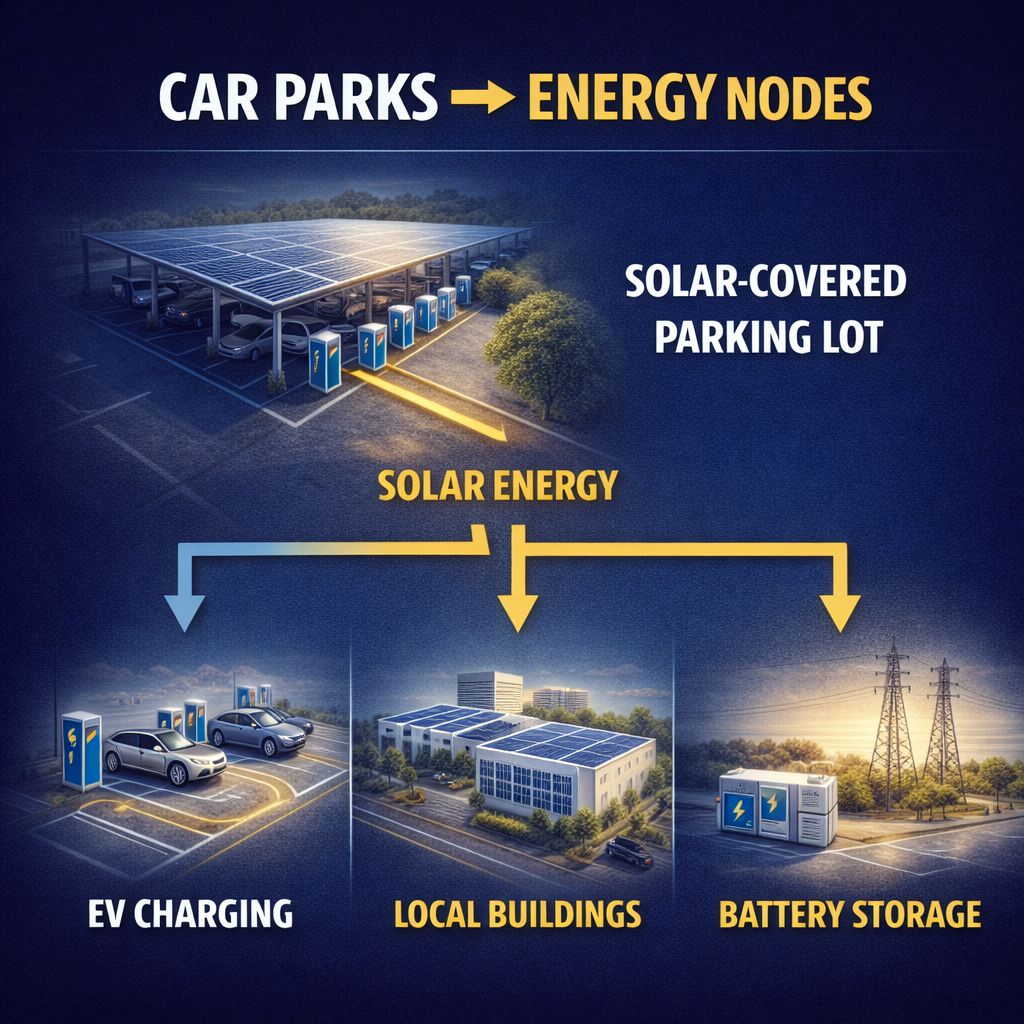
It produces more energy than the zoo consumes—exactly where it’s needed.
The rest?
- powers EV charging onsite
- feeds back into the grid
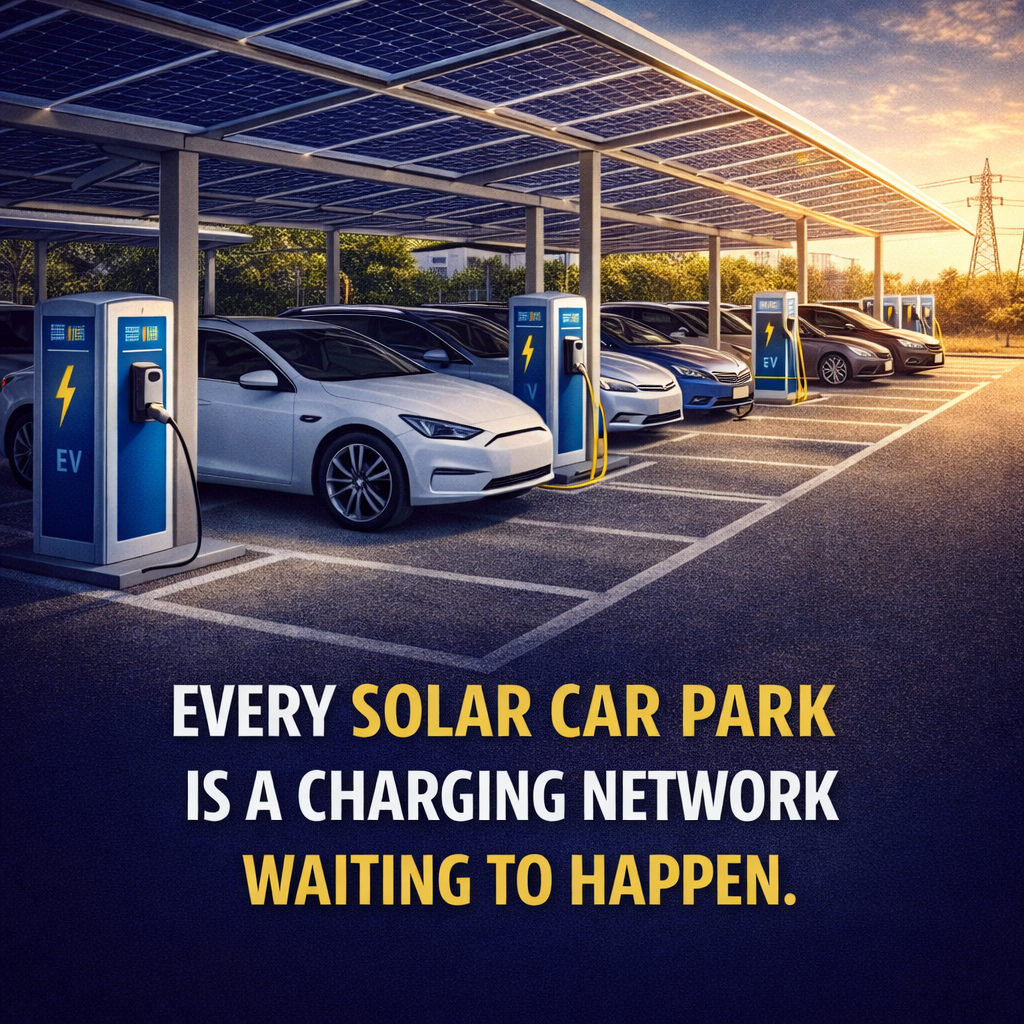
Every solar car park is also a future EV charging hub—by design.
That’s not a car park.
That’s a distributed power plant disguised as parking.
No Trade-Offs — Just Smarter Use
This is the shift:
- No land clearing
- No biodiversity loss
- No competing land use
Just:
Upgrading surfaces that already exist into energy systems
From Examples to System
Projects like Pairi Daiza, Biddinghuizen and Disneyland Paris aren’t the story.
They’re proof.
Because this isn’t about a few flagship sites.
It’s about a model that can be replicated everywhere:
- shopping centres
- airports
- stadiums
- office complexes
- logistics hubs
Anywhere there’s a car park, there’s an energy asset waiting.
These projects prove three things:
- the tech works
- the economics work
- the scale is already proven
What’s missing isn’t innovation.
It’s deployment at scale.
Proof at Scale
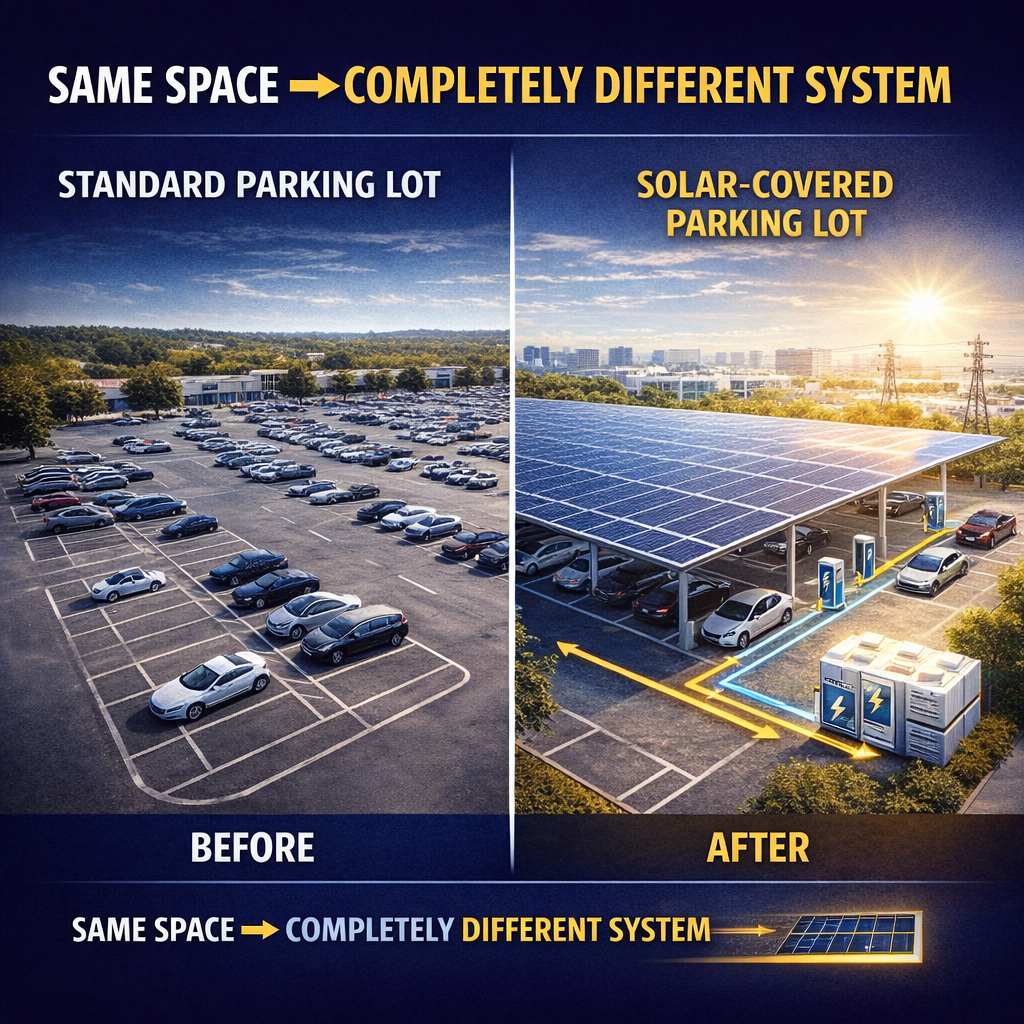
These aren’t concepts. They’re already built.
🇳🇱 Biddinghuizen Solar Carport (Netherlands)
- ~90,000–90,700 panels
- ~37–37.7 MWp capacity
- ~35 GWh/year generation
- ~35 hectares (~350,000 m²)
- ~15,000 parking spaces covered
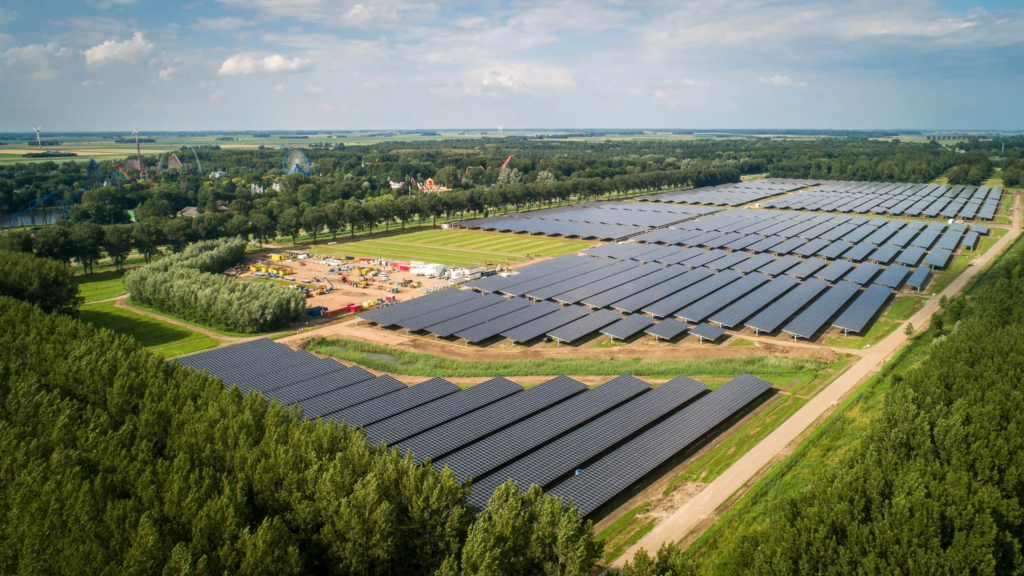
Built on a festival car park.
Used intermittently—but generating power constantly.
🇫🇷 Disneyland Paris Solar Canopy (France)
- ~80,000+ panels
- ~17 MW capacity
- ~36 GWh/year generation
- ~20 hectares (~200,000 m²)
- ~11,200 parking spaces covered

Covers ~17% of the resort’s electricity demand.
Built for visitors—but functioning as infrastructure.
Different countries. Different use cases. Same conclusion—this scales everywhere, immediately.
This Isn’t Just a Trend — It’s Becoming Policy
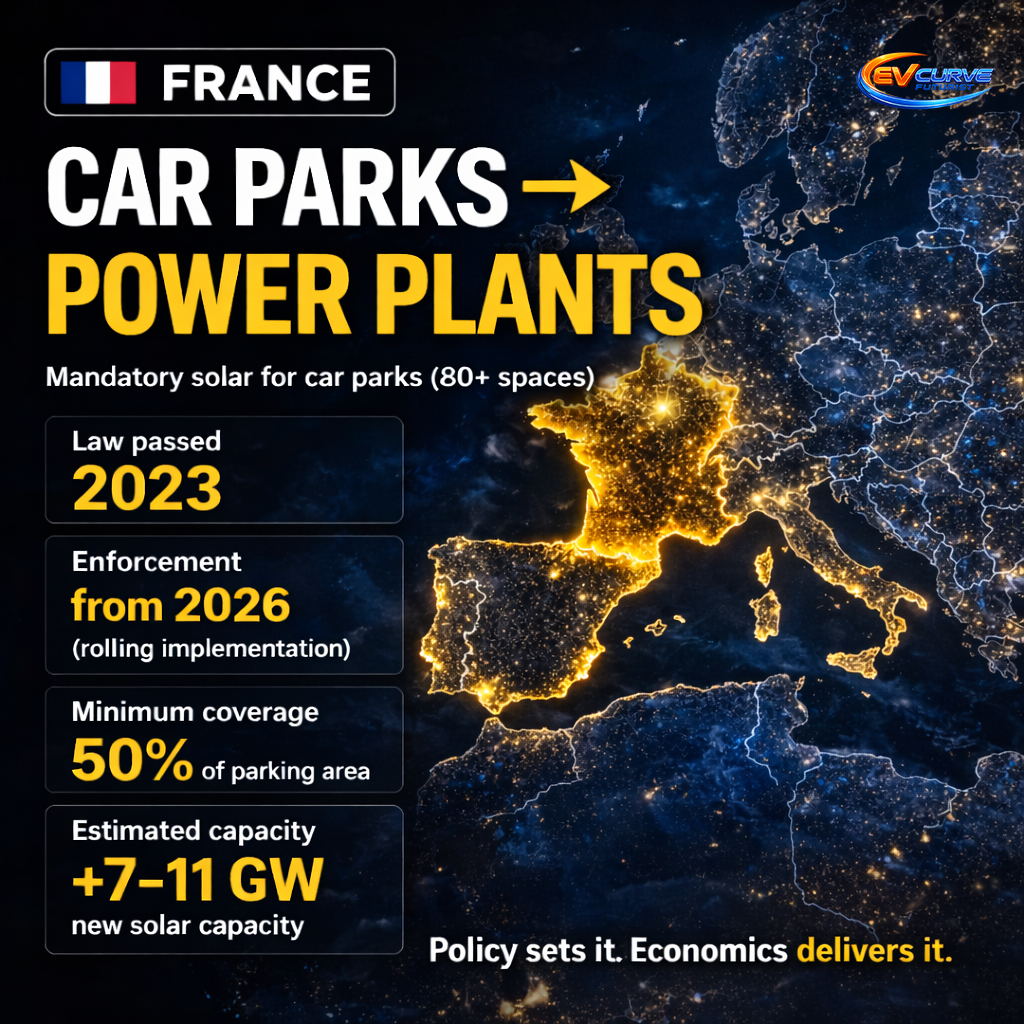
This has already crossed the line from idea → law.
France: From Optional → Mandatory
France looked at parking lots and asked a simple question:
“Why are these not power plants?”
Then legislated it.
- Parking lots with 80+ spaces must install solar canopies
- At least 50% of the area covered
- Applies to existing + new sites
- Estimated impact: ~7–11 GW of new capacity
That’s not policy.
That’s the beginning of system redesign.
Why Isn’t Everyone Doing This?
Because this model breaks the old system.
Solar car parks:
- generate power where it’s used
- reduce grid dependency
- enable EV charging
- flatten peak demand
They don’t just add energy—
They erode the legacy model from multiple angles
And that creates friction:
- unclear ownership
- outdated policy
- centralized thinking in a system that’s already decentralizing
Most mall owners don’t want to run a power plant.
Utilities don’t want to share the meter.
The Standard — No Exceptions
Every car park and every carport should have a solar roof. No exceptions.
If you’re building shade, you’re building structure.
If you’re building structure, you should be generating energy.
This isn’t ambition.
This is the lowest-hanging fruit in energy.
The Untapped System Sitting in Plain Sight
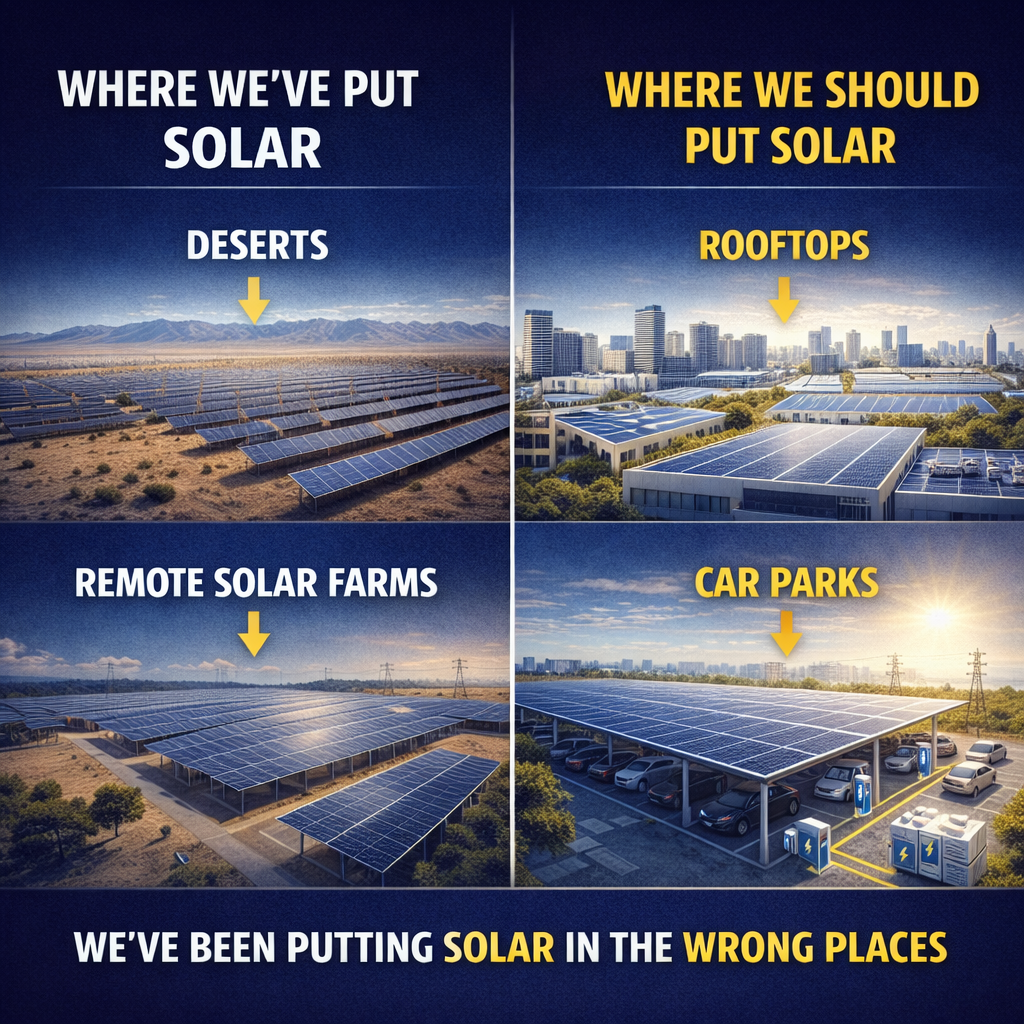
Midong Solar in Xinjiang, China, is now the largest single solar installation on Earth—around 3.5 GW built in one place, generating roughly 6–6.5 TWh per year and powering close to 2 million homes. It proves we can build at massive scale—but it also highlights the trade-offs: remote location, dedicated land use, and the need to move energy long distances, while the infrastructure in our cities sits largely unused.
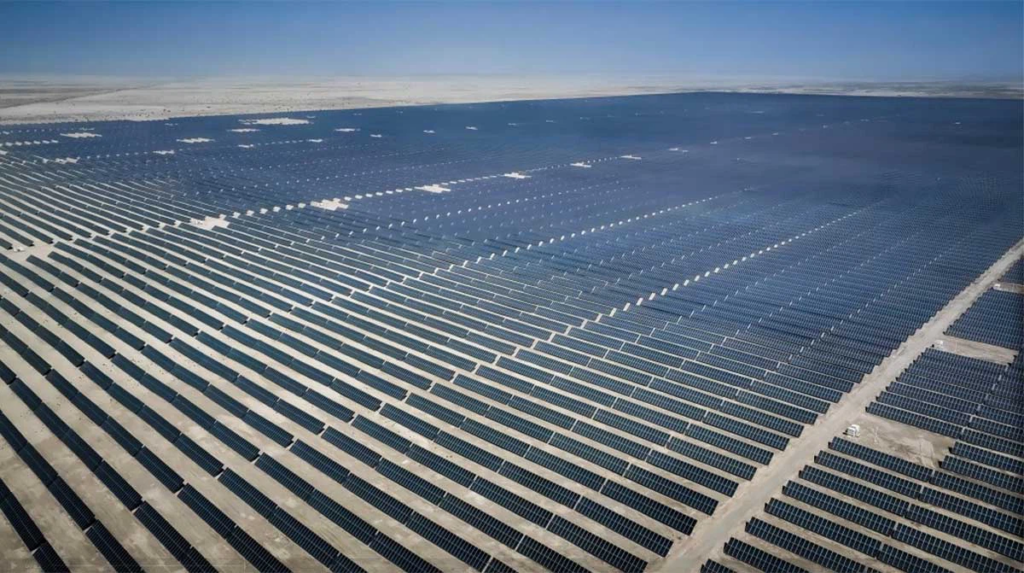
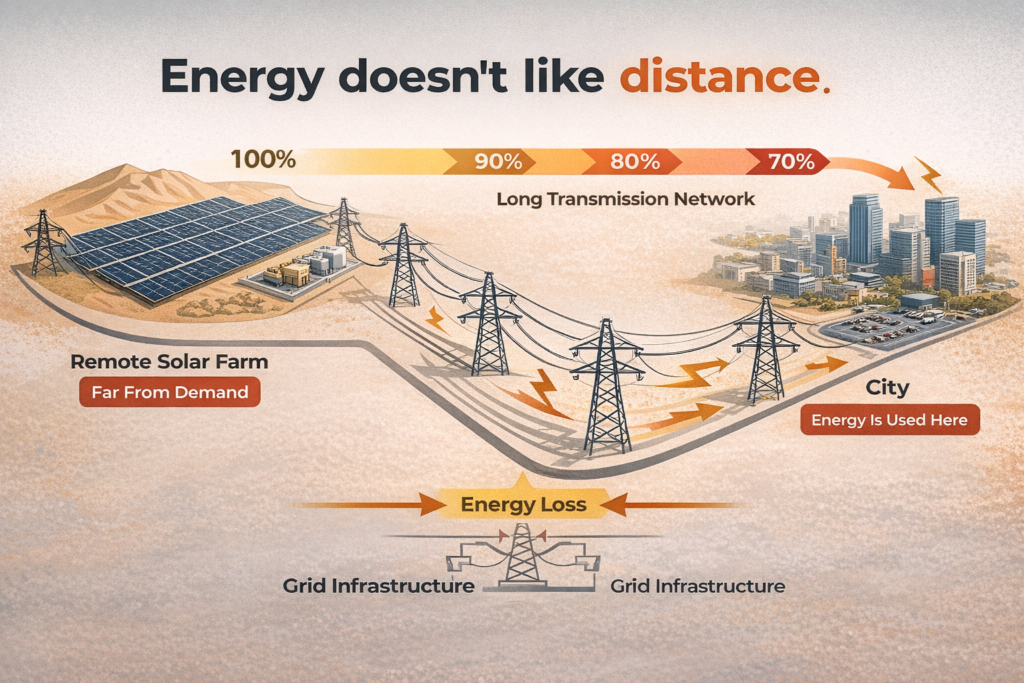
This diagram shows the hidden cost of centralized energy. Power generated at remote solar farms must travel long distances through transmission networks before it reaches where it’s actually used—cities. At every step, energy is lost, infrastructure is required, and complexity increases. The further electricity travels, the more inefficient the system becomes. It works, but it’s not optimal. The closer generation is to demand, the less energy is wasted—and the simpler, faster, and more resilient the system becomes.
Now zoom out.
Globally, parking lots represent billions of square meters of already-developed land.
Cover them with solar and you unlock:
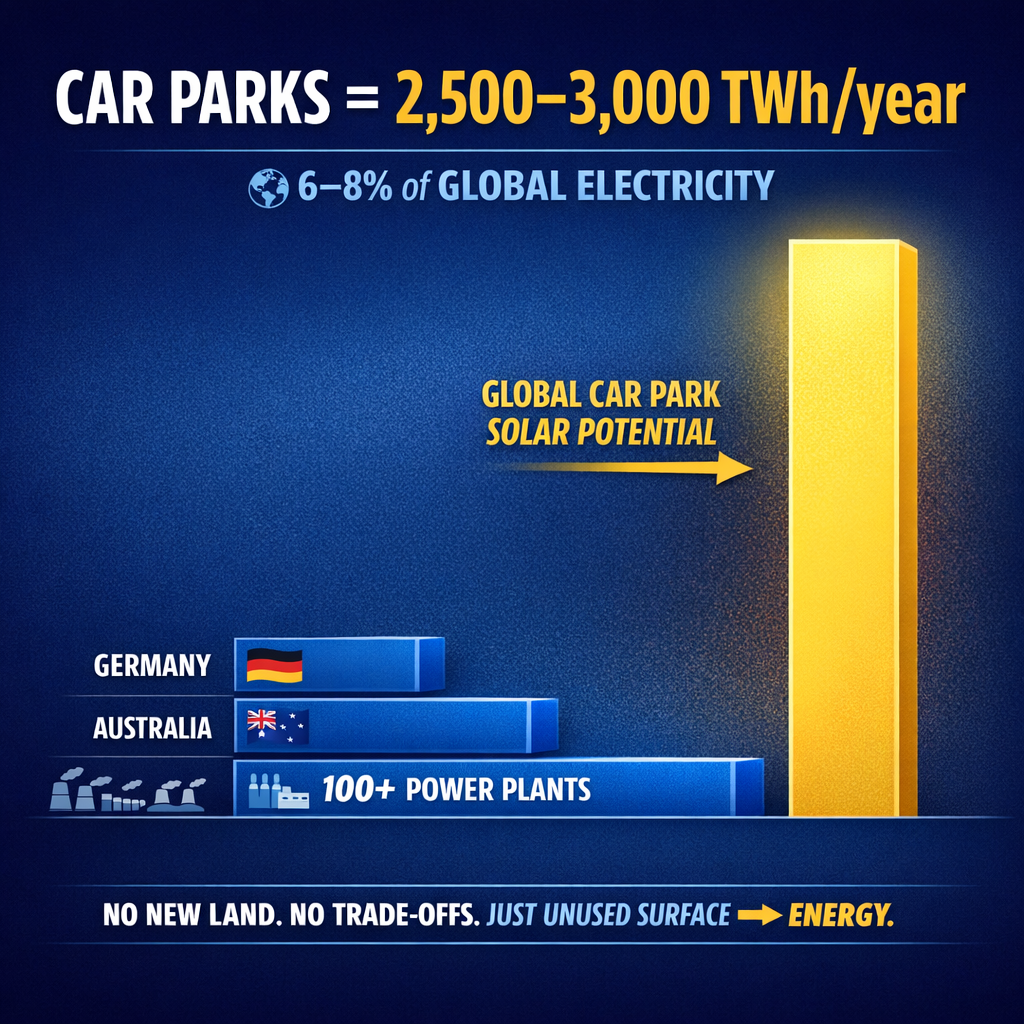
- ~2,500–3,000 TWh/year of electricity
- ≈ 6–8% of global electricity demand (baseline scenario)
From space we’ve already built.
No new land. No trade-offs. Just unused surface → energy.
That’s equivalent to:
- hundreds of large power plants
- or multiple countries’ total electricity consumption
Why This Matters More Than It Looks
Solar car parks don’t just generate power.
They:
- co-locate generation with demand
- enable EV charging at scale
- reduce grid stress
- turn passive infrastructure into active assets
This isn’t just clean energy—it’s some of the cheapest new generation you can build.
This isn’t just generation.
It’s grid redesign happening from the edges inward.
The System Is This Obvious
We spent decades asking:
“Where do we put solar?”
Wrong question.
The answer was always:
Where we already are.
The Punchline
The world’s biggest solar car park…
isn’t in a desert.
It’s over cars.
And that tells you exactly how this ends. ⚡#Bettrification