
Bettrification — How Electrification, Oil Volatility and Industrial Disruption Are Driving the Helical Death Spiral of Oil
I started writing this piece months ago and then put it aside.
Not because the topic lacked importance — quite the opposite. Oil shaped the modern world more than almost any other commodity. But it is also soaked in conflict, geopolitics and human suffering. It is not an enjoyable subject to dwell on.
My disdain for oil goes back much further than my work analysing energy transitions. I remember cycling the smog‑filled streets of Warsaw as a child, lungs burning from exhaust fumes while combustion engines rattled around me.
Even then, at seven years old, it was obvious something about this system was wrong.
For more than a century oil powered economic expansion — but it also fuelled wars, propped up authoritarian regimes, destabilised regions, polluted cities and injected enormous volatility into the global economy.
Now the system that built the oil age is beginning to unravel.
Bettrification — the shift from combustion systems to electrified systems powered by renewables and batteries (“better” + “electrification”) — is beginning to reshape the global energy system. Not gradually. Accelerating.
The fossil fuel system is entering what I describe as a helical death spiral — a tightening loop of volatility, collapsing investment, weakening supply chains and rapidly accelerating electrification.
Legacy analysts still model the transition as a smooth slope. Real technological disruptions behave more like cliffs. What often appears gradual in models tends to unfold through cascading feedback loops in the real world.
In energy markets this dynamic is increasingly visible: oil price spikes accelerate EV adoption, electrification weakens oil demand growth, weakening demand erodes investment in new supply, and reduced investment leaves the system more fragile when the next geopolitical shock arrives.
The result is a tightening feedback loop — a helical death spiral in which volatility, electrification, falling demand and underinvestment reinforce one another. What once looked like a stable commodity market is increasingly behaving like a system destabilising under technological disruption.
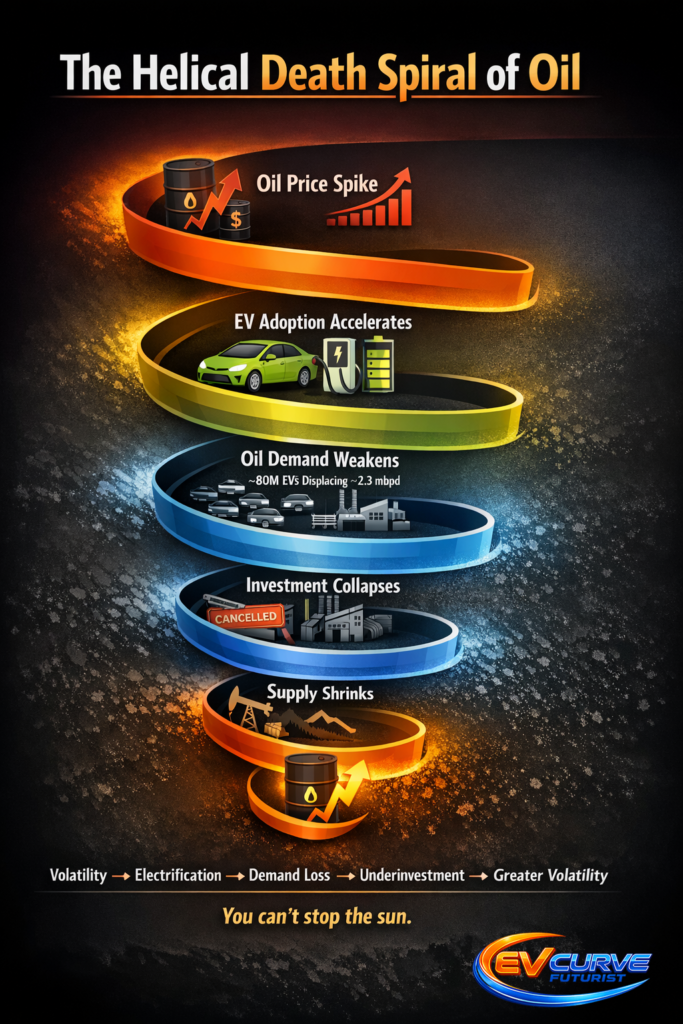
Oil volatility → Electrification → Demand loss → Underinvestment → Greater volatility
The graphic above illustrates this reinforcing loop: oil price spikes accelerate EV adoption, electrification weakens oil demand growth, weakening demand erodes investment in new supply, and shrinking supply buffers make the next shock even more volatile. Each turn of the spiral strengthens the economic case for electrification and weakens the long‑term stability of the oil system.
1. THE DATA IS NOW CATCHING UP
In 2020 I wrote about “The Great EV Shift: 90% Adoption by 2030”, presenting what many considered an extremely aggressive projection for electric vehicle adoption.
The thesis was simple: falling battery costs, rapidly expanding renewable electricity, and the structural fragility of the internal combustion supply chain would push electrification far faster than institutional forecasts suggested.
The reaction from many analysts was predictable: the forecast was considered unrealistic.
(Data referenced in this section draws from sources such as the IEA Global EV Outlook, national vehicle registration datasets, and energy market statistics from agencies including the U.S. Energy Information Administration (EIA) and electricity analysis groups like Ember.)
But real-world data has steadily moved in that direction.
By the start of 2026, global EV sales for 2025 reached roughly 20 million vehicles — only about 300,000 short of the 21 million figure I projected several years earlier.
However, after five additional years of real-world adoption data I updated those projections with a more pragmatic framework.
The reason was not that the technology curve had weakened. In fact the opposite is true: battery costs continue to fall, EV performance keeps improving and electrification economics are strengthening.
What changed was my assessment of how hard the existing system would fight to preserve itself.
Incumbent industries rarely surrender quietly. Fossil fuel interests, legacy automakers, political actors, petro‑states fighting tooth and nail for geopolitical relevance, and entrenched supply chains all have powerful incentives to delay disruption — revenue streams, infrastructure investments and geopolitical influence depend on the status quo.
Pushback, policy friction and institutional inertia can slow the curve temporarily — even when the underlying economics are already shifting.
Transitions are resisted not because they are weak, but because the existing system has so much to lose.
Recognising this, I revised the projections to reflect not just the technology curve, but the resistance of the old system trying to hold it back.
At the same time, I remain open to being wrong. Forecasting disruptive transitions is inherently uncertain, and real-world events — particularly oil shocks and geopolitical instability — can accelerate adoption faster than models anticipate. If the growing volatility in oil markets ends up pushing electrification closer to my original 2020 forecasts for 2030, I will be more than happy to revise the projections again. The goal is not to defend a prediction, but to follow the evidence as the transition unfolds.
Updated EV Curve Futurist projections:
• 2030: ~60% NEV | ~46% BEV
• 2035: ~97% NEV | ~88% BEV
Exact dates matter less than trajectory.
Whether mass electrification arrives in 2030, 2035 or 2040 changes investment timing but not the outcome. The direction is clear — the system ends; the only question is how quickly.
2. ELECTRIFICATION IS ALREADY CUTTING INTO OIL DEMAND
The global EV fleet has now reached roughly 80 million vehicles according to recent estimates from the IEA Global EV Outlook (including battery electric vehicles and plug‑in hybrids).
A typical internal combustion vehicle consumes roughly 10 barrels of oil per year.
Across the global fleet, today’s EVs are therefore displacing approximately 2–2.3 million barrels of oil per day.
That is about 2% of global oil demand, based on global oil consumption statistics compiled by the U.S. Energy Information Administration (EIA) — roughly equivalent to the entire oil consumption of Italy — a G7 economy.
Vehicle fleets change slowly. Adoption curves do not.
3. CHINA: THE GLOBAL OIL DEMAND TIPPING POINT
No country matters more to the future of oil demand than China.
For two decades China was the single largest source of global oil demand growth as industrialisation, urbanisation and vehicle ownership surged.
That dynamic is now shifting. China is simultaneously the world’s largest EV market, the largest battery manufacturer and the largest builder of renewable energy Electrification is therefore occurring faster there than anywhere else.
In many Chinese cities EVs already represent more than half of new vehicle sales, with commercial fleets electrifying even faster. This matters because road transport was one of the primary engines of global oil demand growth. When the largest auto market on Earth begins replacing combustion vehicles at scale, the global oil demand curve begins to flatten.
Scaling Oil Displacement
| Global EV Fleet | Estimated Oil Displaced |
|---|---|
| ~80 million EVs | ~2–2.3 million barrels/day |
| ~200 million EVs | ~5 million barrels/day |
| ~400 million EVs | ~10 million barrels/day |
Oil markets historically swing dramatically with imbalances of only 2–3 million barrels per day. That means the EV fleet is already approaching the scale capable of destabilising traditional oil demand growth.
Oil demand does not need to collapse everywhere at once. It only needs to stop growing where it historically expanded the most. China is approaching that tipping point.
4. VOLATILITY IS THE SYSTEM’S WEAKNESS
Oil markets are extremely sensitive to supply shocks.
A disruption of just 2–3 million barrels per day can move global prices dramatically.
That fragility is being exposed again.
In early 2026 crude oil surged from roughly (price data broadly consistent with global benchmarks tracked by the EIA) $55 per barrel in January to more than $90 by March, driven largely by geopolitical tensions in the Middle East.
This may still be the early phase of the crisis. If tensions around Iran persist or disrupt shipping through the Strait of Hormuz — a chokepoint that carries roughly 20% of global oil supply — prices could climb significantly higher, potentially testing or even exceeding the $120 spike seen during the 2022 Russia-Ukraine energy shock.
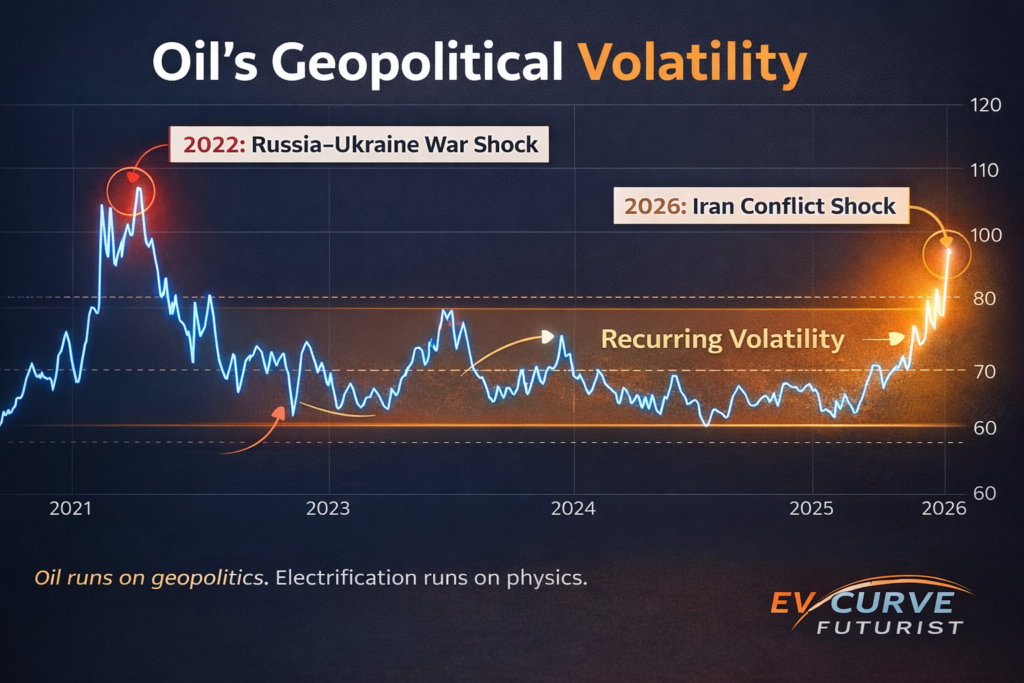
Consumers feel this immediately. Across Australia petrol prices jumped roughly 40–60 cents per litre within weeks. Oil drivers cannot hedge geopolitics — they simply pay. Electric vehicles change that equation. Every oil price shock effectively acts as free advertising for electrification, because electricity increasingly comes from solar, wind and storage — resources that are abundant, domestic and immune to maritime chokepoints. Each new shock therefore strengthens the economic case for electrification. Volatility does not protect the oil system; it accelerates its replacement.
REAL-WORLD VOLATILITY: THE AUSTRALIAN PUMP
The abstract volatility of oil markets becomes painfully concrete at the petrol pump. Just weeks ago petrol across Sydney was selling for roughly 160–165 cents per litre; today many stations are showing 215–220 cents per litre. Nothing about drivers’ lives changed — they did not suddenly drive more or alter their commute. The only thing that changed was geopolitics. A conflict thousands of kilometres away can ripple through oil markets and land directly in the family budget.
Electric vehicle drivers experience something very different: they are not watching oil futures — they are checking the weather forecast, because when energy comes from sun, wind and batteries volatility begins to disappear. The question now becomes simple: if tensions continue to escalate, will petrol hit $2.50, perhaps even $3? Nothing about drivers’ lives changed — they did not suddenly drive more or alter their commute; the only thing that changed was geopolitics. For millions of drivers still tied to oil those shocks are unavoidable, but for those already electrified they are mostly just headlines.

THE FALLING OIL PRICE CEILING
One subtle pattern visible in the oil market over the past few years is easy to miss at first glance: the ceiling on oil price spikes appears to be falling.
In 2022, the Russia–Ukraine war pushed Brent crude close to $120 per barrel, the highest level seen in years. Historically, a shock of that magnitude would establish a new high‑price regime for oil markets.
But something different is happening today.
Subsequent geopolitical shocks have produced smaller and shorter‑lived spikes. Even with tensions involving Iran and renewed fears of supply disruptions through the Strait of Hormuz, oil prices have struggled to sustain levels far beyond the $90 range.
This suggests a structural shift may be beginning to emerge.
In previous decades oil demand had few substitutes. When supply shocks occurred, economies simply absorbed the price increase. Transport systems, industry and heating all relied overwhelmingly on combustion fuels.
Today the landscape is changing. Electric vehicles are scaling rapidly, renewable energy continues to expand, heat pumps are displacing fossil heating, and efficiency gains across industry and transport are gradually weakening the link between economic growth and oil consumption.
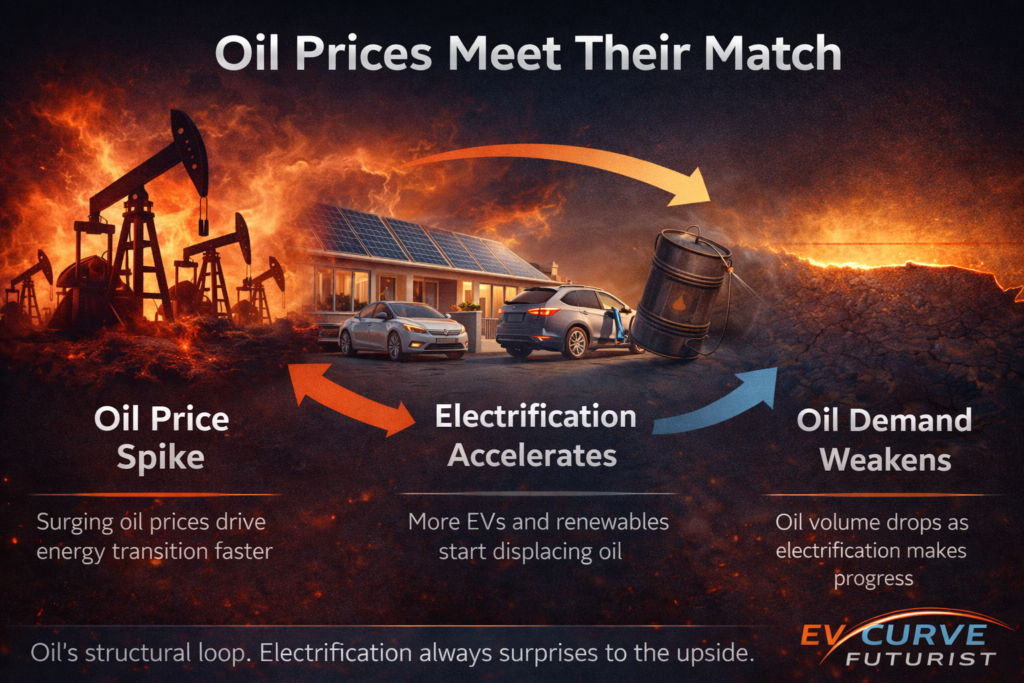
This creates a new feedback dynamic. When oil prices spike sharply, the response is no longer purely economic pain. Instead, high prices increasingly accelerate the adoption of alternatives.
Higher petrol and diesel prices push consumers toward EVs. Utilities expand renewable deployment. Businesses electrify processes where possible.
In other words, price spikes now stimulate the technologies that reduce future oil demand.
The result is an emerging structural loop:
Oil price spike → Electrification accelerates → Oil demand weakens → Price ceiling forms.
This does not mean oil demand has collapsed yet. The global economy still relies heavily on petroleum, and supply disruptions can still move markets dramatically.
But the system is changing.
Volatility in the oil market is no longer just a symptom of geopolitics. Increasingly, it is becoming a driver of the transition away from oil itself.
Or put more simply:
Every oil shock now accelerates the system that replaces oil.
5. ICE DOESN’T DECLINE SMOOTHLY
Legacy analysts often imagine internal combustion vehicles fading slowly over decades.
Industrial ecosystems rarely behave that way.Once supply chains lose scale and profitability, decline accelerates rapidly.
This is what happens when ICE production falls below critical thresholds:
• Transmission manufacturers shut down
• Engine plants lose scale
• Fuel-system suppliers disappear
• Emissions suppliers go bankrupt
• Dealership service revenue collapses
• Mechanics stop ICE training
• Parts networks hollow out
• ICE R&D dries up
When the ecosystem weakens, the technology becomes progressively harder to sustain.
Transitions rarely end with a graceful fade. They accelerate once the industrial base begins to fracture.
6. THE HELICAL DEATH SPIRAL
Once demand growth stalls, oil markets enter an unstable feedback loop.
Phase 1 – Price Spike
Supply shocks push prices sharply higher. EV adoption accelerates.
Phase 2 – Price Crash
High prices trigger supply responses. OPEC increases production, US shale ramps drilling, and demand destruction appears. Prices collapse.
But the damage is already done.
High‑cost production such as deepwater projects, oil sands and marginal shale becomes uneconomic during the crash. Investment dries up and projects are cancelled.
That lost capacity does not immediately return.
Phase 3 – Super Spike
When the next disruption arrives, the supply base is smaller and less flexible. The resulting price spike is sharper than the previous one.
Phase 4 – Demand Destruction
Consumers and fleets accelerate electrification to escape volatility entirely.
Every cycle tightens the spiral: less investment, smaller supply buffers, greater volatility and faster electrification. Each loop also erodes investment confidence in long‑lived oil infrastructure, making supply more fragile and future price spikes more extreme.
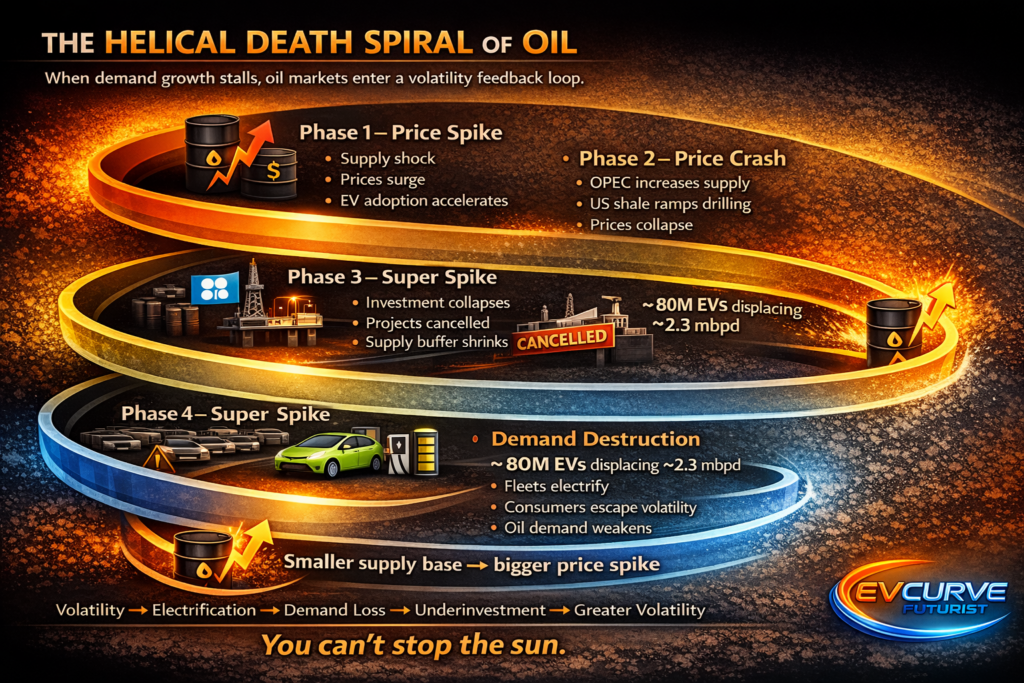
The above represents an enhanced visualisation of the Helical Death Spiral unfolding in oil markets. It illustrates how recurring cycles of price shocks, investment contraction, and supply fragility reinforce one another, tightening the feedback loop and increasing volatility over time.
7. HARD PROBLEMS REMAIN
Not every sector electrifies easily.
Aviation, shipping and petrochemicals will likely remain oil‑dependent for decades, although even these sectors could potentially transition faster than expected as AI‑driven R&D increasingly compresses the timeline from discovery to commercial deployment — a dynamic explored in more detail in my analysis of the global battery innovation pipeline: The Global Battery Technology Frontier. Grid expansion, battery mineral supply chains and infrastructure build‑out will also create friction during the transition.
Lithium, nickel, graphite and rare earth supply must scale significantly to support global electrification. While new mines, recycling and alternative chemistries (such as LFP, sodium‑ion and manganese‑rich batteries) are expanding supply, these transitions can create short‑term bottlenecks.
Grid capacity can also slow adoption in some regions. Countries like Australia, for example, face transmission constraints and interconnection delays that can slow the pace of electrification even when renewable generation is abundant.
Adoption will also remain uneven globally. Mature markets such as China and Europe are electrifying quickly, while developing economies may move more slowly due to infrastructure and affordability constraints.
Yet early signs of energy leapfrogging are also emerging across parts of the Global South. Countries that historically lacked large fossil fuel infrastructure are increasingly deploying solar, EVs and distributed storage simultaneously. In some regions, households and businesses are moving directly to combinations of rooftop solar, batteries and electric mobility as a hedge against volatile oil imports and unreliable fuel supply.
For many developing economies this is not only an environmental shift but a geopolitical one — an attempt to develop greater energy autonomy and reduce exposure to global fossil fuel price swings and external energy dependence.
But these sectors represent the hard edge of the transition, not its center. Passenger road transport drove a large share of global oil demand growth. And that is precisely the sector electrifying fastest. The end of the oil age does not require every molecule of oil to disappear.
It only requires that the demand engine which sustained the system for a century begins to stall.
Recent data already shows the transition becoming uneven rather than reversing, consistent with recent global EV sales analyses from the IEA and market tracking by organisations such as BloombergNEF. Global EV sales growth slowed to roughly ~20% in 2025, reflecting policy adjustments and market maturity in some regions. But even at that pace, the global fleet continues to expand rapidly and cumulative oil displacement keeps rising.
What we are witnessing is not simply an energy transition. It is the early stage of Bettrification — the replacement of combustion‑based systems with electrified systems powered by solar, wind and batteries. Once cost curves favour electrons over molecules, industrial transitions tend to accelerate rapidly.
8. THE END OF OIL WILL NOT BE QUIET
Even with electrification accelerating, the transition away from oil will not be smooth. Expect periods of sharp price volatility, refinery consolidation, geopolitical tension and waves of rapid electrification as the system adjusts — dynamics we are already witnessing amid rising tensions involving Iran and renewed concerns around global oil supply.
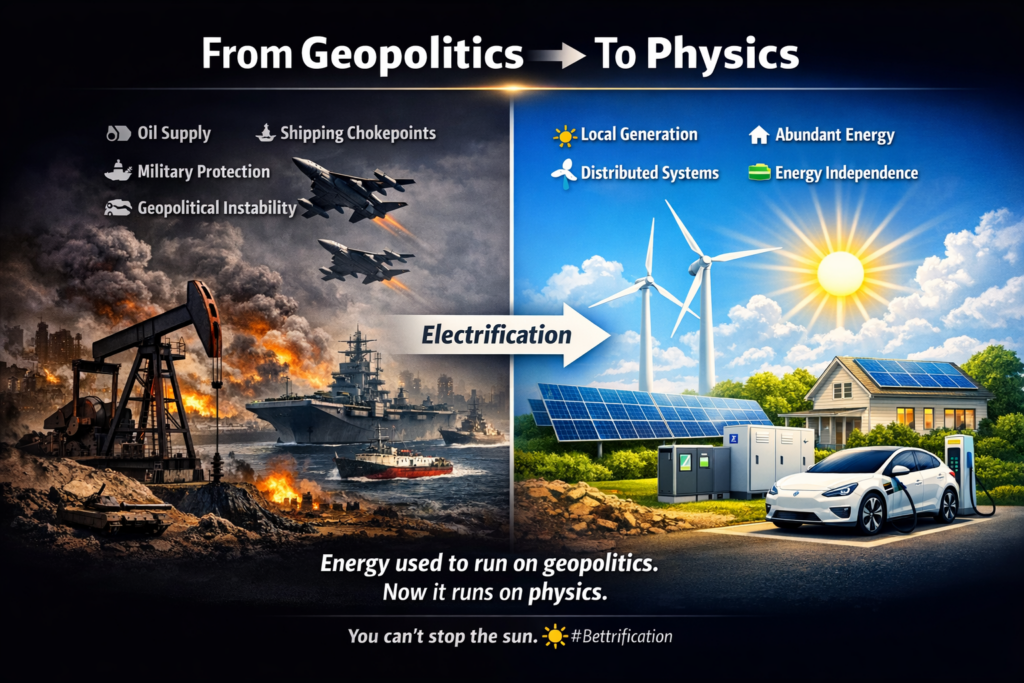
For more than a century oil shaped geopolitics. Nations fought wars over supply routes, maritime chokepoints and access to reserves, and entire alliances, military strategies and national economies were built around securing the flow of crude.
Electrification begins to change that equation. Solar panels do not require oil fields, wind turbines do not rely on shipping lanes, and batteries do not need aircraft carriers. As transport, power generation and industry electrify, the foundations of the old energy system begin to erode.
The shift underway is deeper than an energy transition — it is a structural shift from a system governed by geopolitics to one increasingly governed by physics. Sunlight cannot be embargoed, wind cannot be blockaded, and batteries do not require naval fleets to secure their supply.
As electrification spreads, oil volatility does not slow the transition — it accelerates it. Each geopolitical shock pushes more consumers, fleets and economies toward energy systems that no longer depend on chokepoints, tankers or conflict zones.
In the past oil shocks strengthened the fossil system. In the Bettrification era they increasingly weaken it.
Note: Key data referenced in this article draws from sources such as the IEA Global EV Outlook, global oil statistics from the U.S. Energy Information Administration, national vehicle registration datasets, and electricity transition analysis from organisations such as Ember. Inline links are provided where relevant to improve transparency and verifiability.