How technological revolutions create entirely new industrial ecosystems.
The more I think about it, the more I believe we’ve been asking the wrong question.
The challenge facing much of the West isn’t simply that China makes cheaper cars.
Nor is it just about batteries.
It’s that China may have built an industrial system better suited to the technologies defining the 21st century.
The industrial dominance of Europe, Japan and the United States was built during the age of fossil fuels. Over more than a century they created extraordinary ecosystems around extracting, refining and burning hydrocarbons. Energy companies, automakers, manufacturers, suppliers, financiers, universities and governments all evolved around that reality. It became one of the greatest industrial systems in history.
Then the centre of gravity shifted.
The emerging economy increasingly rewards a different set of capabilities: abundant electricity, batteries, power electronics, semiconductors, AI, robotics, advanced manufacturing, software, vertically integrated supply chains, and the critical minerals that make those technologies possible.
China didn’t simply build EV factories.
It spent the past two decades building an industrial ecosystem around this new paradigm. Battery manufacturers grew alongside automakers. Renewable energy expanded alongside battery production. Charging infrastructure grew alongside EV adoption. Critical mineral processing expanded alongside manufacturing. AI increasingly supports industrial automation. Each part of the system reinforces the others.
And the scale matters. Lithium-ion battery pack prices have fallen about 93% in real terms since 2010, while China’s average pack price had already fallen to $84/kWh by 2025. China also accounted for around 91% of global refined magnet rare-earth output in 2024. Those aren’t simply statistics about cheaper products. They are evidence of what happens when manufacturing scale, supply chains, competition and accumulated learning reinforce one another.
This isn’t a collection of factories.
It’s an industrial flywheel.
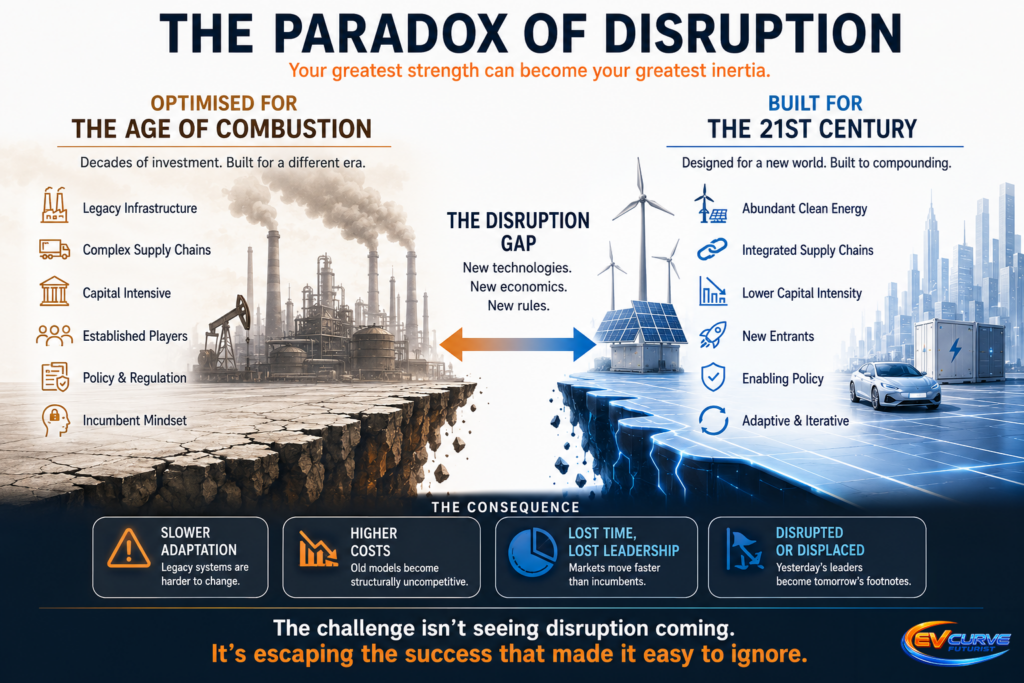
Figure 2. The greatest strength of one industrial era often becomes its greatest inertia in the next.
At the company level, the same pattern emerges. The winners increasingly aren’t those with the best software or the cheapest labour. They’re those that integrate the entire system. Batteries, motors, power electronics, semiconductors, software, AI, manufacturing and supply chains are designed together rather than as separate components. Optimising the whole system consistently outperforms optimising the individual parts.
Perhaps the most overlooked advantage isn’t labour costs or subsidies.
It’s learning.
Every factory creates more than products. It creates experience. Every production problem solved becomes institutional knowledge. Every engineer trains the next generation. Every supplier becomes more capable.
Industrial capability compounds. The more a country manufactures, the better it becomes at manufacturing. While others are planning, debating and announcing strategies, those already building are learning, and that accumulated experience becomes an enduring competitive advantage.
There’s another structural advantage: scale of people and market.
China built much of this industrial capability with an enormous workforce, a deep engineering talent pool and a domestic market large enough to absorb new products while companies learned and scaled.
But demographics are now turning from advantage to challenge. China’s population is ageing and its workforce is shrinking, just as many other industrial economies face similar labour constraints.
That makes the next stage particularly interesting. AI, robotics and autonomous manufacturing aren’t simply new industries within the system. They may increasingly become the mechanism that allows the system to overcome its own demographic limits.
In that sense, industrial automation isn’t separate from the flywheel.
It becomes part of what keeps the flywheel turning.
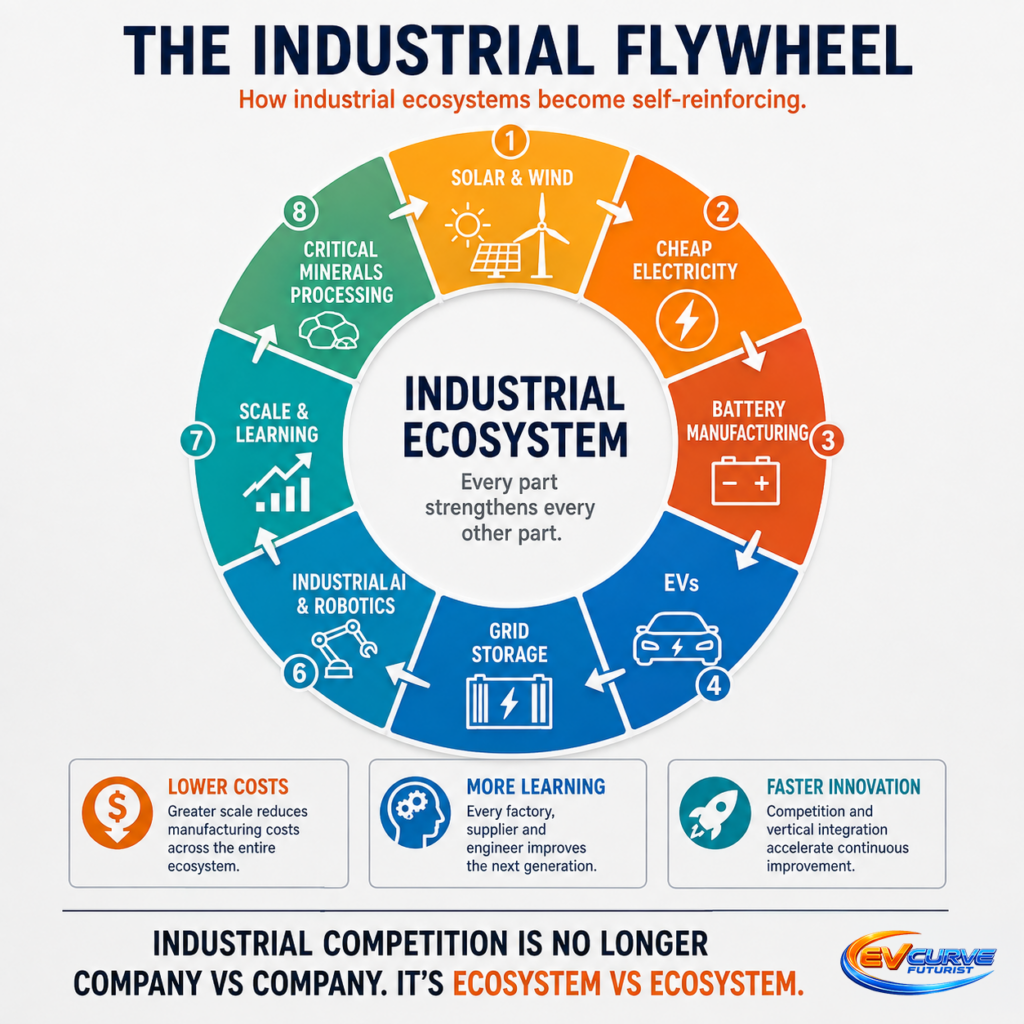
Figure 3. Modern industrial ecosystems compound through feedback loops, creating lower costs, faster innovation and continuous learning.
Another common misconception is that Chinese companies operate like divisions of one giant state enterprise. The reality is more interesting.
BYD competes with Geely. CATL competes with CALB. Huawei competes with everyone. China combines long-term state direction, infrastructure and capital with ferocious market competition. The state builds the playing field; companies fight for market share within it. That hybrid model may be one of China’s greatest industrial advantages, and one of the hardest to replicate.
It’s increasingly geopolitical too. Semiconductors, batteries, critical minerals, AI and energy infrastructure are now strategic assets. Subsidies, tariffs, export controls and industrial policy are being used to secure entire technological ecosystems. Industrial capability has become a matter of national security.
Meanwhile, Western economies must transform systems that were already enormously successful. Their strengths differ: the US in AI, software, semiconductors and capital; Europe in engineering and advanced manufacturing; Japan and South Korea in batteries, materials and precision manufacturing. Different strengths will produce different responses.
China isn’t unassailable. Overcapacity, protectionism, fractured supply chains and environmental costs all create vulnerabilities. Nor must others copy its model. But AI needs semiconductors, robots need factories, electrification needs batteries and grids, and innovation ultimately has to become physical.
That’s the paradox of disruption.
And it reaches far beyond cars. The same forces are beginning to reshape food, agriculture, materials and carbon itself. These disruptions won’t move at the same speed: electrification is already scaling globally, while precision fermentation, cellular agriculture and carbon removal remain much earlier.
Precision fermentation and cellular agriculture could shift parts of food production from animals, feed crops and vast areas of farmland toward biological manufacturing. That could reduce demand for land, water, fertiliser and machinery, shorten supply chains and eventually free land for restoration and reforestation.
Again, technology removes intermediate steps from the production system.
Then comes carbon. Decarbonisation reduces future emissions but doesn’t remove what we’ve already added to the atmosphere. Direct air capture, biochar, enhanced weathering and automated reforestation could form another emerging industrial layer: carbon removal.
Together, these technologies point toward something larger.
The old industrial model is largely linear:
Extract → Manufacture → Consume → Discard.
The emerging model can become increasingly circular: renewable energy replaces fuels consumed once and lost, materials are recovered and recycled, waste becomes feedstock, biological manufacturing creates new products, and carbon can be captured, reused, mineralised or returned to the biosphere.
It will never be perfectly circular. Thermodynamics ensures that. But the direction is fundamentally different:
Extract less. Waste less. Recover more. Reuse more. Regenerate what we can.
The transition isn’t simply fossil fuels to renewables or combustion cars to EVs. It is a shift toward a more circular industrial system built around electricity, information, automation, recovery and regeneration.
The car was simply where this industrial transition became visible first.
The real story is much bigger.
Different technological eras reward different industrial systems.
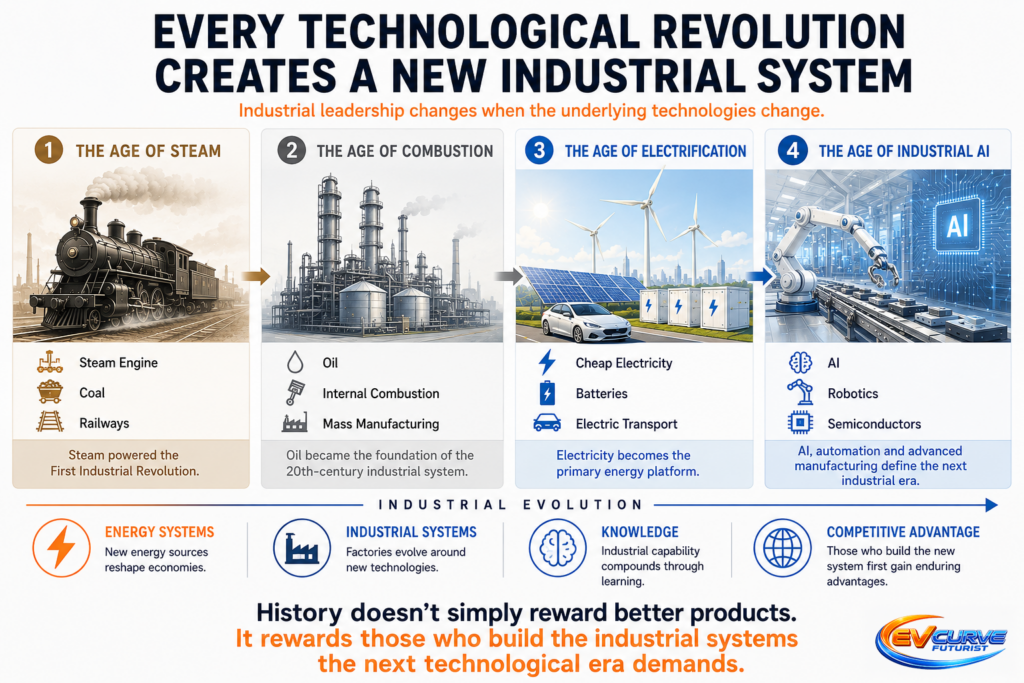
Figure 4. Throughout history, each technological revolution has created a new industrial system and shifted industrial leadership.
The West mastered the age of combustion.
China has spent the past two decades building for the age of electrification, intelligent machines and industrial AI.
That doesn’t mean one economic or political system is universally superior. Every model has strengths and weaknesses. But industries that depend on massive capital investment, manufacturing at scale and tightly integrated supply chains increasingly reward ecosystem thinking.
None of this means the West cannot compete. It can. But industrial ecosystems cannot be created overnight. They emerge through years of investment, competition, learning and continuous iteration.
Ultimately, this is the distinction that matters. Products are outputs. Industrial systems are the capability that produces them. Technologies can be copied, factories can be built and capital can be deployed, but accumulated learning takes time. China has spent two decades building that capability while much of the world was still debating the transition.
And this transition isn’t temporary. The technologies will continue to evolve, some will disappoint and others we haven’t yet imagined will emerge. But the underlying shift, from combustion to electrification, from mechanical systems to intelligent machines, and from linear consumption toward greater circularity, is structural.
The winners won’t necessarily be those with the best product today.
They’ll be those who build the system that keeps producing the best products tomorrow.
Further Reading
- Beyond Baseload: The Evolution of Energy Grids
- KISS and the Energy Transition: The Hidden Driver of Exponential Disruption
- 1974 vs 2026: When Energy Systems Break
- This Is How Energy Systems Collapse
- After Oil: The Same World, Only Better
- The 2027–2035 Tipping Points That Reshape Global Energy
- Disruption Decimating the Old World
