

The term “baseload power” gets thrown around a lot in debates over the future of energy. But where did this concept come from, and does it still matter in an age defined by solar panels, wind turbines, batteries, artificial intelligence and smart grids?
More importantly, is baseload still an engineering necessity, or has it simply become a legacy concept from an electricity system built for a different era?
What Is Baseload Power?
Baseload power refers to the continuous supply of electricity traditionally provided by large power stations that operate around the clock. These included coal, nuclear and large hydro plants, which were designed to run continuously and provide a stable foundation for the electricity grid.
These technologies became the foundation of electricity systems for several reasons:
- Stability: Consistent, predictable output.
- Scale: Large amounts of electricity from a single facility.
- Economics: High upfront costs but relatively low operating costs, making continuous operation the lowest-cost option.
The Origins of Baseload Thinking
The concept of baseload emerged during the 20th century as electricity grids were built around centralized generation, one-way power flows and highly predictable patterns of demand. Grid operators categorised demand into baseload (always required), intermediate, and peaking (needed only during periods of high demand).
Coal and nuclear became the dominant baseload technologies not because continuous generation was inherently superior, but because it made the most economic sense. Both required enormous upfront investment but had relatively low operating costs. The more hours they ran, the lower the cost of each unit of electricity they produced. Running these plants continuously maximised asset utilisation and delivered the lowest-cost electricity under the conditions of the time.
Natural gas occupied a different role. With lower capital costs but higher fuel costs, it was uneconomic to run continuously, making it well suited to meeting short-lived peaks in demand.
This created a simple but highly effective operating model:
- Baseload = Always on (coal, nuclear)
- Peaking = Flexible but expensive (gas)
For much of the 20th century, this was the least-cost way to build a reliable electricity system. But baseload was never the objective. Reliable, affordable electricity was. Baseload was simply the optimal solution given the technologies, economics and operating constraints of the era.

The transformation of electricity systems didn’t happen overnight. It has unfolded over decades as new technologies, changing economics and digital intelligence gradually reshaped how electricity is generated, transported, stored and consumed. The timeline above highlights the major stages of that evolution.
Why the Old Model No Longer Fits
The electricity system of the 21st century operates under a fundamentally different set of technological and economic conditions than the one that gave rise to baseload thinking. The objective hasn’t changed. It remains to deliver reliable, affordable electricity. What has changed is the optimal way of achieving it.

1. Demand Is No Longer Fixed
Historically, electricity demand was largely treated as uncontrollable. Generators were expected to adjust their output to follow whatever consumers required.
Today, demand itself has become increasingly flexible. Smart meters, dynamic pricing, electric vehicles, home batteries and AI-powered demand response allow electricity consumption to shift in real time. Instead of simply matching generation to demand, modern grids can increasingly match demand to available generation, reducing peaks, improving reliability and lowering system costs.
2. Supply Has Become Cheap but Variable
Solar and wind are now the lowest-cost sources of new electricity generation across much of the world. Their output depends on weather conditions rather than operator control, but advances in forecasting, geographic diversity and grid interconnection have made renewable generation far more predictable than many assume.
The challenge is no longer generating inexpensive electricity. It is delivering it at the right place and the right time.
3. Storage Has Changed the Economics
The rapid emergence of Battery Energy Storage Systems (BESS), pumped hydro, thermal storage and Vehicle-to-Grid (V2G) technology has fundamentally changed how electricity systems operate.
Instead of requiring generators to run continuously, excess renewable energy can now be stored when production exceeds demand and discharged when needed. Battery costs have fallen by more than 90% over the past decade, making storage one of the fastest-growing components of modern electricity systems and dramatically reducing the need for conventional baseload generation.
The best way to visualise this transformation is through the famous “duck curve.” Without storage, surplus midday solar creates deep troughs followed by steep evening ramps. Storage doesn’t eliminate the curve by generating more electricity. It tames it by shifting abundant daytime energy into the evening when demand is highest.

Storage is only one part of this transformation. As costs fall and digital intelligence improves, flexibility itself is becoming the defining characteristic of modern electricity systems.
4. Flexibility Is the New Foundation
The defining characteristic of a modern electricity grid is no longer continuous generation, but flexibility.
Rather than relying on a handful of large power stations operating around the clock, modern grids combine renewable generation, battery storage, demand response, interconnectors, flexible generation and increasingly AI-driven control systems to balance supply and demand in real time.
The objective has shifted from maximising the utilisation of individual power stations to optimising the performance of the entire electricity system.
In other words, reliability no longer comes from keeping large generators running continuously. It comes from coordinating millions of distributed energy resources that can respond faster, more efficiently and at lower cost than the traditional baseload model ever could.
Debunking the Baseload Myth
One of the most persistent myths in energy policy is that reliable electricity requires baseload power. It doesn’t.

What every electricity system actually requires is a continuous balance between supply and demand. For much of the 20th century, coal and nuclear provided that balance because they were the most economical technologies available. But that was a consequence of the technologies of the time, not a fundamental engineering requirement.
The changing economics of electricity systems have also reshaped the role of nuclear power. This doesn’t mean nuclear won’t have any part in the future grid. It may remain appropriate in countries with existing expertise, infrastructure or specific energy security objectives. However, as solar, wind and battery storage continue to fall in cost, many markets are effectively leapfrogging directly to solar, wind and batteries (SWB) rather than embarking on new large-scale nuclear programs. Increasingly, the question isn’t whether nuclear can replace coal, but whether it can compete with the speed, cost and flexibility of modern renewable energy systems. Readers interested in this debate may find Darrin Durant’s essay, Nuclear After-Life, a worthwhile perspective on why expectations for a nuclear renaissance may exceed its likely contribution.

This shift reinforces a central theme of this article: electricity systems are no longer being designed around keeping large generators running continuously. They are increasingly being designed around balancing abundant, low-cost renewable generation with storage, flexible demand and intelligent coordination. In other words, the focus has shifted from baseload to system optimisation.
Today, reliability is increasingly delivered through a combination of complementary technologies rather than a single type of power station:
- Renewable energy
- Battery Energy Storage Systems (BESS)
- Pumped hydro
- Vehicle-to-Grid (V2G) systems
- Demand response
- AI-powered grid management
- Interconnectors and flexible dispatchable generation
Critics often argue that thermal power stations remain essential because they provide inertia and other critical grid services. This doesn’t mean the engineering challenges disappear. Grid stability remains essential, but the technologies capable of providing these services are becoming increasingly diverse. The debate is no longer whether these services are needed, but which technologies can provide them most effectively and economically.
While those services are important, they no longer require large spinning generators. Synchronous condensers, grid-forming inverters and other advanced power electronics can now provide frequency control, voltage support and system strength, enabling high-renewable grids to maintain world-class reliability.
Perhaps the biggest misconception is equating baseload with reliability. Reliability is the objective. Baseload was simply one way of achieving it under the economic and technological constraints of the last century.
As electricity systems become more decentralised, digitalised and flexible, reliability increasingly comes from diversity rather than uniformity. Millions of distributed energy resources working together can respond faster, recover more quickly and operate more efficiently than a system built around a handful of large power stations.
Baseload isn’t disappearing because reliability matters less. It’s disappearing because we have discovered better ways to deliver it.
Reliability vs. Resilience
Reliability and resilience are often used interchangeably, but they describe two different qualities of an electricity system.
Reliability is the ability to consistently supply electricity under normal operating conditions. Resilience is the ability to withstand, adapt to and recover from unexpected events such as extreme weather, bushfires, cyberattacks or major equipment failures.
Traditional electricity grids were designed around a relatively small number of large, centralised power stations. While reliable under normal conditions, this architecture can be vulnerable to single points of failure. The loss of a major generator or transmission corridor can have widespread consequences across the network.
Modern electricity systems are becoming increasingly decentralised. Solar, wind, batteries, distributed energy resources, flexible demand and interconnectors create a more diverse network with fewer critical dependencies. Rather than relying on a handful of large assets, resilience is achieved through redundancy, diversity and the ability to rapidly rebalance the system when disruptions occur.
Diversity doesn’t eliminate failures, but it reduces dependence on any single asset and provides more pathways for the system to recover. In the electricity system of the future, success will be measured not simply by keeping the lights on under ideal conditions, but by how quickly and efficiently the grid can respond when conditions are far from ideal.
Policy Is Catching Up
The shift away from baseload isn’t just being driven by technology, it’s increasingly being reflected in energy policy and market design.
Around the world, regulators are redesigning electricity markets to reward flexibility, resilience and system services rather than simply paying generators to produce electricity.
The pace and optimal pathway will differ between countries depending on geography, existing infrastructure, market design and available energy resources. However, the overall direction is increasingly the same: electricity markets are placing greater value on flexibility, storage and fast-response system services.
In the United States, FERC Order 2222 opens wholesale electricity markets to distributed energy resources, allowing batteries, demand response, virtual power plants and aggregated customer resources to compete alongside traditional generators.
Across Europe, flexibility markets, capacity auctions and ancillary service markets increasingly reward fast-response technologies capable of balancing variable renewable generation. Australia is following a similar path, with the Australian Energy Market Operator’s Integrated System Plan (ISP) and the GenCost reports identifying renewable energy, storage and transmission as the least-cost pathway to maintaining a reliable electricity system.
The direction of travel is becoming increasingly clear. Energy policy is evolving from supporting individual generation technologies to optimising the performance of the electricity system as a whole.
As market rules continue to adapt, the value of flexibility, storage and distributed energy resources is likely to grow, while the traditional economic advantage once enjoyed by baseload generators continues to diminish.
A Smarter Grid for a Decentralized Future
We’re entering a future where electricity is generated, stored and managed across millions of interconnected assets rather than a handful of large power stations.
In this emerging system:
- Solar increasingly becomes the dominant source of daytime electricity in many markets
- Wind complements solar across nights, seasons and regions
- Batteries and pumped hydro shift electricity to when it is needed
- EVs and home batteries become flexible, distributed energy resources
- Demand response moves consumption away from periods of grid stress
- Interconnectors share electricity across wider geographic areas
- AI and digital control systems balance supply and demand in real time
This more distributed system can also be more resilient. A grid built around many diverse resources is less dependent on any single generator, transmission line or fuel supply. When one part fails, other resources can respond quickly, isolate disruption and support recovery.
In this new paradigm, baseload becomes less relevant as a planning concept. What matters is whether the electricity system can deliver reliable, resilient and affordable power whenever it is needed.
The future grid will not be defined by what runs continuously. It will be defined by how intelligently everything works together.
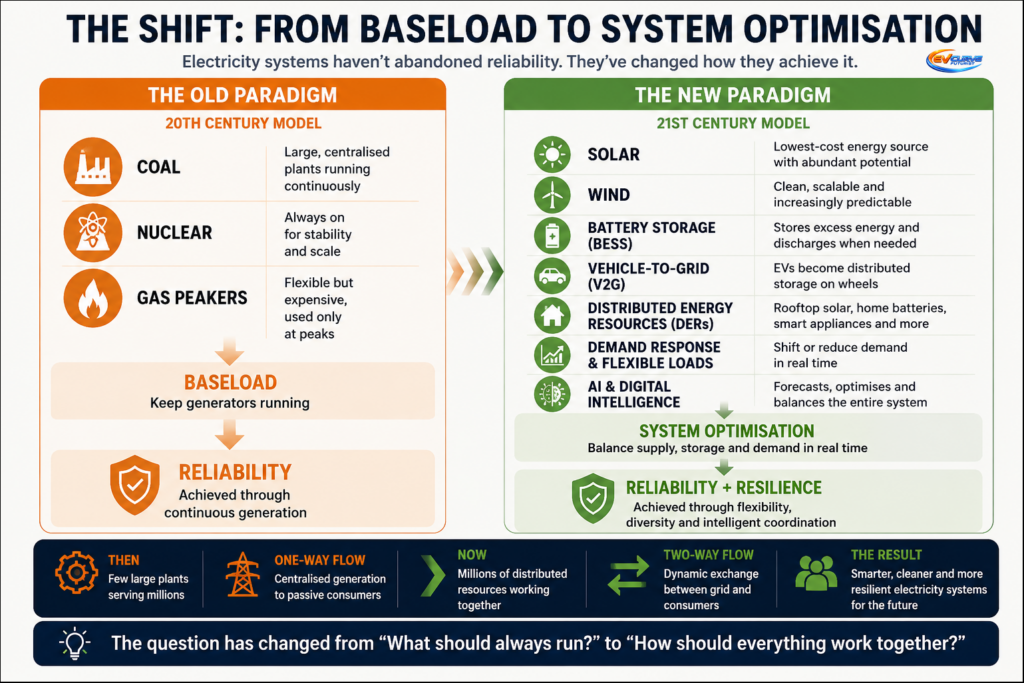
The evolution of electricity systems can be distilled into a simple idea. The objective has never changed: deliver reliable, affordable electricity whenever it is needed. What has changed is how that objective is achieved. The transition is not from reliability to unreliability, or from conventional generation to renewables alone. It is from baseload thinking to system optimisation.
Conclusion
The concept of baseload power wasn’t wrong. It was the right solution for the technologies, economics and operating constraints of the 20th century. Baseload wasn’t an engineering law. It was an economic outcome of the technologies available at the time.
But electricity systems have changed. Cheap renewable generation, energy storage, digital technologies, artificial intelligence and flexible demand have fundamentally altered how reliable power can be delivered. The objective remains exactly the same, providing reliable, affordable electricity whenever it is needed. What has changed is the most effective way of achieving it.
Baseload isn’t disappearing because reliability no longer matters. It’s disappearing because we have discovered better ways to deliver it.
The electricity grid of the future won’t be defined by what runs continuously. It will be defined by how intelligently millions of distributed resources work together to deliver reliable, resilient and affordable power.
References
1. International Energy Agency (IEA) – World Energy Outlook
- Why? Confirms solar as the “cheapest electricity in history” and discusses grid modernization.
- Link: https://www.iea.org/reports/world-energy-outlook
2. Lazard’s Levelized Cost of Energy (LCOE) Analysis
- Why? Shows the plummeting costs of renewables and storage vs. traditional baseload (coal/nuclear).
- Link: https://www.lazard.com/research-insights/levelized-cost-of-energyplus/
3. MIT Study – “The Future of Nuclear Energy in a Carbon-Constrained World”
- Why? Highlights the economic challenges of nuclear (a classic baseload source) in modern grids.
- Link: https://energy.mit.edu/research/future-nuclear-energy/
4. BloombergNEF – “Battery Storage Price Survey”
- Why? Documents the 90% drop in lithium-ion battery costs, enabling renewable flexibility.
- Link: https://about.bnef.com/blog/energy-storage-investments-boom-battery-costs-plummet/
5. Australian Energy Market Operator (AEMO) – Integrated System Plan (ISP)
- Why? Australia’s roadmap for maintaining reliability through renewable energy, storage and transmission.
- Link: https://www.aemo.com.au/-/media/files/major-publications/isp/draft-2026/
6. CSIRO / AEMO – GenCost Report
- Why? Independent analysis showing renewables plus storage are the lowest-cost pathway for new electricity generation in Australia.
- Link: https://www.csiro.au/en/research/technology-space/energy/electricity-transition/gencost
7. Tony Seba – “Rethinking Energy” (RethinkX Report)
- Why? Argues that baseload is obsolete in a decentralized, renewable-driven system.
- Link: https://www.rethinkx.com/energy
8. Darrin Durant – “Nuclear After-Life: From Tragedy to Farce, the Claims of a Nuclear Renaissance”
- Why? Provides a critical examination of claims surrounding a nuclear renaissance, arguing that many expectations for large-scale nuclear deployment exceed its likely economic and practical contribution in an era increasingly shaped by renewable energy, storage and flexible electricity systems.
- Link: https://arena.org.au/nuclear-after-life
9. EV Curve Futurist – “The Storage Surge That Tames the Duck“
- Why? Explores how rapidly expanding battery storage reshapes the duck curve, reduces curtailment and enables increasingly flexible, high-renewable electricity systems.
- Link: https://evcurvefuturist.com/2026/02/the-storage-surge-that-tames-the-duck/
