

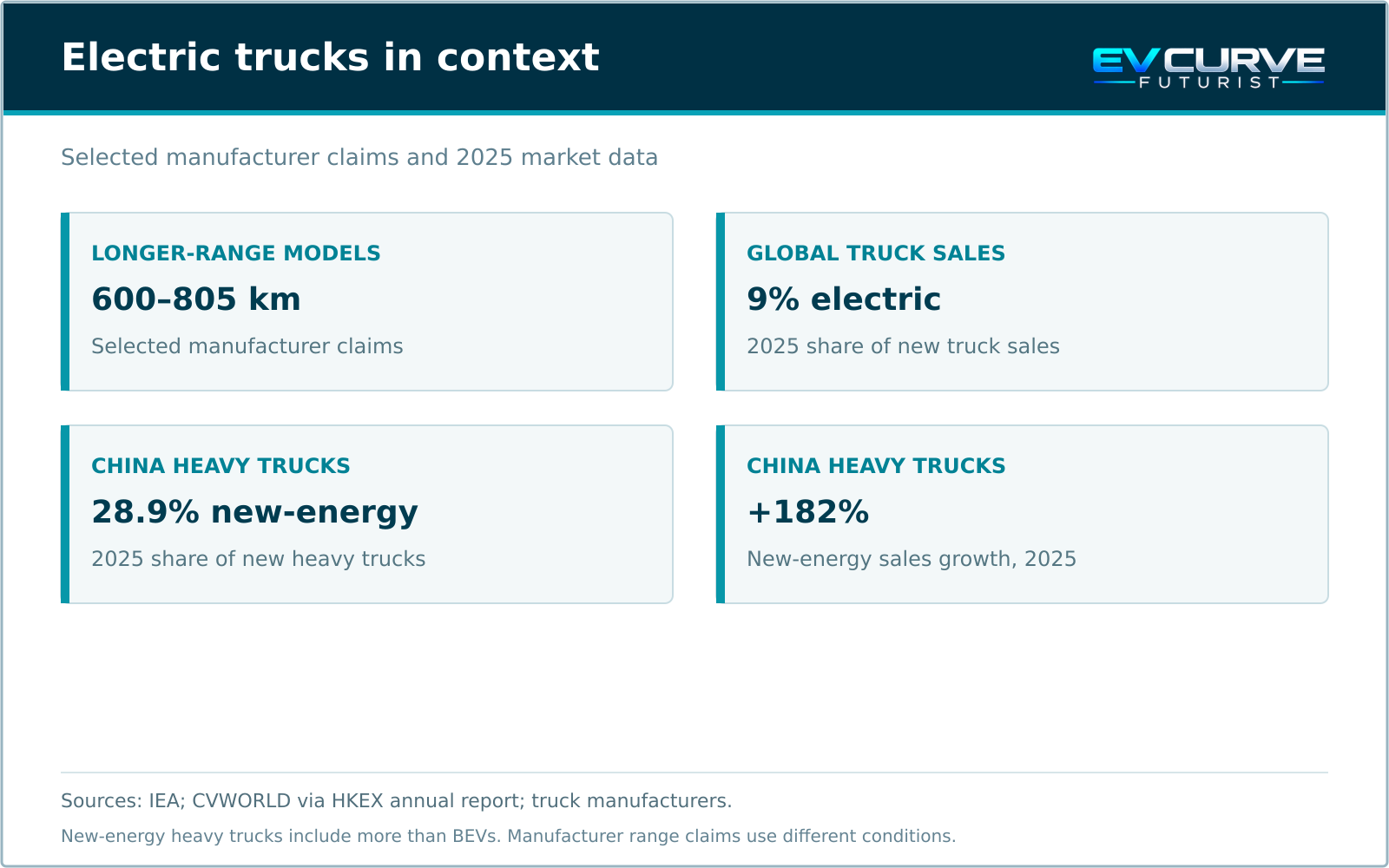
Electric trucks are moving beyond short depot routes and into regional and long-distance freight. Several manufacturers now quote ranges of 600 kilometres or more for particular models and operating conditions. The bigger question for fleets is whether the truck, charging plan and economics work for the job.
The answer will vary by route, payload, energy price and utilisation. But the direction is clear: battery-electric freight is becoming a practical choice in a growing number of applications, with China leading deployment and manufacturers expanding their offerings elsewhere.
Updated 15 November 2026: manufacturer specifications, market context and the cost examples have been refreshed. The original publication date remains unchanged.
Quick guide: An electric vehicle (EV) uses an electric motor. Here, battery-electric vehicle (BEV) means a vehicle powered by a rechargeable battery with no combustion engine. LFP means lithium iron phosphate; NMC means nickel manganese cobalt. MCS means Megawatt Charging System. State of charge (SoC) is how full a battery is; gross train weight (GTW) or gross combination weight (GCW) is the combined weight of the truck, trailer and load. Total cost of ownership (TCO) includes more than fuel or electricity.
The 600 km class
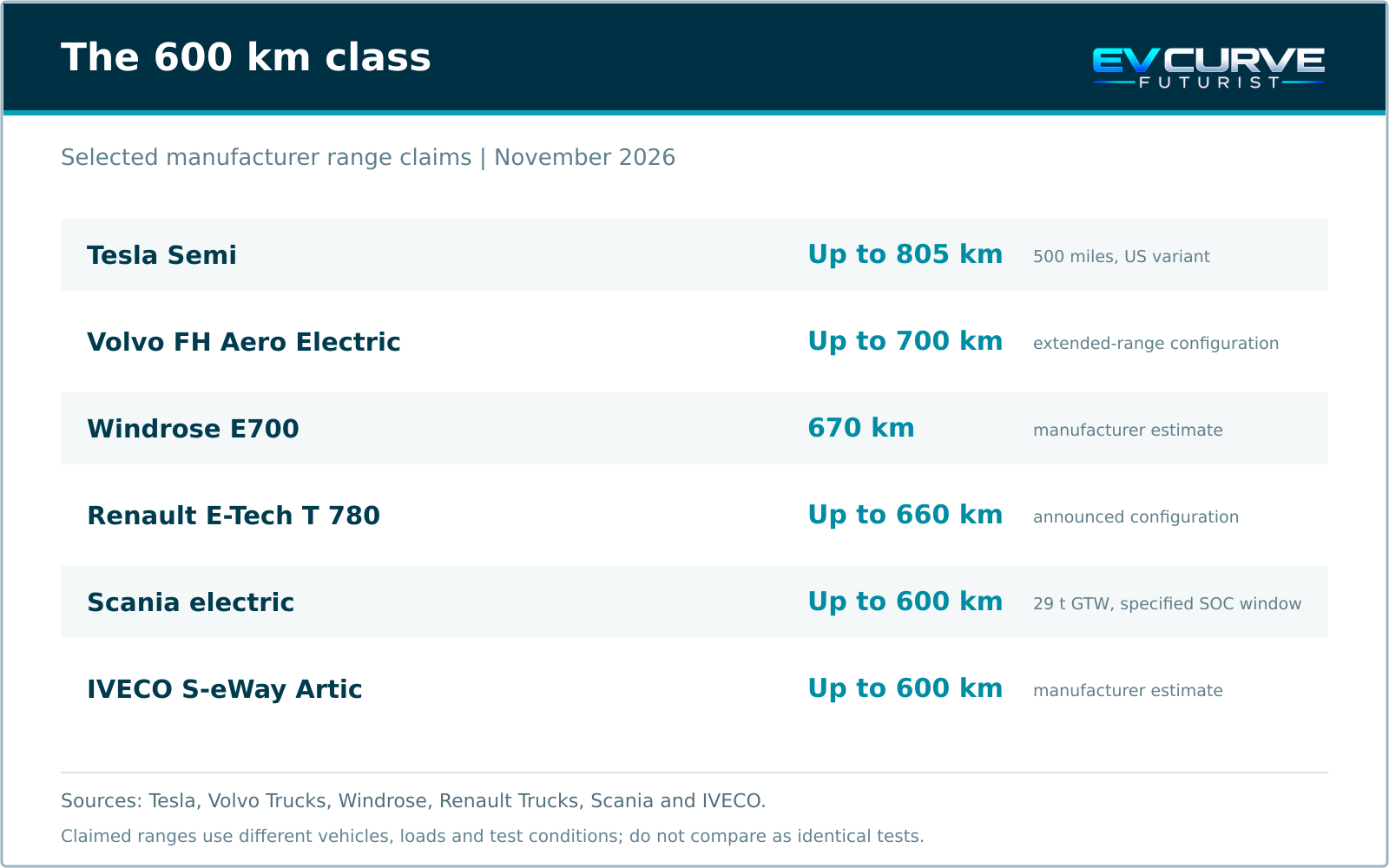
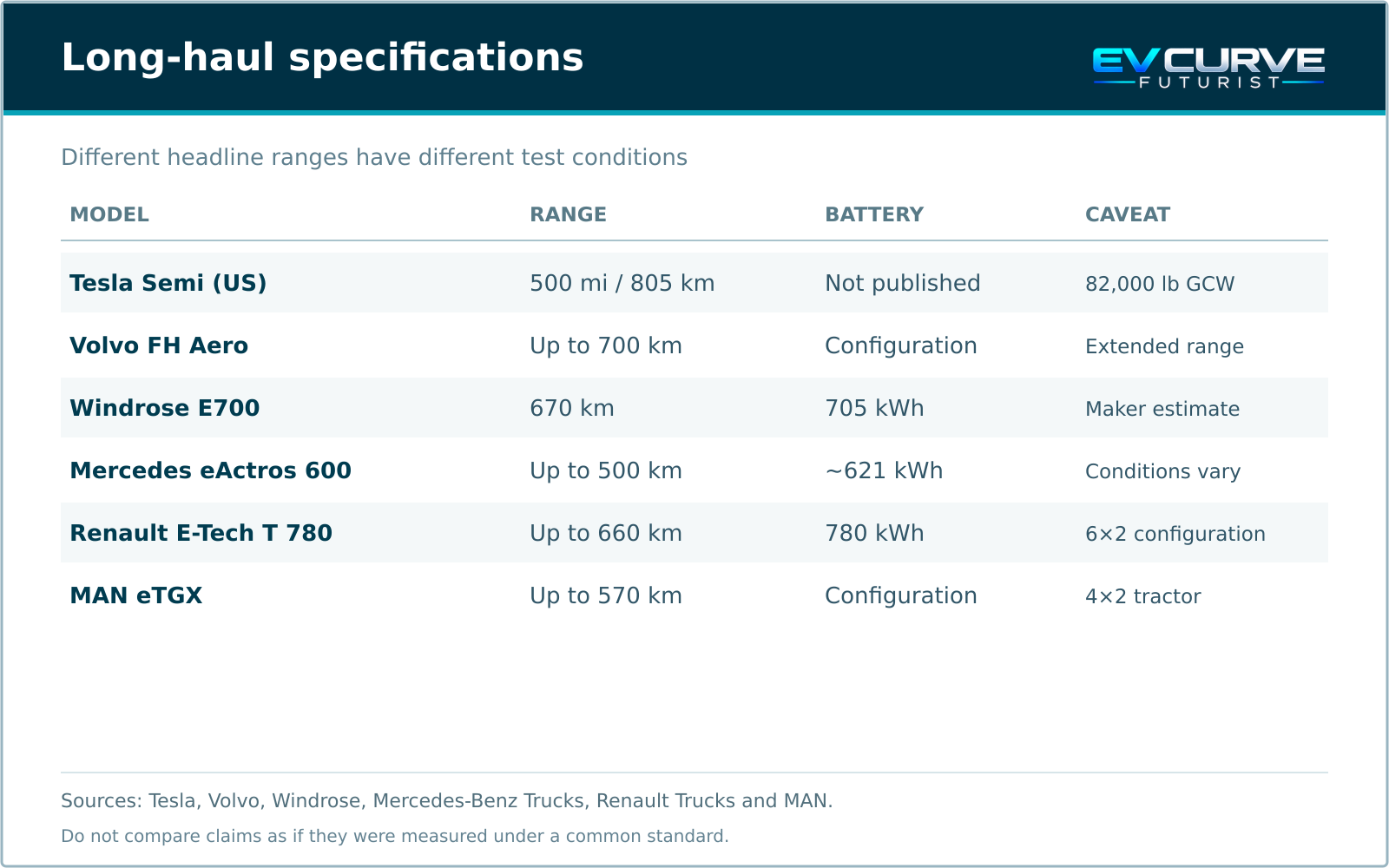
The US Tesla Semi’s long-range variant is rated at 500 miles (about 805 km), while Volvo’s extended-range FH Aero Electric is rated at up to 700 km. Windrose quotes 670 km for the E700. These are manufacturer figures, not like-for-like independent road tests. Real range changes with weight, speed, terrain, weather, driving and the reserve a fleet needs.
Long-range specifications
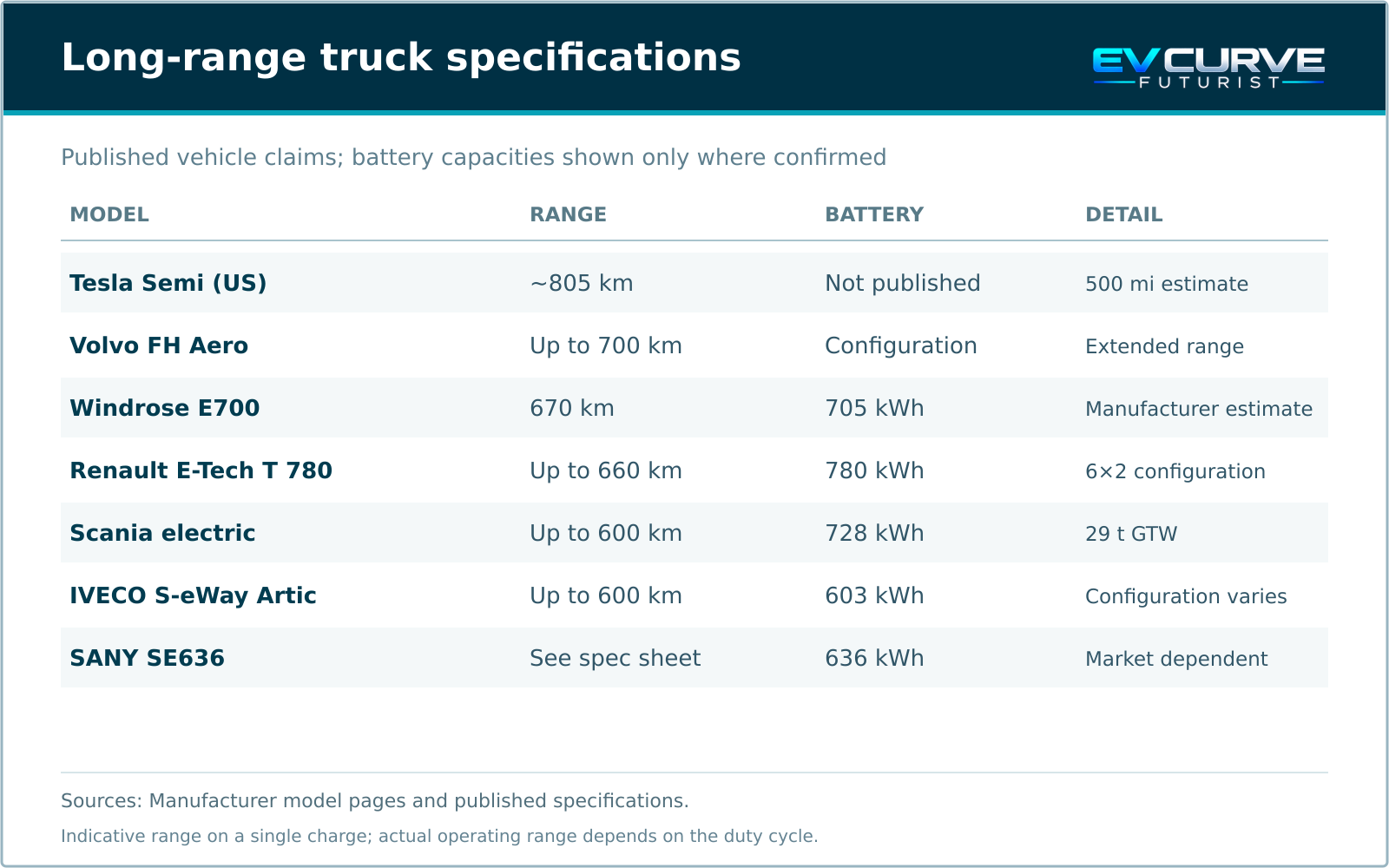
Tesla has begun volume production of the Semi. Volvo started series production of its new electric range in 2026, and Renault, Scania and IVECO have announced or introduced longer-range variants. Vehicle availability, battery size and service support vary by market. These distinctions matter more than a single headline number.
Chinese manufacturers are part of the same competition. Windrose and SANY are developing heavy trucks for demanding routes, while BYD has focused many of its existing products on regional, urban and port work. A manufacturer’s absence from the long-range table does not mean its trucks are irrelevant to freight electrification.
Range follows the route
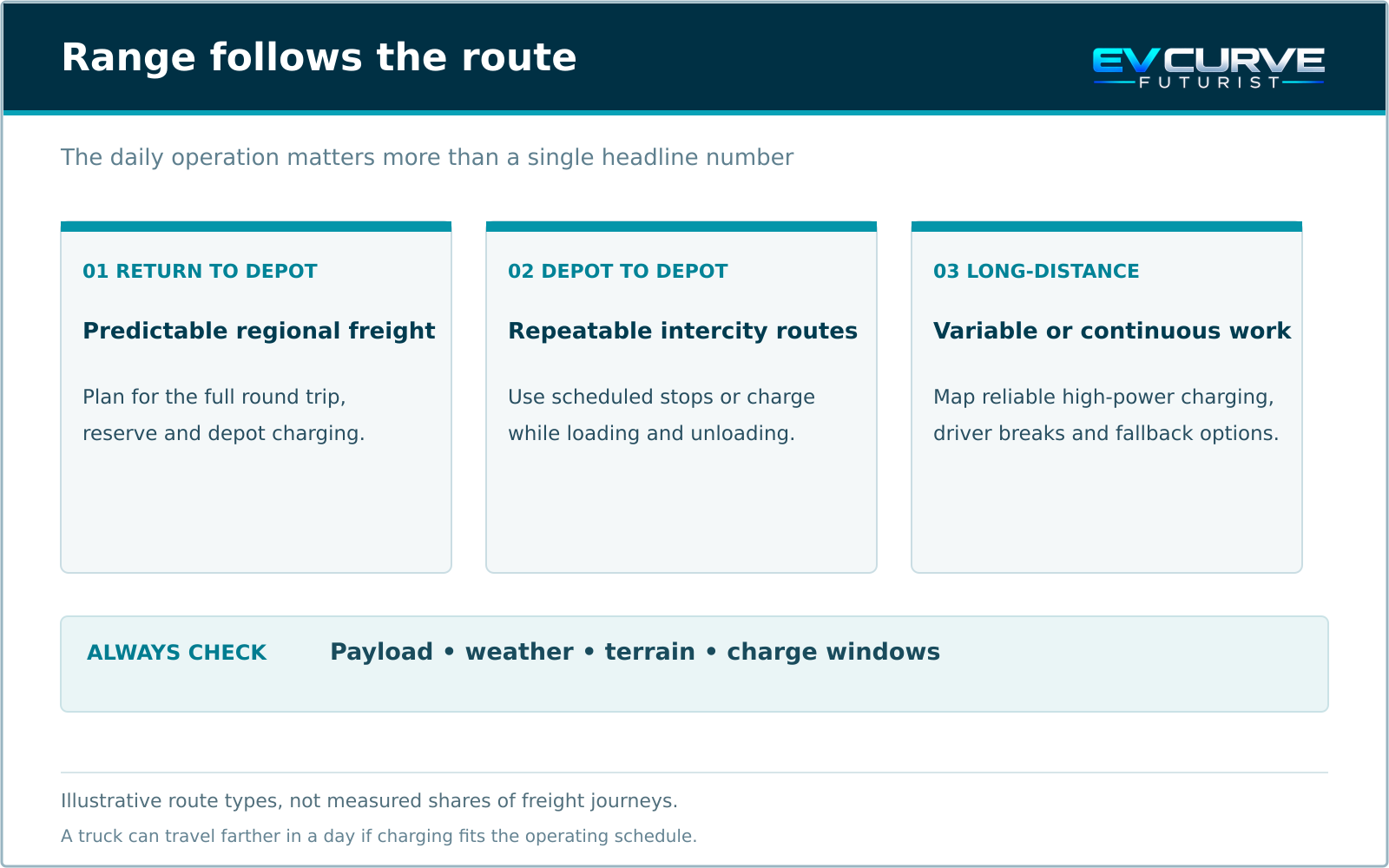
A 600 km range is useful, but it is not a universal threshold. Many trucks operate repeatable depot-to-depot or regional runs where a shorter range can work if the vehicle can complete its shift with a suitable reserve and recharge while parked.
The right question is not “Can every electric truck drive 800 km without stopping?” It is “Can this truck complete this route, with this load, in these conditions, at a competitive cost?” A route may also cover more kilometres per day than a single charge if charging fits normal breaks or loading windows.
Trucks already at work
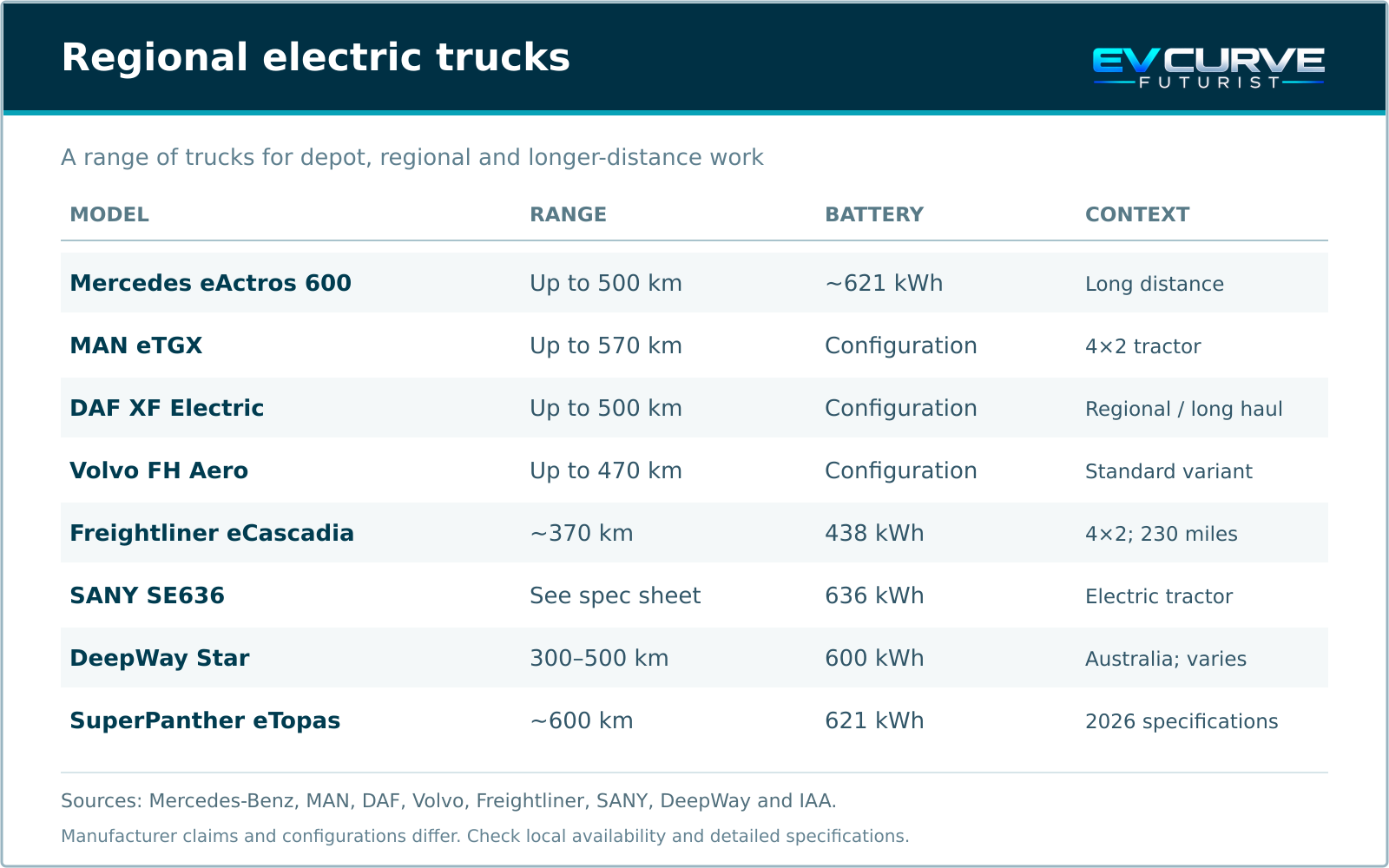
The Mercedes-Benz eActros 600, MAN eTGX and DAF XF Electric are among the trucks intended for regional or longer-distance work. Freightliner’s eCascadia offers a different range and operating profile. Choosing between them involves far more than comparing the biggest battery or the longest quoted distance.
Other entrants widen the field. The Australian distributor quotes a 300–500 km range for the DeepWay Star, depending on the configuration and job. SuperPanther’s eTopas 600 combines a 621 kWh battery with assembly at Steyr in Austria; the company reports customer trials and series production in 2026. Verify current local availability, support and warranty before comparing offers.
Battery technology matters, too. LFP and NMC chemistries offer different trade-offs in energy density, weight, cost and durability. Chemistry alone does not determine a pack’s life: thermal management, charging, depth of discharge, duty cycle and warranty terms all matter. See my battery technology overview for the wider context.
Infrastructure and utilisation
Charging infrastructure and vehicle utilisation remain real constraints. A depot operator can schedule charging around predictable shifts, while a truck operating continuously or across long corridors may require reliable high-power public charging, carefully planned breaks or battery swapping where it is available.
MCS can reduce charging time for compatible trucks, but charger availability, connection power, battery temperature and the vehicle’s own limits determine the result. A charger’s nameplate rating is not a guarantee that a truck receives that power throughout a session.
Maintenance may be lower with fewer drivetrain components, but uptime is not automatic. Fleets still need tyres, brakes, servicing, trained technicians and backup plans. The right comparison is the entire operation, including any lost or gained payload and productive time.
The long-haul comparison
Long-haul specification snapshot
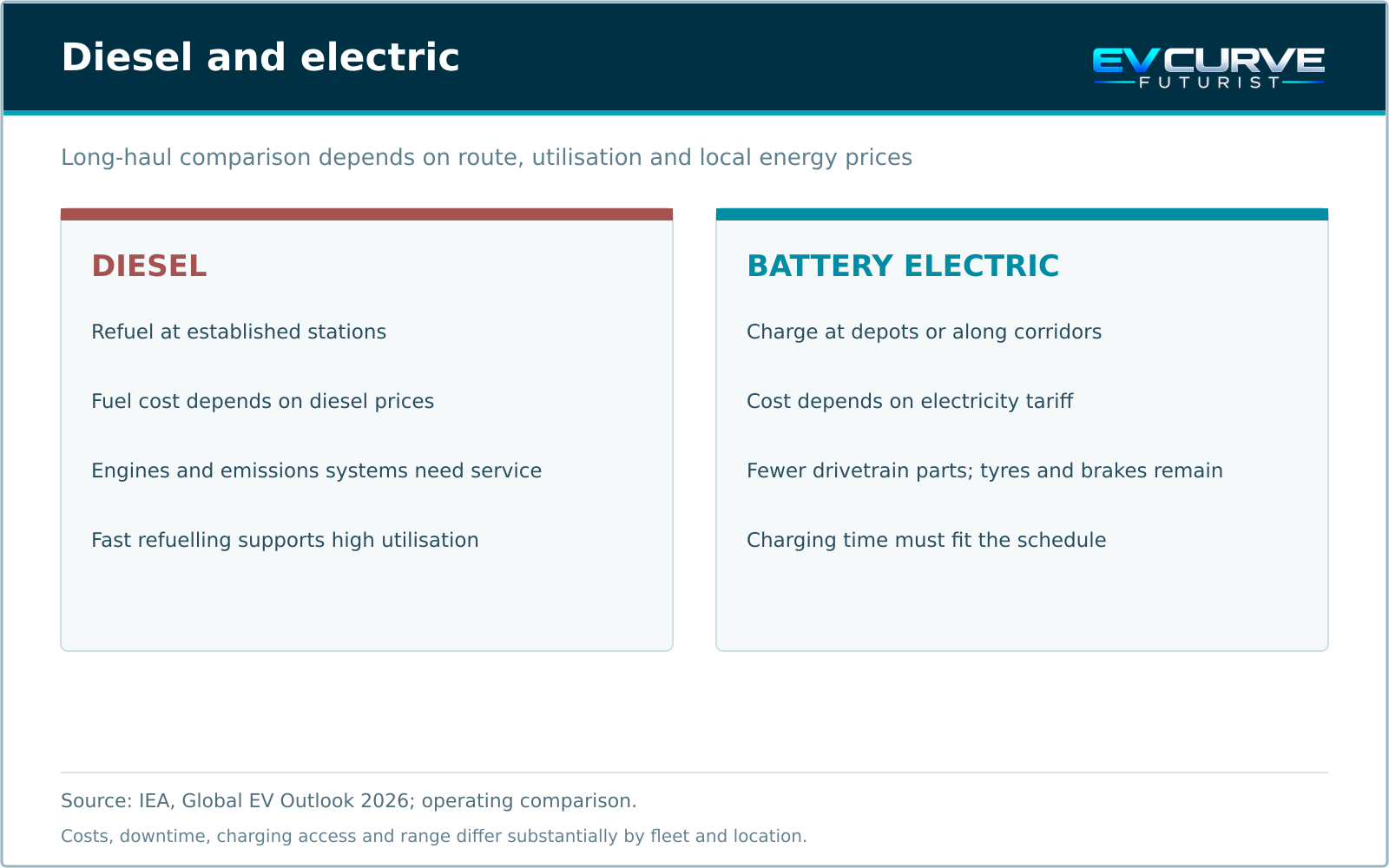
Longer range can increase flexibility on intercity corridors, but it does not remove the need to plan. Diesel benefits from a mature refuelling network; electric trucks can benefit from charging during existing downtime and from access to electricity tariffs that differ from retail diesel prices. Neither advantage is universal.
The economics that decide
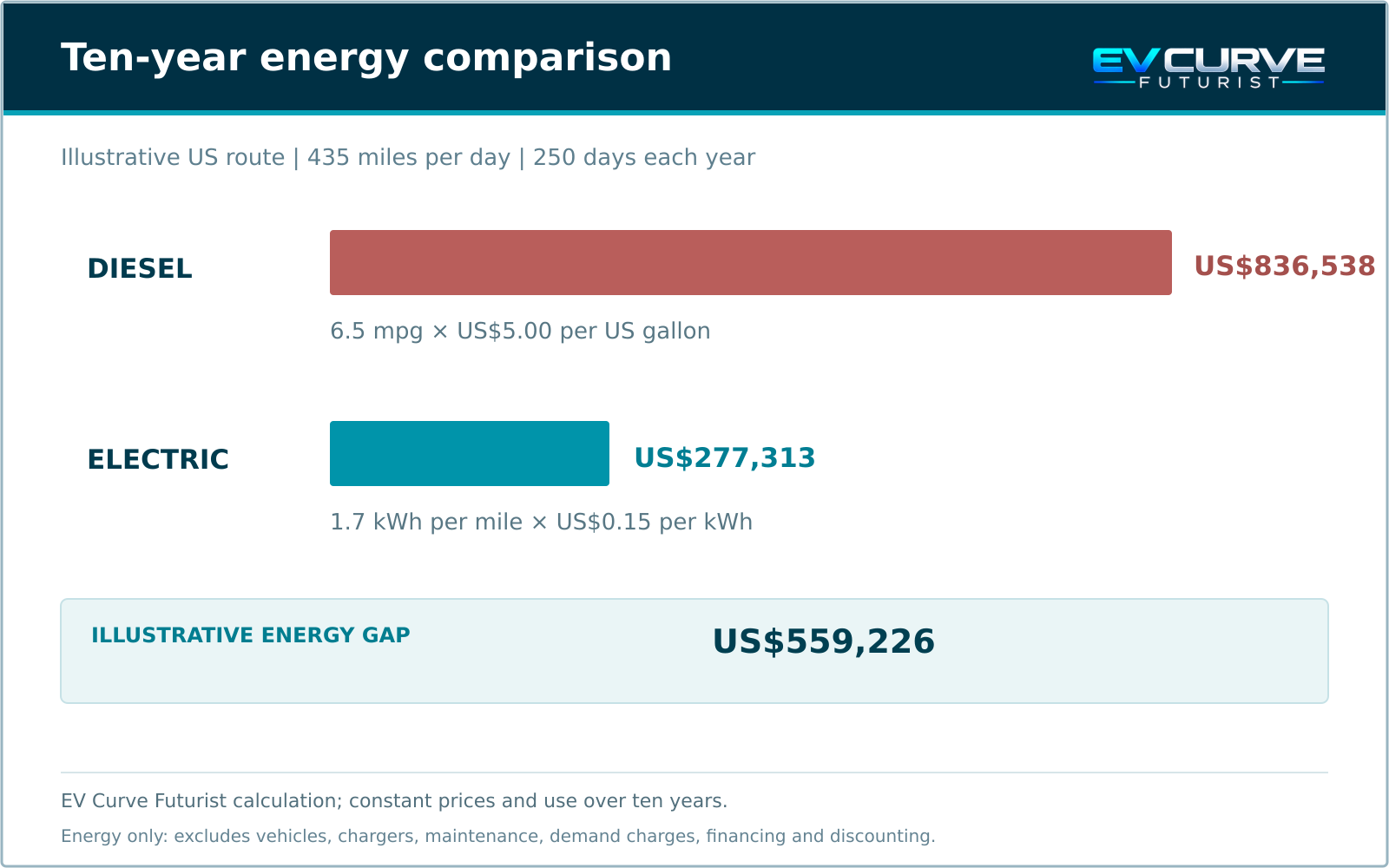
The IEA finds that electric trucks remain more expensive to buy than diesel trucks, but their total cost of ownership is already competitive in certain Chinese use cases. Elsewhere, the result depends on local prices, investment, financing, incentives and the kilometres actually driven.
A useful starting point is to compare energy for the same route. The chart above is deliberately an energy-only illustration, not a claim about full ownership cost or a forecast of future prices.
The daily maths
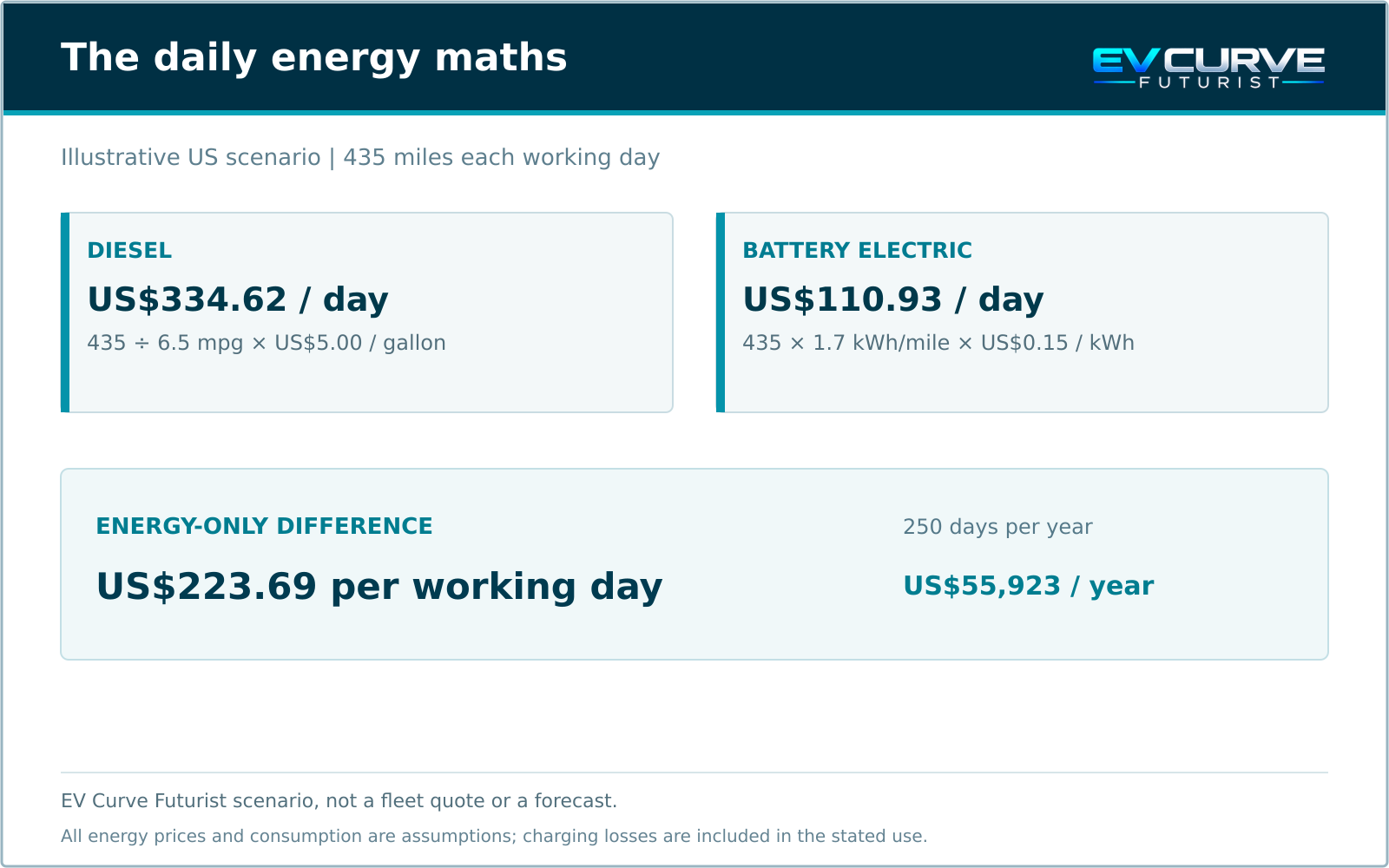
At those assumed prices, diesel costs about US$334.62 per day, compared with US$110.93 for electricity: an energy difference of about US$223.69 per working day. At 250 working days, that is approximately US$55,923 per year before other costs. Ten years at constant use and prices gives an undiscounted difference of roughly US$559,226.
These are assumptions, not average prices or a fleet quote. Different tariffs, charger demand charges, diesel consumption, energy losses or annual distance can change the result substantially. A full TCO model also needs truck purchase or lease cost, infrastructure, maintenance, battery provisions, finance, residual value and downtime.
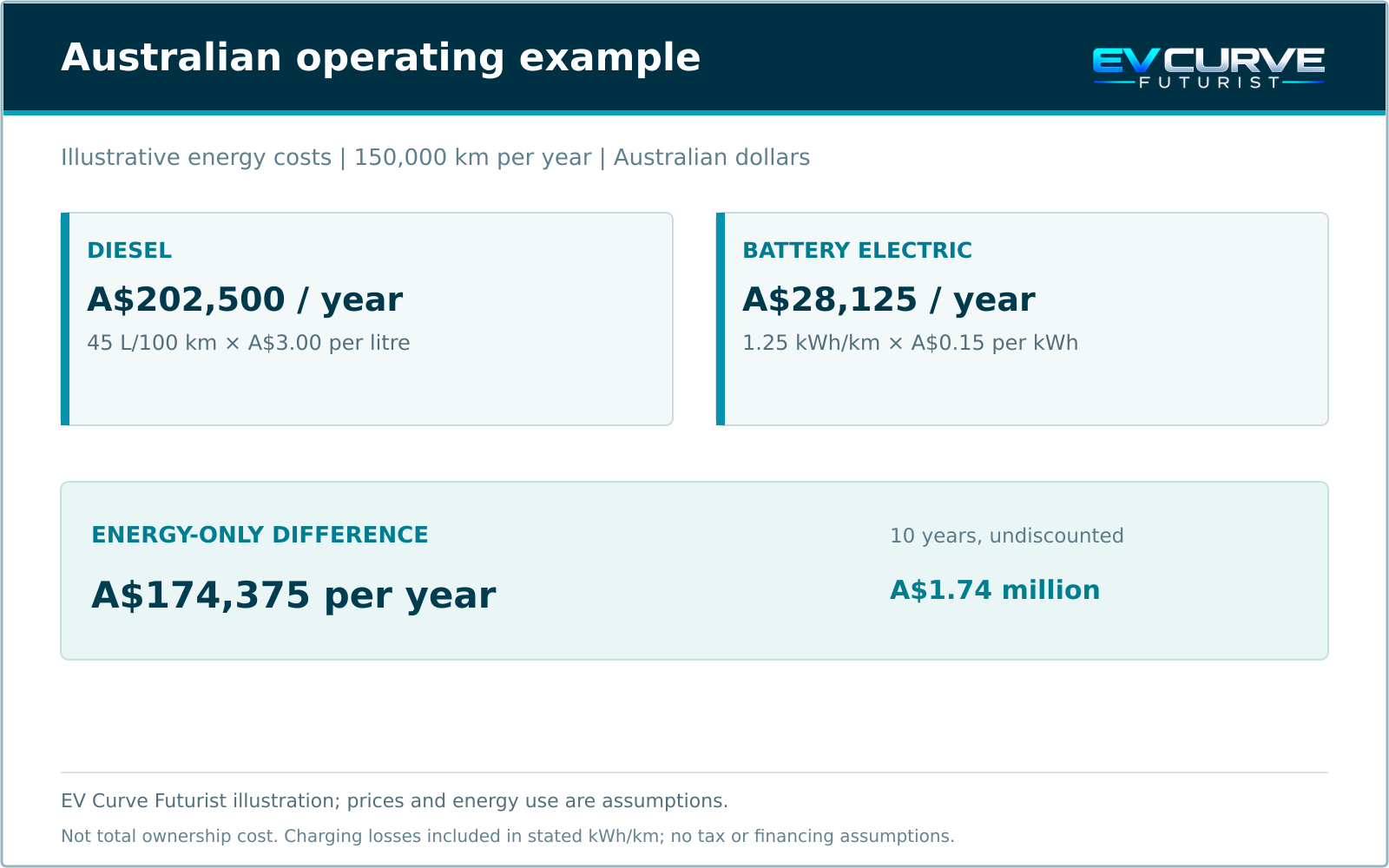
In the Australian example, 150,000 km at 45 litres per 100 km and A$3 per litre produces a diesel bill of A$202,500 per year. At 1.25 kWh per km and A$0.15 per kWh, electricity costs A$28,125. The difference is A$174,375 a year, but it is an illustration under the stated assumptions, not a guaranteed saving.
For comparison, at 40–45 litres per 100 km and A$3 per litre, the same annual distance would use A$180,000–A$202,500 of diesel. At 1.2–1.4 kWh/km and A$0.10–A$0.20/kWh, electricity would cost A$18,000–A$42,000. These ranges demonstrate sensitivity, not a matched best-case and worst-case forecast.
As I explored in EV truck cost savings, high utilisation can amplify an energy advantage. Whether it outweighs the capital and operating costs needs to be tested for each fleet.
A global systems shift
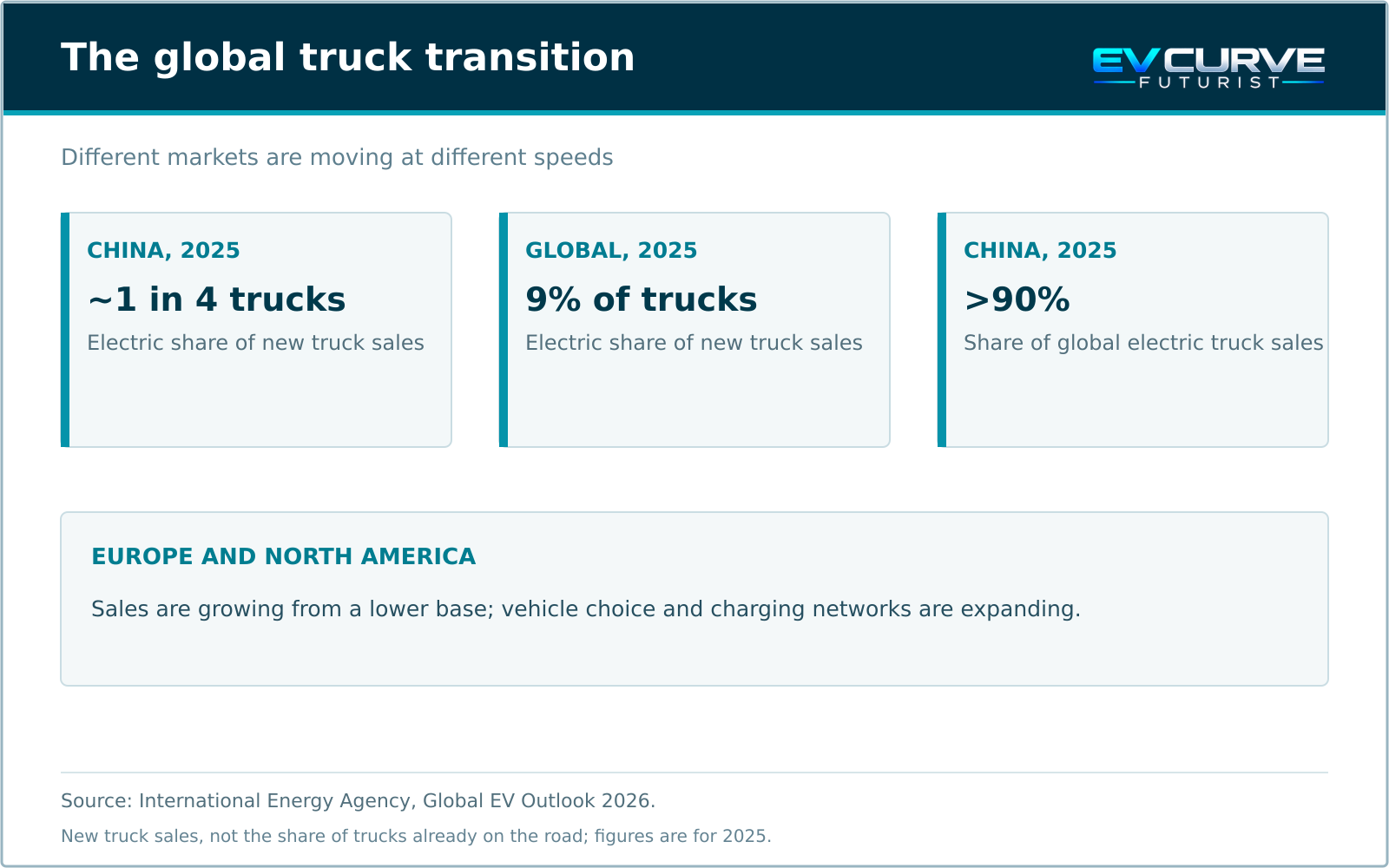
The US, Europe and China are following different paths. China leads by scale; Europe’s established manufacturers are broadening their electric ranges; and North America is developing new vehicles and charging corridors from a smaller base. The IEA estimates electric trucks made up 9% of global new truck sales in 2025, with more than 90% of global electric truck sales in China.
New sales are a flow, while the fleet is the stock. Even rapid growth in electric sales takes time to replace the trucks already on the road. That distinction is central to Fleet First: why stock beats flow.
Freight and oil
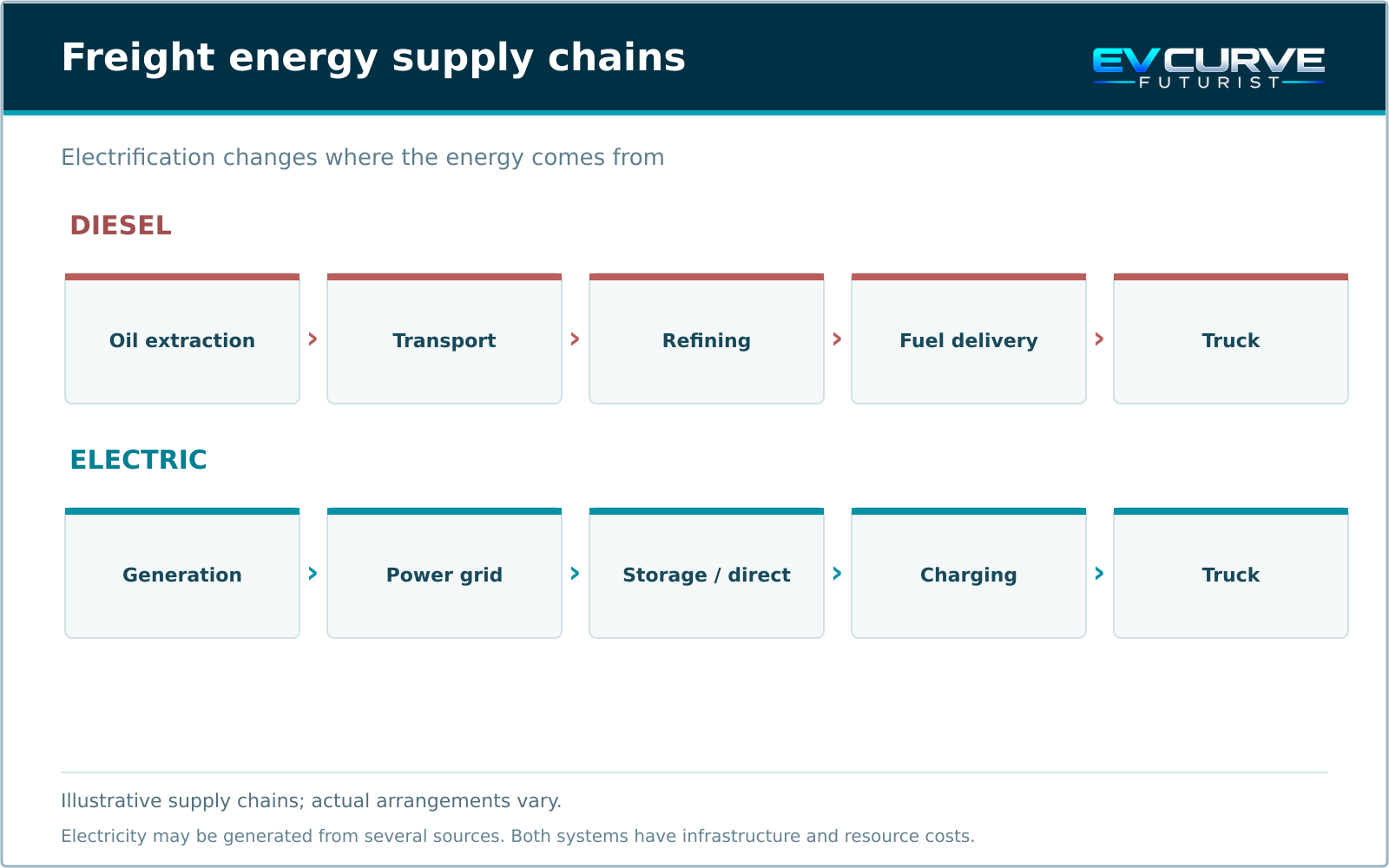
For more than a century, road freight has relied on oil extraction, refining and fuel distribution. Electric trucks shift part of that energy demand to electricity generation, grids and charging infrastructure. That can reduce a fleet’s direct exposure to diesel, but it does not remove energy-price risk or eliminate upstream emissions and material requirements.
Where local renewable generation, storage and depot charging are economical, an operator may have more options for managing supply and cost. The result depends on the electricity mix, network connection and tariff. The broader system is examined in Transportation: the first sector to flip.
China’s freight opportunity
China has strong reasons to electrify freight: energy security, industrial policy, local air quality and operating costs. Its established battery, power-electronics, vehicle and charging industries can reinforce one another as deployment grows.
An annual report filed with the Hong Kong exchange, citing CVWORLD, puts China’s 2025 new-energy heavy-truck sales at about 231,000, up 182% year on year, or 28.9% of heavy-truck sales. New-energy vehicles can include more than battery-electric trucks, so this is not directly interchangeable with every BEV-only or all-truck measure. The Reuters analysis in the original article explores the implications for diesel demand.
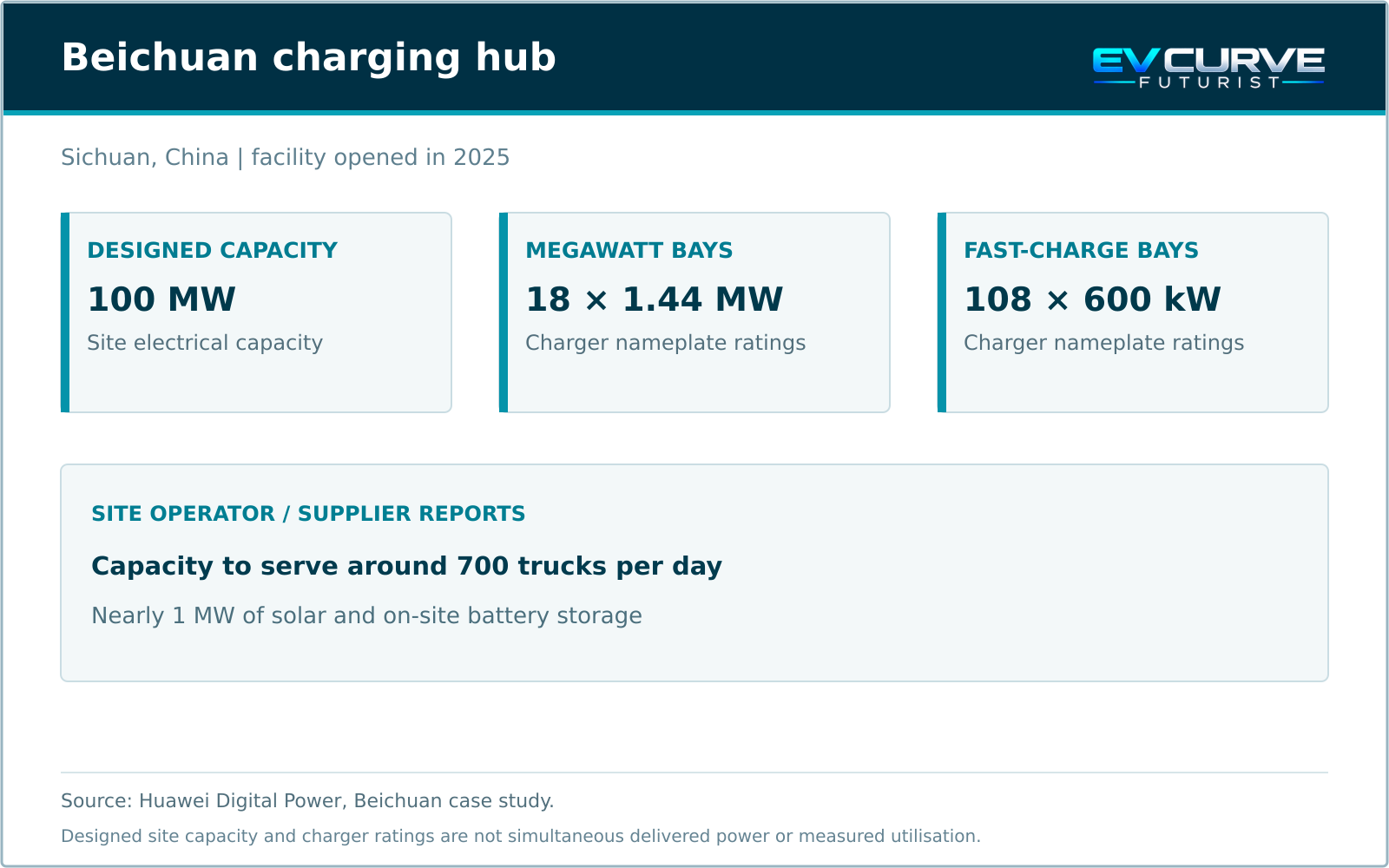
Beichuan illustrates the infrastructure scale involved. The site’s technology supplier reports nearly 1 MW of on-site solar and battery storage alongside the charging bays. The stated 100 MW is a design figure, while the reported capacity to serve around 700 trucks a day is not the same as verified daily utilisation.
What fleet operators should check
- Route: Measure the real daily distance, payload, terrain, temperature and reserve required.
- Charging: Check access, electrical connection, power limits, dwell time and a backup option.
- Total cost: Include the vehicle, energy, infrastructure, maintenance, finance and residual value.
- Utilisation: Model driving shifts, servicing, payload and the effect of charging on productive time.
My view is that electric trucks do not need to win every freight task at once. They need to work reliably and economically on enough routes to earn their place in fleets. As vehicles, charging networks and operational experience improve, the addressable share can expand.
Sources and manufacturer links
These sources describe the models and evidence discussed above. Specifications and availability change, so check the current local configuration before making a purchasing decision.
View sources
- IEA: Global EV Outlook 2026; full report
- HKEX annual report citing CVWORLD: 2025 China new-energy heavy-truck sales
- Tesla Semi; Volvo FH Aero Electric; Scania electric trucks
- Renault Trucks E-Tech T; IVECO S-eWay Artic; Windrose E700
- SANY electric trucks; DeepWay Star Australia; SuperPanther eTopas 600
- Huawei Digital Power: Beichuan charging hub