I first wrote about this subject in April 2025, after Liam Bartlett’s Electric Vehicle Con put the environmental damage associated with Indonesia’s nickel industry under the spotlight. More recently, a discussion about cobalt mining in the Democratic Republic of Congo brought me back to the subject.
So let’s start with the uncomfortable truth: nickel mining can cause serious environmental damage. Cobalt mining can involve appalling human exploitation.
Those problems are real and should never be dismissed. But presenting them as evidence against EVs without comparing the entire systems involved misses the bigger story.
BATTERY CHEMISTRY IS CHANGING FAST
There is no single “EV battery.”
The best example is lithium iron phosphate (LFP), which contains no nickel and no cobalt. In 2020, LFP supplied less than 10% of the global electric-car battery market. By 2025, it accounted for more than 55% of EV batteries deployed globally. In China the shift has gone even further, with LFP accounting for 81.2% of EV battery installations in 2025.
That’s an extraordinary change in just five years.
Why? LFP is cheaper, durable and thermally stable. Its traditional disadvantage, lower energy density, continues to shrink as chemistry, battery architecture and vehicle efficiency improve.
Meanwhile, LMFP adds manganese to improve performance, high-nickel batteries use far less cobalt than earlier chemistries, and sodium-ion is entering commercial production without lithium, nickel or cobalt.
Materials get substituted, costs fall and engineers get more from less.
It’s also why projecting today’s mineral requirements decades into the future is so problematic.
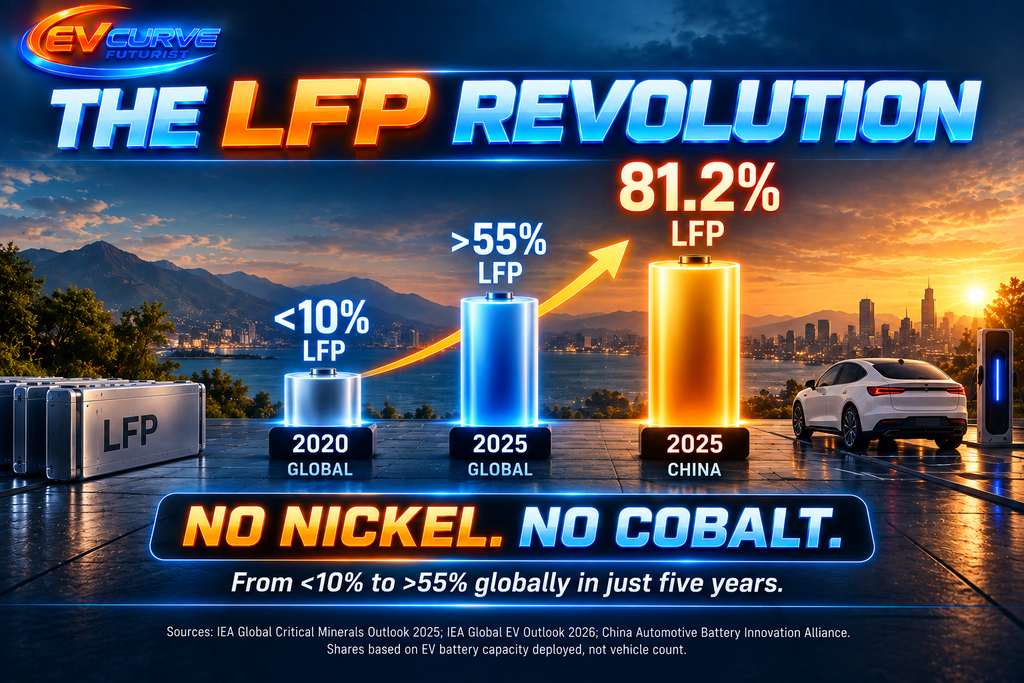
Graphic footnote: Sources: International Energy Agency, Global Critical Minerals Outlook 2025 and Global EV Outlook 2026; China Automotive Battery Innovation Alliance. LFP supplied less than 10% of the global electric-car battery market in 2020 and more than 55% of EV batteries deployed globally in 2025. In China, LFP represented 625.3 GWh, or 81.2%, of EV battery installations in 2025. Shares are based on battery capacity rather than vehicle count.
COBALT AND NICKEL ARE STILL REAL PROBLEMS
The Democratic Republic of Congo supplies roughly two-thirds of global cobalt, and serious abuses including dangerous working conditions, exploitation and child labour have been documented in parts of its mining industry.
Indonesia’s nickel boom has likewise brought deforestation, pollution, community impacts and energy-intensive processing, much of it historically powered by coal.
None of that gets a free pass because the minerals end up in an EV.
But the response isn’t simply to stop using batteries. It’s to reduce problematic materials where possible and clean up the supply chains where they’re still needed.
Europe is moving in that direction. From 18 February 2027, EV batteries placed on the EU market must have a digital battery passport, creating an electronic record containing information about the battery and its lifecycle.
From 18 August 2027, EU battery due-diligence rules require affected companies to address environmental and social risks associated with raw materials including cobalt, nickel, lithium and natural graphite, backed by third-party verification and public reporting.
Recovery requirements are tightening too. By 31 December 2027, EU rules require recovery of 90% of cobalt, copper and nickel and 50% of lithium from processed battery waste. By 2031, those targets rise to 95% for cobalt, copper and nickel and 80% for lithium.
None of this makes mining clean overnight, and regulation is only as effective as its enforcement. But several things are happening simultaneously: less nickel and cobalt in many batteries, rapid growth of chemistries requiring neither, greater traceability, tighter due diligence and increasingly stringent recovery requirements.
At the same time, falling material intensity doesn’t necessarily mean falling absolute demand. Electrification is expanding so rapidly that demand for lithium, copper, graphite and other minerals can rise even while manufacturers use less per vehicle. Nickel also remains important in some long-range batteries, stainless steel and other industries.
Electrification doesn’t eliminate mining. It changes the resource model.
A BATTERY IS NOT A TANK OF PETROL
This is the distinction that matters most.
Battery minerals are predominantly materials. We mine them, refine them and manufacture them into an asset that can move a vehicle hundreds of thousands of kilometres. Eventually, many of those materials can potentially be recovered and used again.
Oil used as transport fuel is different. We extract it, transport it, refine it, transport it again, put it into a vehicle and burn it.
It’s gone.
Road transport accounts for around 45% of global oil demand. Oil will continue to have major uses in aviation, shipping, petrochemicals and other industries even as cars and trucks electrify, but for road transport the distinction is fundamental.
Battery minerals become part of an asset. Transport fuel is consumed.
You can’t recycle the petrol you burned last Tuesday.
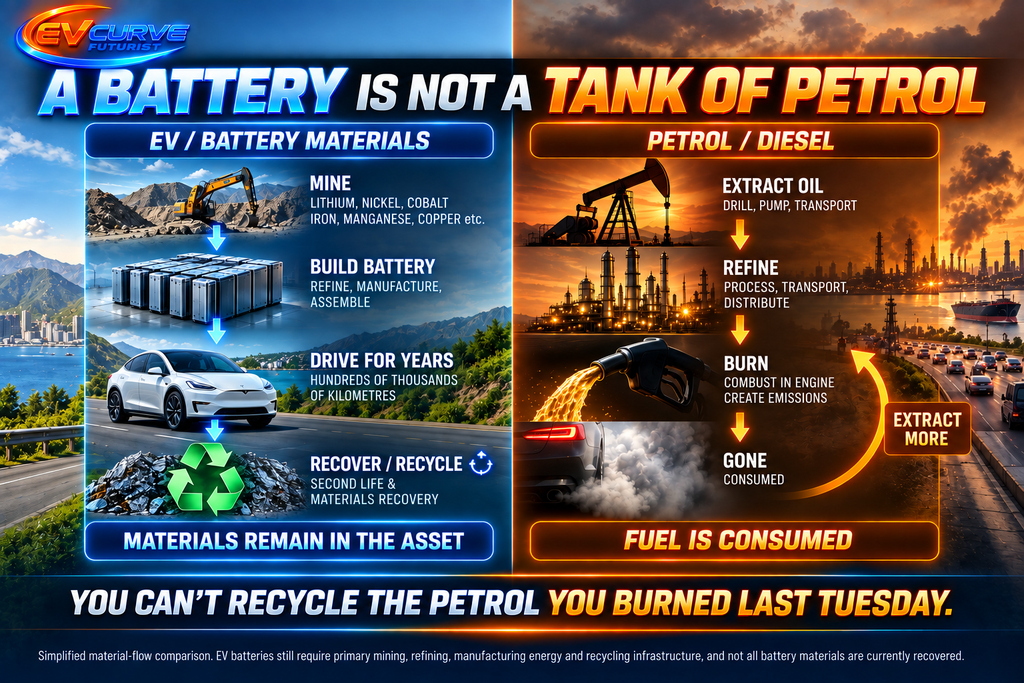
Graphic footnote: Simplified comparison of material and fuel flows. EV batteries still require primary mining, refining, manufacturing energy and recycling infrastructure, and not all battery materials are currently recovered. Battery minerals remain embodied in a durable asset, whereas petrol and diesel are consumed during vehicle operation.
RECYCLING HELPS, BUT IT ISN’T MAGIC
Recycling won’t eliminate mining anytime soon. Most EV batteries are still on the road, so there simply isn’t enough end-of-life material available to supply a rapidly growing industry. Collection, transport, different chemistries and processing costs add further challenges.
Primary mining will therefore remain essential during the build-out.
But as millions of batteries eventually reach end of life, recycling can increasingly return lithium, nickel, cobalt, copper and aluminium to the supply chain.
The opportunity isn’t zero mining. It’s an increasingly circular material system where more of what we’ve already extracted stays in circulation.
Transport fuel has no equivalent pathway.
BUT THE MINING DAMAGE IS HAPPENING NOW
This is a legitimate criticism.
New mines disturb land now. Processing consumes energy now. Communities can bear environmental and social costs now, while some of the benefits of electrification accumulate over years.
But delaying electrification doesn’t preserve an impact-free alternative. It means continuing to extract, refine, transport and burn fossil fuels during those same years.
We’re comparing two industrial systems with environmental impacts, not mining versus nothing.
Lifecycle studies consistently find BEVs have higher manufacturing emissions upfront but substantially lower emissions over their operating lives, although the size of that advantage varies with vehicle size, battery production and electricity mix.
A 2025 ICCT analysis, for example, estimated that a medium-sized BEV sold in the EU produced 73% lower lifetime greenhouse-gas emissions than a comparable petrol car under its projected electricity mix. The additional manufacturing footprint was recovered after roughly 17,000 km.
That 73% isn’t a universal EV number. Different grids and assumptions produce different results. The important distinction is structural: EVs front-load more of their footprint into manufacturing, then recover it during operation. Combustion vehicles require a continuous flow of new fuel for as long as they’re driven.
And as electricity gets cleaner, an EV already on the road gets cleaner with it.
ZOOM THE CAMERA OUT
Show me the nickel mine in Indonesia. Show me the cobalt mine in Congo. Show me the pollution, deforestation and exploited workers.
Expose it. Regulate it. Fix it.
But don’t stop the camera there.
Zoom out.
Show me the oil wells, pipelines, tankers and refineries. Show me the spills, flaring and pollution.
Road transport alone accounts for around 45% of global oil demand.
Because EVs aren’t replacing some imaginary transport system requiring no resources. They’re replacing one built around a continuous flow of fossil fuel that must be extracted, refined, transported and permanently consumed.
Electrification still requires enormous amounts of mining. Absolute mineral demand can rise during the build-out. Recycling won’t solve that overnight.
But battery chemistry can change. Material intensity can fall. Supply chains can become more transparent. Batteries can last longer. Their materials can increasingly be recovered and used again.
Transport fuel cannot.
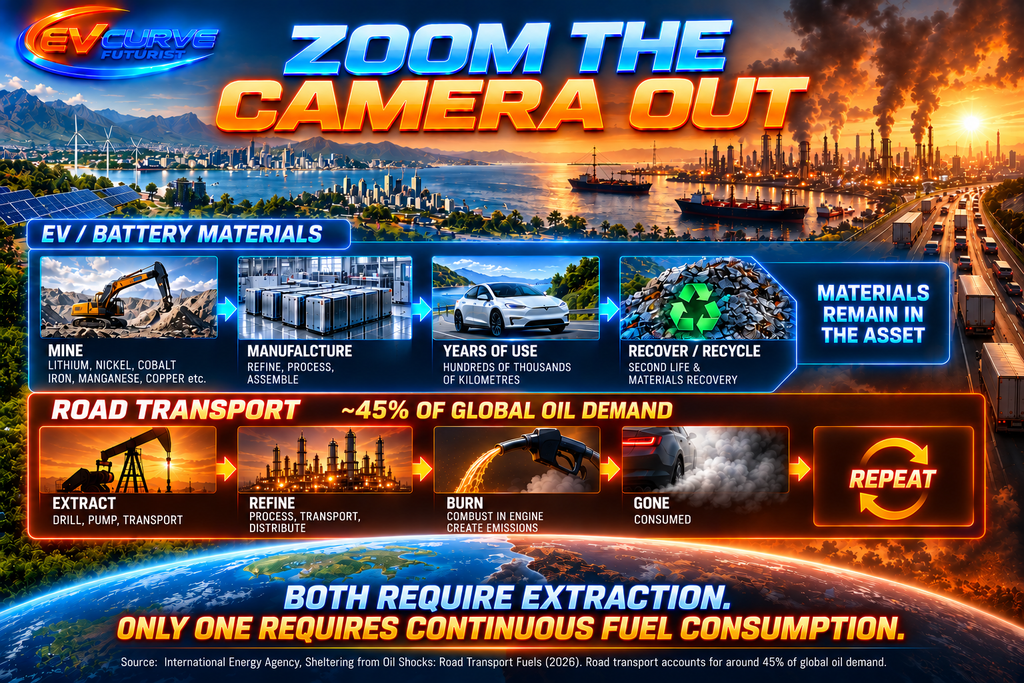
Graphic footnote: Source: International Energy Agency, Sheltering from Oil Shocks: Road Transport Fuels (2026). The IEA estimates road transport accounts for around 45% of global oil demand. This comparison concerns oil consumed as road-transport fuel; oil also has substantial uses in aviation, shipping, petrochemicals and other industries.
The goal isn’t zero mining. That’s unrealistic.
It’s cleaner mining, fewer problematic materials, longer-lasting batteries and getting vastly more useful transportation from every tonne of material we extract.
So yes, show me the nickel mine. Show me the cobalt mine.
But then zoom the camera out and compare the whole system.