Ford, Toyota and Volkswagen still have time to survive the Chinese EV disruption. The problem is that survival requires them to dismantle much of the business that made them successful.
I keep coming back to one uncomfortable thought: legacy auto isn’t dead yet. It could still save itself.
Ford, Toyota, Volkswagen, GM, Stellantis and others still possess enormous advantages: globally recognised brands, manufacturing expertise, distribution networks, engineering talent, access to capital and tens of millions of existing customers. But if they genuinely want to remain globally relevant in 2035, rather than simply maximise profitability over the next few years, I think they have to do something extraordinarily painful.
They have to deliberately begin killing the business that made them successful.
If Ford, Toyota, Volkswagen and the other major incumbents announced that from their next generation of vehicle platforms onward, virtually every genuinely new platform would be PHEV or BEV, I’d give them a fighting chance. Not necessarily to win. To survive.
And those decisions can’t be made in 2030. Given automotive development cycles, they effectively have to be made now.
The Innovator’s Dilemma on Wheels
The problem isn’t that these companies don’t understand electrification. They employ some of the smartest engineers on Earth. Their executives can see what’s happening in China. They’ve watched battery costs fall, Chinese development cycles compress and their own market share inside China collapse.
The problem is much harder: their old business still makes money.
ICE vehicles generate enormous cash flow. Existing factories are optimised around them. Suppliers depend on them. Dealers sell and service them. Entire corporate structures have evolved around improving, manufacturing, financing, maintaining and replacing them.
Every additional year that machine keeps running looks rational from the perspective of the next quarterly earnings call, and potentially disastrous when viewed from 2035. That’s the trap. The business generating the cash required to finance their transition also gives them an enormous incentive to delay it.
Kodak understood digital photography. Nokia understood smartphones were coming. Blockbuster understood streaming. Understanding disruption doesn’t guarantee survival. Sometimes it makes the problem worse because management spends years trying to protect the incumbent business while simultaneously building the thing that will destroy it.
Automotive is now experiencing that dilemma on an almost unimaginable scale.
What I Would Do
If I were running one of these companies, I’d stop treating electrification as one drivetrain option among many. I’d declare that the destination is settled.
And I’d declare it publicly and loudly.
I’d tell customers, investors, suppliers, dealers and employees: this is our final generation of ICE-only platforms. From here, every genuinely new global architecture will be PHEV or BEV.
Tesla already demonstrated that a Western automaker could build around many of these principles: BEV-first platforms, vertically integrated software, direct sales, fewer vehicle architectures and relentless manufacturing simplification. But Tesla had one enormous advantage legacy auto doesn’t: it had no ICE empire to dismantle. Ford, Toyota and Volkswagen aren’t simply being asked to build the future. They’re being asked to build it while deliberately cannibalising the enormously profitable industrial system they already own.
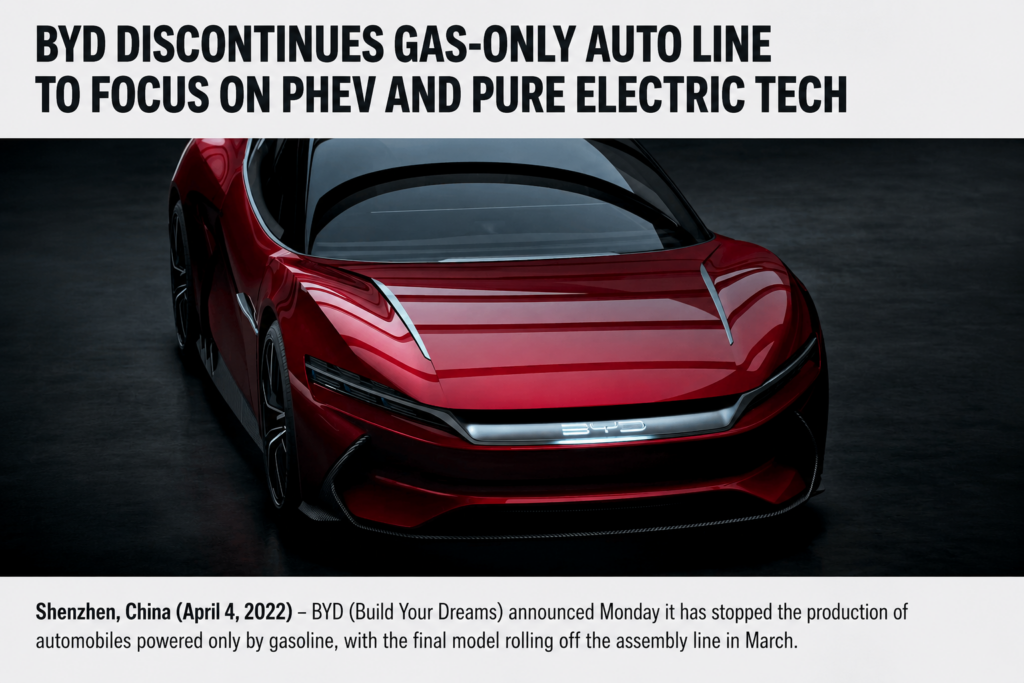
BYD went one step further in 2022 when it stopped producing ICE-only vehicles altogether, shifting entirely to PHEVs and BEVs. The significance wasn’t simply technological. It sent an unmistakable signal to the entire organisation and supply chain: we’ve picked a future. There is no going back.
I’d want legacy auto to create the same kind of moment. Make a song and dance about it. Turn the decision into a line in the sand. Because a public commitment doesn’t just tell the market where you’re going, it forces the organisation to start behaving as though you actually mean it.
And critically, it forces the supply chain to start adapting to the same future.
If suppliers know that every genuinely new platform from here is electrified, their investment decisions change too. Capital, engineering talent and manufacturing capacity begin shifting toward batteries, motors, power electronics, semiconductors and software instead of continuing to defend an ICE ecosystem with a shrinking future.
That’s how you begin moving an entire industrial system rather than just one company. Suppliers need certainty before they’ll commit billions to new factories and technologies. Give them that certainty and suddenly thousands of businesses have an incentive to start solving the same problem.
You don’t just transform the automaker. You force the ecosystem around it to transform with you.
That doesn’t mean combustion engines disappear tomorrow. Existing platforms could continue where demand justified them, particularly in markets where charging infrastructure remains weak. But ICE-only platforms would enter managed decline and the direction of engineering investment would become irreversible.
No more hedging across six possible futures. No more enormous capital commitments to entirely new engines and transmissions intended to remain in production deep into the 2030s. No more treating BEVs as regulatory compliance products sitting beside the “real” cars.
The company would have one technological trajectory: electrification.
PHEVs would provide the bridge where infrastructure or consumer behaviour isn’t ready for full BEV adoption. But I’d design that bridge knowing exactly where it leads: BEV.
Then I’d Go to War on Cost
Legacy manufacturers don’t simply need competitive electric cars. They need competitive cost structures, and that’s a completely different challenge.
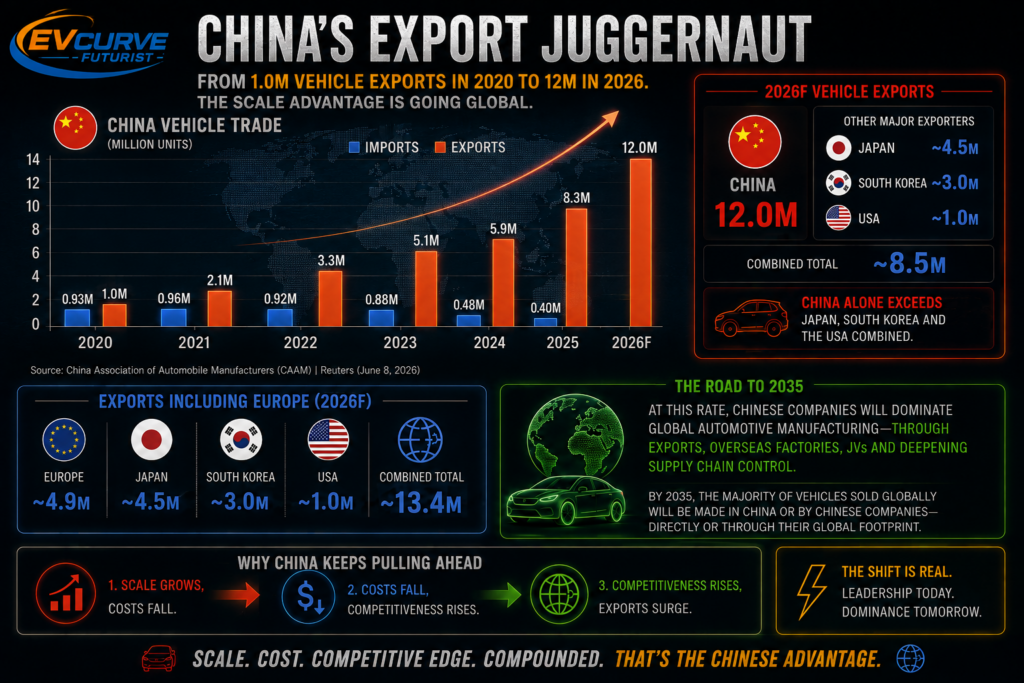
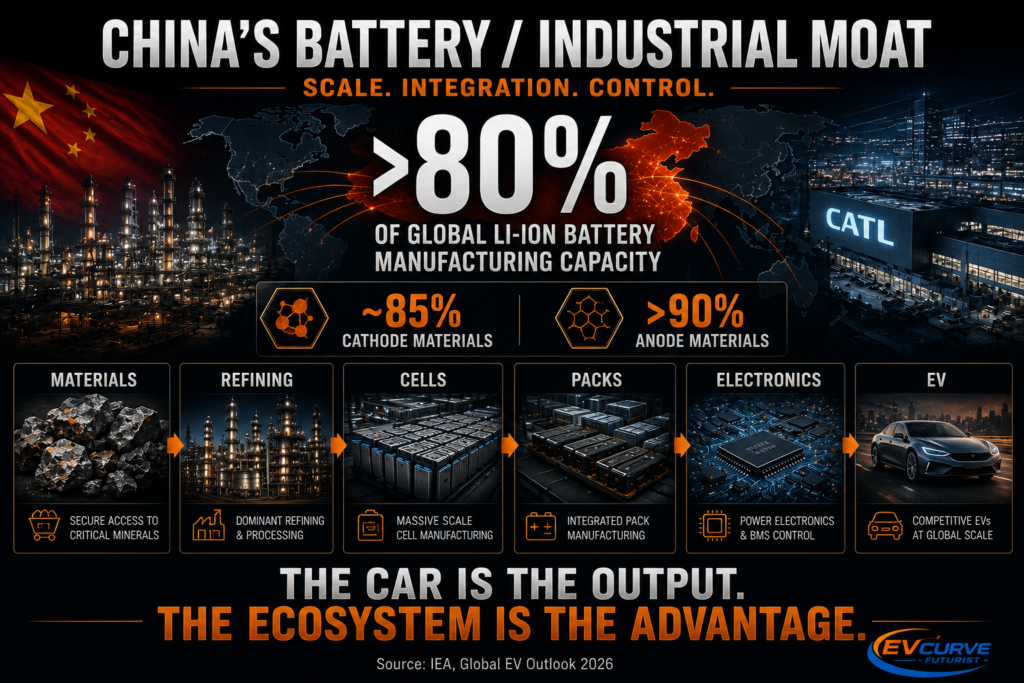
China’s advantage isn’t one magical battery chemistry or clever manufacturing technique. It’s an ecosystem: battery cells, cathodes, anodes, refining, electronics, motors, power semiconductors, software, automation, tooling and enormous supplier density increasingly sitting within the same industrial network.
And critically, you can’t copy a vehicle architecture without copying the supply chain behind it.
China’s position across lithium conversion, graphite processing, cathode and anode materials, cells and other parts of the battery chain creates an industrial advantage that Western manufacturers can’t solve simply by designing a cheaper EV. Even if Ford could reproduce the engineering of a Chinese EV tomorrow, it would still need competitive access to the materials, processing capacity and battery cells required to manufacture millions of them.
And here’s one number that puts the scale of the problem into perspective: China already accounts for more than 80% of global lithium-ion battery manufacturing capacity. It also produces around 85% of the world’s cathode active materials and more than 90% of its anode active materials.
This isn’t some advantage China might develop by 2030. It already exists.
There’s another problem: time.
You can redesign a vehicle in a few years. You can’t recreate an entire industrial ecosystem on the same timetable. Mines, lithium conversion facilities, cathode and anode plants, battery factories, power semiconductor capacity and the supplier networks surrounding them take years to permit, finance, construct, commission and optimise.
And building the factory isn’t the end of it. The IEA estimates that for many battery manufacturing facilities it can take more than five years after operations begin to reach production levels close to nominal output.
China isn’t waiting while the West builds these things. Its ecosystem is already operating and still expanding.
That’s what makes the arithmetic so brutal. Even if Ford, Volkswagen and Toyota made every strategic decision correctly tomorrow, they’d still be racing against competitors operating inside a supply chain that has already been built, scaled and subjected to years of manufacturing learning.
Western governments can throw hundreds of billions of dollars at rebuilding that capacity, and increasingly they are. Capital helps. But money can accelerate industrial development; it can’t eliminate time.
And every year the West spends building the ecosystem it needs to compete, China’s existing ecosystem gets another year to improve.
This isn’t simply an automotive race anymore. It’s an industrial-system race.
Then add China’s extraordinary domestic scale and throw hundreds of manufacturers into that ecosystem and make them fight. Prices fall. Development cycles compress. Suppliers improve. Weak companies disappear. Strong companies scale.
State-enabled. Market-selected.
Western manufacturers now have to compete against the survivors of that process.
So I’d tear apart every vehicle architecture looking for unnecessary complexity: fewer platforms, fewer parts, fewer variants, more structural integration, greater use of common electronics, software architectures designed from scratch rather than accumulated over decades, and battery packs designed as fundamental structural and economic components of the vehicle.
And I’d benchmark against China relentlessly. Not Mercedes against BMW. Not Ford against GM. Ford against BYD. Volkswagen against Geely. Toyota against whoever is moving fastest this year. Because that’s increasingly where the benchmark is being set.
Swallow Your Pride, Within Geopolitical Reality
Here’s another uncomfortable reality: legacy manufacturers need to learn from Chinese technology wherever they legally and strategically can.
License it. Partner with it. Joint venture with it. Tear it apart and understand it. Whatever works.
But this is becoming much harder than it sounds. The geopolitical environment has changed dramatically. Tariffs, national-security restrictions, local-content requirements, technology controls and growing political hostility toward Chinese industrial dependence mean that simply saying “buy Chinese technology” is no longer realistic in every market.
In some cases, Western manufacturers may have to do something considerably more expensive: learn from Chinese technology while simultaneously rebuilding an independent or allied supply chain capable of reproducing its economics.
That makes the challenge harder, not easier.
Western companies spent decades transferring manufacturing expertise into China because Chinese manufacturers had something to learn. That relationship is increasingly reversing just as geopolitical barriers are making technology transfer more difficult.
There’s no shame in learning from your competitor. The shame would be allowing corporate pride to destroy a century-old company. If a Chinese battery architecture saves thousands of dollars per vehicle, understand why. If a Chinese electrical architecture eliminates kilometres of wiring, study it. If a Chinese company can develop a vehicle in half the time yours takes, understand exactly how. If someone else’s software stack is better than yours, stop pretending otherwise.
The objective isn’t preserving engineering pride. It’s survival.
Fix the Software Problem
This may be even harder than electrification.
Traditional automotive companies are extraordinarily good at mechanical engineering. They spent a century perfecting engines, transmissions, suspension, safety and manufacturing. Software developed differently.
But software isn’t just an architecture problem. It’s a talent problem.
Ford, Toyota and Volkswagen aren’t merely competing with each other for engineers anymore. They’re competing with Tesla, Silicon Valley, AI companies and an enormous Chinese technology and automotive ecosystem for exactly the people they need to reinvent themselves.
That’s a very different labour market from the one legacy auto was built around. The best mechanical engineer in the world can’t replace a world-class team building operating systems, AI, autonomous driving, vehicle software and high-performance computing architectures.
And talent tends to follow momentum. Engineers want to work where decisions happen quickly, ambitious products actually ship and their work matters. A company can announce that it’s becoming a software company. Convincing thousands of exceptional software engineers that it really is one is much harder.
This is another advantage the disruptors possess that doesn’t appear on a vehicle specification sheet: they aren’t just building different cars. They’re attracting a different kind of workforce to build them.
A modern EV increasingly resembles a distributed computing system with wheels attached. Software controls battery management, thermal systems, infotainment, driver assistance, charging and power delivery, and increasingly the relationship between the vehicle and the outside world.
Then comes AI. Then autonomy. Eventually robotics.
This is why I keep saying an EV isn’t simply a car with a battery. Calling it that is like calling an iPhone a telephone with a screen.
When automobiles first appeared, people called them horseless carriages because humans naturally understand new technology through the thing it replaces. But the automobile didn’t remain a carriage without a horse. It reorganised cities, energy, manufacturing, logistics and human mobility.
I believe we’re making the same conceptual mistake again. The EV is becoming a battery-powered computing platform, and that changes who your competitors are.
Break the Five-Year Development Cycle
This one may be existential. China’s automotive development speed has become extraordinary. Models are refreshed rapidly. Electronics evolve continuously. Software changes after the vehicle leaves the factory. Battery technology can change during a product generation.
Meanwhile, some legacy manufacturers are still operating development structures created for an era when a vehicle platform could remain fundamentally unchanged for many years. That can’t continue.
You cannot compete in a technological industry when your competitor experiences several learning cycles during one of yours.
The organisation itself has to accelerate: fewer committees, fewer layers of approval, more simulation, greater digital development, closer supplier integration and acceptance that occasionally moving faster means getting things wrong.
China’s automotive ecosystem is brutally Darwinian partly because failure is allowed to happen quickly. That’s uncomfortable. It’s also how evolution works.
The Dealer Fortress
Then there’s the dealer problem, particularly in the United States, and I’ve probably understated how difficult this is.
The dealership system isn’t simply an outdated business model manufacturers can decide to replace. In many US states it’s protected by powerful franchise laws, dealer associations and decades of political influence. Tesla’s long battles over direct sales demonstrated just how difficult that structure can be to challenge.
That makes dealerships something closer to a legal and financial fortress embedded inside the incumbent automotive system.
The economics are problematic too. The traditional dealer model doesn’t end when the vehicle leaves the showroom. Servicing and parts are major components of dealer economics: oil changes, filters, spark plugs, exhaust systems, transmissions, cooling systems and scheduled maintenance.
EVs eliminate enormous amounts of that mechanical complexity. That’s fantastic for consumers and potentially disastrous for a business model partly dependent on maintaining complexity.
So legacy manufacturers aren’t simply being asked to redesign the automobile. They’re being asked to redesign the economic relationship between manufacturer, dealer and customer, while many of the organisations that would lose from that transition possess legal protections specifically designed to prevent manufacturers bypassing them.
Factories may actually be easier to rebuild.
They Have to Cannibalise Themselves
Steve Jobs understood something incredibly important: if somebody is going to destroy your existing product, it might as well be you.
Legacy auto has spent too long worrying that EVs will cannibalise profitable combustion sales. Of course they will. That’s the point.
The alternative is allowing BYD, Geely, Xiaomi, XPeng and dozens of others to cannibalise them instead.
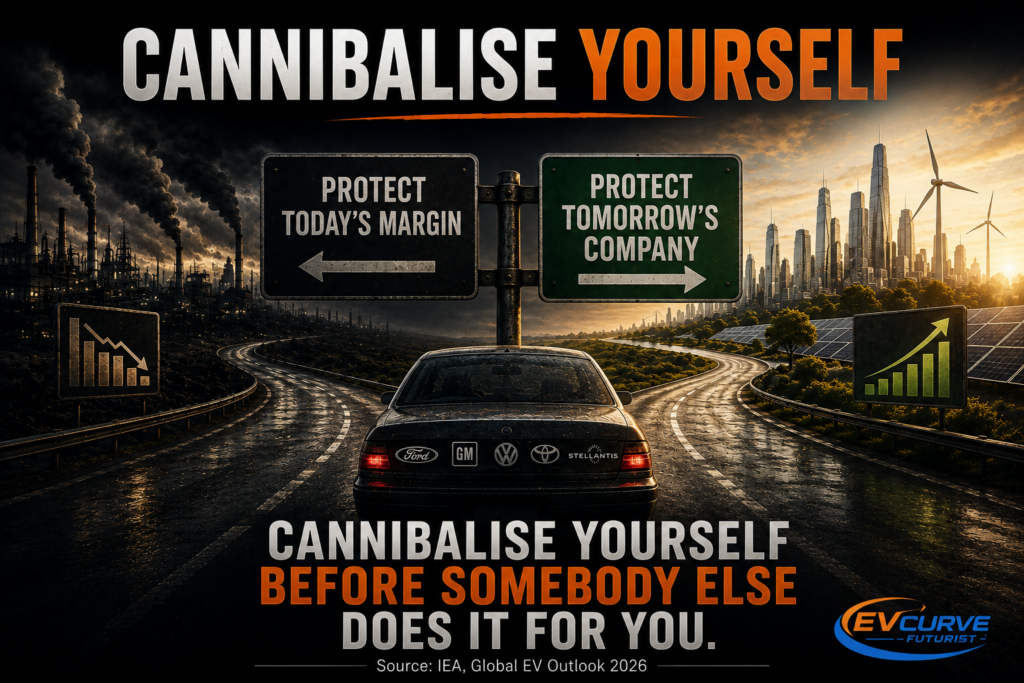
Every company facing technological disruption eventually reaches this decision: protect yesterday’s margin or protect tomorrow’s company.
You rarely get to do both.
Why I Don’t Think They’ll Do It
This is where my optimism runs out.
Everything I’ve described is technically possible. None of it requires science fiction. The batteries exist. The manufacturing techniques exist. The software exists. The capital exists. The engineering talent certainly exists.
What’s missing is organisational permission to destroy enormous amounts of existing economic value.
Imagine being the CEO who tells shareholders: we’re going to accelerate the decline of our most profitable products, write down factories, pressure suppliers, fight entrenched dealer interests, spend tens of billions rebuilding our technological architecture and potentially license technology from companies we once considered inferior competitors. Our margins may fall. Our earnings may fall. And we’re doing all of this because the alternative might destroy us ten years from now.
Now imagine making that argument while your ICE division is still producing billions in profit.
That’s why disruption is so powerful. The incumbent isn’t usually stupid. It’s trapped.
Every individual decision to protect today’s business makes sense. Collectively, those decisions can destroy tomorrow’s company.
But there’s another problem: the cost of delay compounds.
As incumbents continue to stall, play blame games and shelter behind the temporary buffer of Western protectionism, the Chinese juggernaut doesn’t stand still. It keeps moving. Every year brings another generation of batteries, power electronics, software, manufacturing automation and vehicle architectures, produced inside the brutally competitive industrial ecosystem I described earlier.
Tesla is perhaps the clearest warning of how quickly this can happen. Five years ago, it was the undisputed technological benchmark for the EV industry, and to many the gap looked almost unassailable. Tesla remains years ahead of most Western legacy manufacturers in several important areas, but by 2026 the picture in China looks very different. Chinese manufacturers now compete at the frontier across batteries, charging, vehicle electronics, software-defined architectures, manufacturing speed and cost.
The brutal reality in China today is that consumers looking for the latest technology, cutting-edge features and premium EV experiences are increasingly turning to domestic brands like Xiaomi, XPeng, Zeekr and BYD. These are no longer companies simply chasing Tesla or Western premium brands. In many areas, they’re now setting the benchmark themselves.
Even Tesla’s remaining standout advantages, particularly efficiency and autonomous driving, are being pursued aggressively. And that should be a warning to every incumbent: if the technological leader of the EV revolution could see its lead eroded this quickly, imagine what another five years of hesitation could do to companies already starting from behind.
That’s what legacy auto is really racing against. Not where China is today, but where China will be by the time they finally decide to move.
Protectionism may buy Western automakers time in their home markets. It cannot stop the technological gap from widening behind the tariff wall.
And the longer they use that protection to postpone the hard decisions rather than accelerate them, the more brutal the eventual reckoning becomes.
Who Has the Best Chance?
I don’t think all legacy manufacturers are equally doomed, and the survivors won’t all survive for the same reason.
Toyota may have the strongest manufacturing culture of the group. Its obsession with continuous improvement, supplier integration, reliability and production efficiency could become an enormous advantage if it genuinely commits to the new architecture. Toyota doesn’t need to learn how to manufacture efficiently. It needs to apply one of the greatest manufacturing systems ever created to a fundamentally different technological platform.
That’s what makes Toyota such a fascinating test. Its greatest strengths could either save it or become the reason it changes too slowly. The question isn’t whether Toyota can build an excellent EV. Of course it can. The question is whether Toyota can move quickly enough when doing so threatens an extraordinarily successful existing business.
Volkswagen has extraordinary scale, deep engineering capability and the strategic weight of Europe’s largest automotive economy behind it. It has also experienced the Chinese disruption firsthand. China was once an extraordinary source of profits for Volkswagen. Now it’s becoming one of the clearest demonstrations of what happens when the competitive architecture changes underneath an incumbent.
Ford has something different: a huge and relatively protected North American profit pool, particularly in trucks and commercial vehicles. That buys it time and cash flow. But that’s a double-edged sword. Those profits could finance Ford’s transition, or become another reason to delay it. That’s basically the Innovator’s Dilemma this entire essay is about.
GM and Stellantis have their own possible paths. Some brands may disappear, merge or retreat into protected regional niches. Others may survive as much smaller companies than they are today.
I don’t expect one dramatic Kodak moment where legacy auto suddenly disappears. The more likely outcome is a decade-long sorting process between companies willing to cannibalise themselves and companies that wait until the market does it for them.
The Window Is Still Open
I don’t think the outcome is predetermined. Western legacy auto still has extraordinary assets. Hundreds of millions of people trust these brands. They understand safety, manufacturing, financing, regulation and global distribution at enormous scale.
China has challenges too. Trade barriers are rising. Geopolitics matters. Local manufacturing requirements matter. Brand recognition outside China takes time. And plenty of Chinese manufacturers won’t survive their own domestic bloodbath.
Legacy manufacturers still have cards to play. But the window is closing.
And when I say closing, I don’t mean that rhetorically. At the end of 2025, China already accounted for more than 80% of global lithium-ion battery manufacturing capacity. Under the IEA’s stated-policies outlook, China is still expected to supply roughly two-thirds of global batteries in 2035, alongside around three-quarters of cathode active materials and nearly 90% of anode active materials.
That’s after another decade of Western attempts to diversify the supply chain.
Every year China produces more batteries, EVs, power electronics and software-defined vehicles, its ecosystem accumulates another year of learning. Every vehicle produced generates manufacturing knowledge. Every battery deployed improves supply chains. Every price war forces another round of cost reduction. Every failed Chinese manufacturer releases engineers and knowledge back into the ecosystem.
That’s what makes this so difficult to reverse.
Scale creates learning. Learning lowers cost. Lower cost creates more scale.
That’s the flywheel legacy auto is now racing against.
The Last Exit
So what would I do? I’d make the destination explicit: PHEV and BEV from the next generation of platforms forward.
I’d use PHEVs aggressively where consumers genuinely need the bridge, but stop pretending the bridge is the destination. I’d stop investing enormous amounts of capital extending ICE architectures deep into the next decade. I’d collapse the number of platforms, redesign vehicles around batteries rather than fitting batteries into vehicles designed around engines, treat software as core engineering, fight for the engineering talent required to build that software, cut development cycles brutally, secure battery materials and processing capacity, partner with Chinese companies wherever geopolitics allows it, rebuild allied supply chains where it doesn’t, benchmark against the fastest competitors on Earth and accept lower margins today to buy relevance tomorrow.
And I’d start immediately, because rebuilding industrial capacity takes years and the competitors I’m chasing aren’t standing still.
Most importantly: I’d cannibalise myself before somebody else does it for me.
Could Ford do this? Yes. Could Volkswagen? Absolutely. Toyota? Probably better than almost anyone if it genuinely committed.
That’s why I don’t think the story is necessarily over. But knowing what needs to be done and actually doing it are very different things.
Twenty years ago, Western companies possessed much of the knowledge and China wanted to learn. Today, Chinese manufacturers increasingly possess technologies, supply chains, cost structures and development speeds the West is trying to understand.
The teachers are becoming the students.
Legacy auto still has an exit, but it’s approaching quickly, and taking it requires abandoning much of the road that brought them here.
Some will survive. Perhaps even thrive. But I suspect the companies that do will look very different by 2035 from the companies we know today.
The Western automotive industrial structure we’ve known for the last century?
That era is ending.
Further Reading & Sources
My related writing
- The Industrial System of the 21st Century
- Global Auto Sales: The Compression Phase
- The Electric Vehicle: Tip of the Spear
- 2028 Is the Year ICE Dies in China
- The Great Electric BEV Reordering of 2025
- Global Auto Sales: When Compression Hits the P&L
- 25 Reasons EVs Are Better Than ICE Cars
- When the Innovators Enter the New Order
- Electric Darwinism: Evolution of Mobility
- Flogging a Dead Horse, ICE Doom
Key external sources
- IEA, Global EV Outlook 2026 — EVs, batteries and supply chains
- Dunne Insights — China auto industry, manufacturing and legacy disruption
- ICCT — Global EV market and vehicle sales data
- CAAM — Chinese vehicle production and export data