
Updated 14 November 2026: Clarified vehicle and electricity-access estimates, and added source links.
With billions spent on imported fuel, abundant renewable electricity and much of its future vehicle fleet still unbuilt, Ethiopia has an opportunity to grow directly into electric transport.
The International Energy Agency’s (IEA) 2026 Electrification report says Ethiopia’s fuel imports have exceeded US$4 billion annually in recent years. That recurring expense is comparable in scale to the roughly US$5 billion estimated construction cost of the Grand Ethiopian Renaissance Dam.
Hydropower generates more than 95% of Ethiopia’s electricity, according to the same IEA report. That gives electric transport a powerful domestic energy source.
The Ethiopian Energy Outlook 2025 reports about 1.4 million vehicles in 2022. The UN population estimate was about 135 million in 2025. The figures use different years, so their ratio is illustrative rather than a current ownership rate.
Those three numbers explain one of the most interesting energy transitions happening anywhere in the developing world.
When I first wrote about Ethiopia’s electric vehicle (EV) transition in June 2025, in The Electric Underdog: Ethiopia’s Awesome Race to the Future, I focused on the internal-combustion engine (ICE) import restrictions, the arrival of Chinese EVs and Ethiopia’s ability to leapfrog much of the petrol-car era.
A year later, the bigger story is clear.
This isn’t primarily an EV story. It’s an energy-sovereignty story.
In January 2024, Ethiopia made history. It became the first country to effectively halt imports of petrol and diesel vehicles, rather than merely announce a future phase-out date. The policy used restrictions on foreign-currency allocations and other import barriers, with limited exemptions. It did not require existing combustion vehicles to disappear from Ethiopia’s roads. IEA policy record; Ethiopian Energy Outlook 2025.
Why? Ethiopia’s enormous petroleum-import bill was consuming scarce foreign currency, exposing the country to global fuel-price shocks. At the same time, its hydropower resources made domestically generated electricity a strategic alternative. With much of its future vehicle fleet still unbuilt, Ethiopia could choose a different development path. The significance goes beyond one nation’s EV market: this is an early, real-world attempt to skip the oil-dependent stage of mass motorisation. That ambition comes with serious challenges in affordability, charging, grid reliability and vehicle servicing. JICA research.
In its 9 May 2026 report, the Associated Press put more than 115,000 EVs on Ethiopia’s roads, accounting for about 8% of the national vehicle fleet. That is a dated fleet estimate, rather than a share of new-car sales. The IEA’s 2026 report describes its roughly 115,000 EV estimate as mostly two- and three-wheelers. Sources may count vehicle types differently.
Oil is something Ethiopia has to buy. Electricity is something Ethiopia can make.
And Ethiopia is connecting the second directly to transport.
For a look at this transition on the ground, watch this 15-minute documentary on Ethiopia’s electric-vehicle transition. For the wider global picture, my Transportation: The First Sector to Flip analysis explores battery economics, passenger-car adoption scenarios, fleet turnover and illustrative oil displacement to 2035.
The cost of imported fuel
Ethiopia’s dependence on imported petroleum is economically brutal.
For a dated baseline, National Bank of Ethiopia figures cited by the World Resources Institute put fuel imports at around US$3.6 billion in 2024, roughly 20% of goods imports and about 95% of merchandise-export foreign-exchange earnings. Those figures describe 2024, while the IEA’s 2026 report refers more broadly to annual bills above US$4 billion in recent years.
Think about that.
A country exporting coffee, flowers, sesame and other goods to earn scarce foreign currency was spending almost the equivalent value of its entire merchandise exports importing fuel.
Because Ethiopia is landlocked, that petroleum must also travel through international supply chains and transport corridors before reaching consumers.
Recent turmoil around the Strait of Hormuz has made that vulnerability even harder to ignore. Ethiopia has no control over conflicts thousands of kilometres away, yet disruptions to global oil flows can drive up fuel prices and put even greater pressure on scarce foreign currency.
An EV powered by Ethiopian electricity doesn’t care what’s happening in the Strait of Hormuz.
That’s energy sovereignty in its simplest form.
Fuel subsidies added another burden. The IMF reported that reforms from December 2021 to July 2024 eliminated off-budget fiscal costs equivalent to roughly 1% of gross domestic product (GDP); some transitional support followed.
Every litre is part of a recurring transaction:
Earn foreign currency → import petroleum → burn it → repeat.
Electrification breaks that cycle.
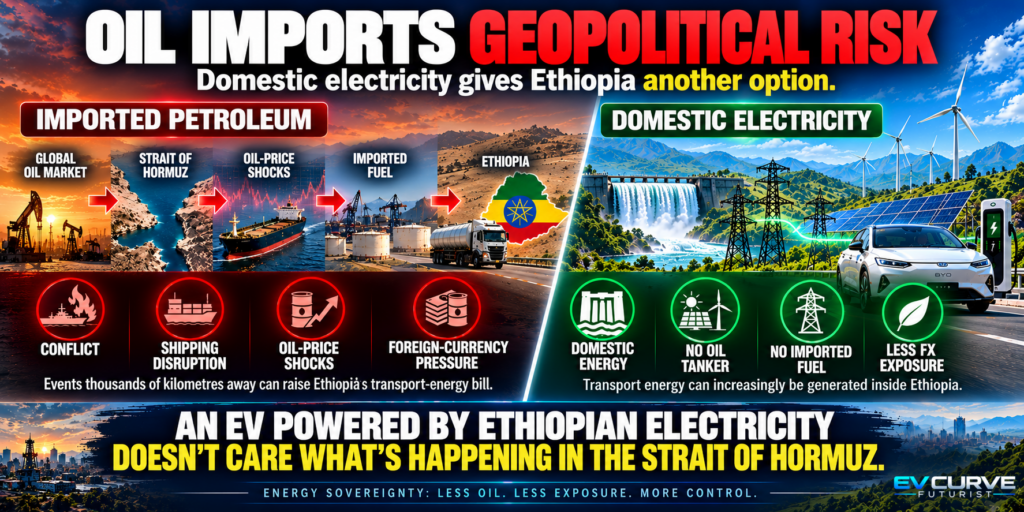
ENERGY SECURITY: Imported petroleum exposes Ethiopia to global oil-price shocks and geopolitical events far beyond its borders. Electrification increasingly allows transport energy to be generated at home, reducing both petroleum dependence and foreign-exchange exposure.
From river to road
More than 95% of Ethiopia’s installed electricity generation capacity is renewable, predominantly hydro. The National Energy Compact reports around 9.76 gigawatts (GW) of installed capacity in 2025, with the 5.15 GW Grand Ethiopian Renaissance Dam, or GERD, at the centre of that expansion.
The Nile Basin Initiative’s GERD project record puts the dam’s estimated construction cost at approximately US$5 billion. It was inaugurated in September 2025 and is Africa’s largest hydroelectric dam.
One is a recurring expense. The other is an investment in the country’s future. Fuel must be bought and burned repeatedly. A hydroelectric asset can generate useful electricity for decades.
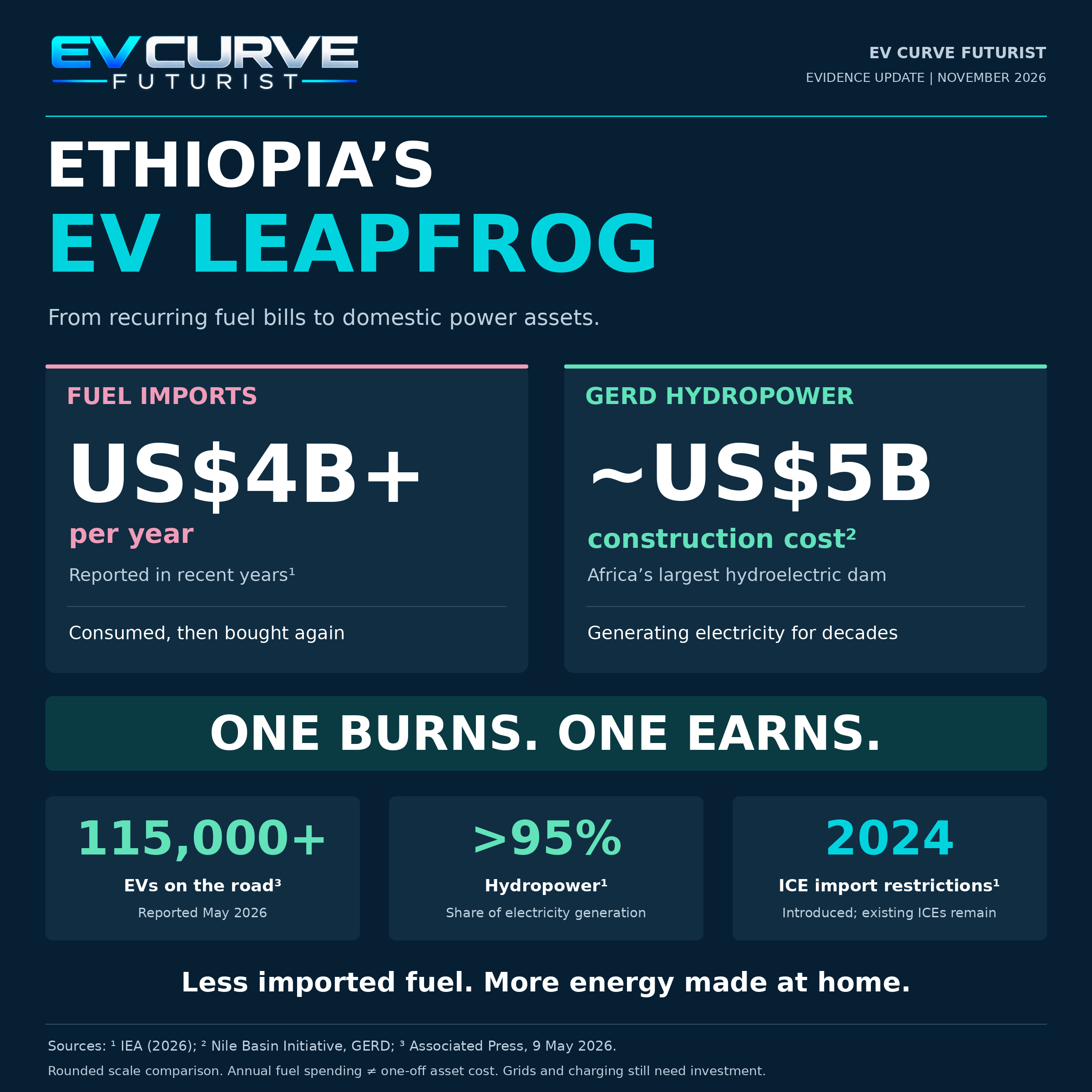
The opportunity is to connect that domestic generation to growing transport demand. Charging, reliable networks, affordable vehicles and servicing still need investment. The dam is one part of that wider system.
The contrast is extraordinary.
Petroleum:
Oil extracted overseas → bought with foreign currency → shipped → transported → distributed → burned once.
Then Ethiopia buys some more.
Electricity:
Rain → river → turbine → electricity → battery → motor → kilometres.
The river doesn’t send Ethiopia an oil bill.
Electrification doesn’t eliminate Ethiopia’s need for foreign currency. EVs, batteries, chargers, spare parts and grid equipment still need to be imported.
But it fundamentally changes what Ethiopia imports.
Instead of continually buying an energy source that disappears when burned, Ethiopia can buy capital assets that operate for years on domestically generated energy.
That’s a profound economic shift from recurring overseas energy expenditure towards vehicles and infrastructure powered at home.
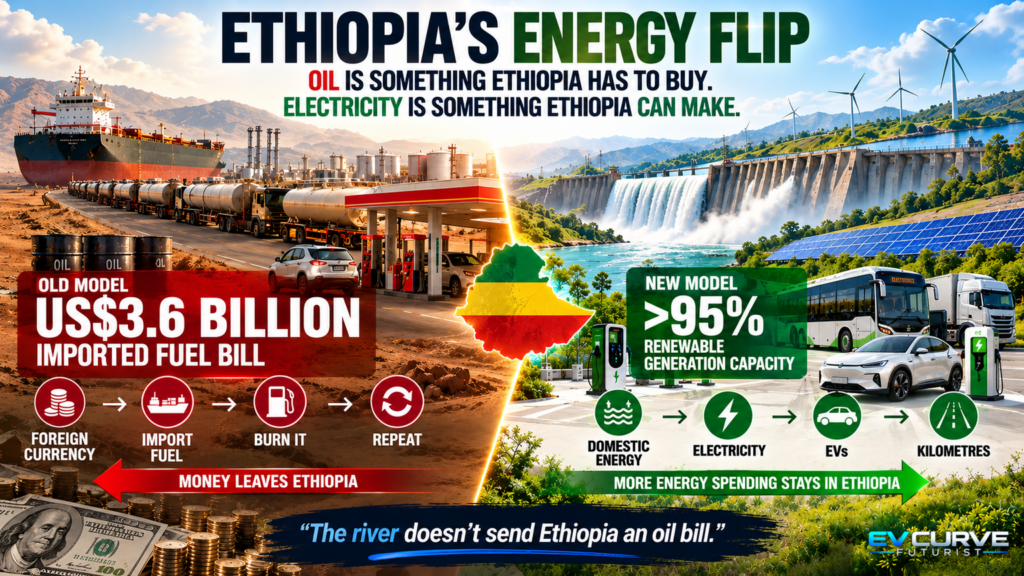
ETHIOPIA’S ENERGY FLIP: Imported petroleum creates a recurring flow of foreign currency out of Ethiopia. Electrification allows transport to be powered increasingly by renewable energy produced at home.
The prize isn’t merely cleaner cars.
It’s reducing a recurring foreign-energy bill.
How China changed the equation
Twenty years ago, this pathway barely existed.
Then China changed the economics of electric vehicles.
Chinese manufacturers have pushed EV production to enormous scale while driving down battery and vehicle costs across everything from tiny city cars to buses and heavy trucks.
According to Associated Press reporting based on Chinese trade data, Africa imported 44,358 EVs from China during 2025, more than double the previous year, with Ethiopia accounting for roughly one-third.
Brands including BYD, Changan and Neta are already present in Ethiopia. Illustrative local listings have included the Changan Lumin around 2 million Ethiopian birr (ETB) and BYD Seagull around ETB 2.5–3.3 million.
Those aren’t cheap cars to most Ethiopian households. Prices vary by seller and change over time, while affordability remains a major constraint.
But the structural change is bigger.
China has dramatically lowered the economic threshold at which transport electrification becomes possible.
For an oil-importing developing country:
Lower-cost EVs + expensive imported oil + domestic renewable electricity = an overwhelming incentive to electrify.
Skipping a step
Perhaps the most important number in this story isn’t 115,000 EVs.
It’s the 1.4 million vehicles reported for 2022.
That older fleet count and the 2025 population estimate point to low motorisation, but they cover different years and should not be presented as a current one-vehicle-per-96-people figure.
For context, the US Federal Highway Administration reports around 298 million registered vehicles and 339 million residents in 2024, or about one vehicle for every 1.1 people. Categories and reporting years differ from Ethiopia’s estimate.
Most of the transport fleet Ethiopia will eventually need hasn’t been bought yet.
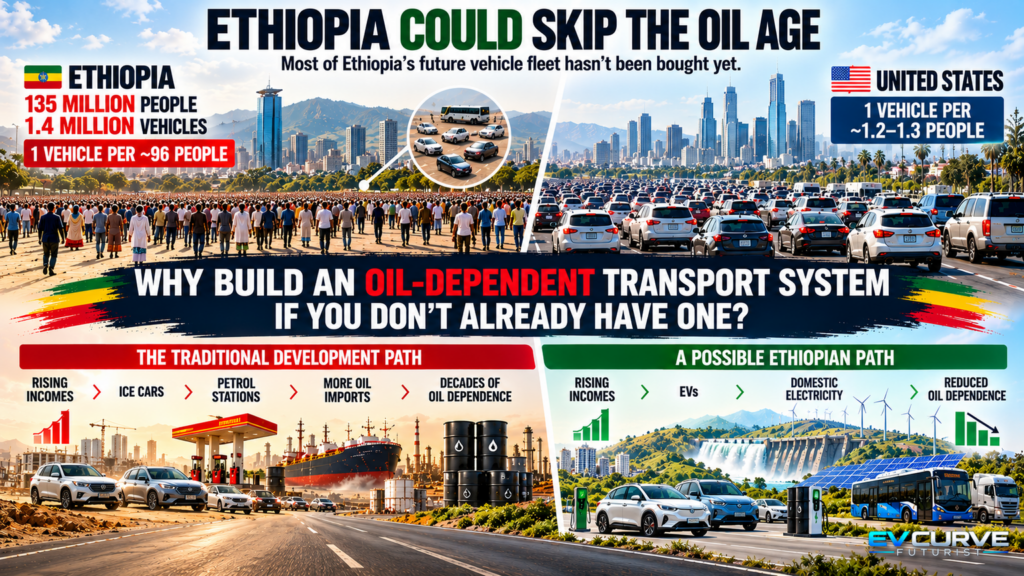
THE LEAPFROG: Much of Ethiopia’s future transport system is still to be built, allowing it to skip much of the petroleum-dependent development pathway.
Wealthy countries spent more than a century building enormous petroleum ecosystems: combustion vehicles, refineries, pipelines, fuel terminals, petrol stations and supply chains.
Now they have to replace them.
Ethiopia doesn’t.
Ethiopia is electrifying before mass motorisation.
Much of Africa never reproduced the vast fixed-line telephone networks wealthy countries spent generations constructing. Mobile phones arrived and hundreds of millions of people jumped straight to wireless communications.
Transport is beginning the same leap.
The old pathway:
Rising incomes → mass car ownership → rising oil consumption → more fuel infrastructure → decades of petroleum dependence.
Ethiopia’s pathway:
Rising incomes → growing vehicle ownership → electric transport → domestic electricity.
Ethiopia isn’t converting a mature fleet of tens of millions of combustion vehicles.
It is building much of its future fleet electric from the beginning.
The biggest disruption isn’t replacing an enormous combustion fleet.
It’s never building one.
The transition is underway
The existing combustion fleet won’t disappear overnight. Petrol and diesel vehicles will remain on Ethiopian roads well into the 2030s.
But every new EV entering the fleet instead of a combustion vehicle is one less machine requiring imported fuel for perhaps the next 15 or 20 years.
And the biggest oil displacement may come from taxis, buses, vans and trucks.
Commercial vehicles can travel several times farther annually than private cars, meaning one heavily utilised electric taxi, bus or truck can displace far more petroleum.
More than 100 electric buses were operating in Addis Ababa by early 2026, with electric buses introduced in nine Ethiopian cities, according to Addis Media Network.
The metric worth watching isn’t simply how many EVs Ethiopia has.
It’s how much imported oil they eliminate.
Building the infrastructure
Ethiopia’s 2025–2030 E-Mobility Strategy targets 2,230 charging centres by 2030, including 1,176 in Addis Ababa and 1,054 elsewhere.
In June 2026, officials reported around 200 completed charging stations in the capital, more than 40 additional stations planned nationally and 16 being designed along the Ethiopia-Djibouti corridor. The IEA’s 2026 Electrification report cited around 100 stations nationwide; reporting dates and definitions may differ.
The next stage is straightforward:
More EVs require more chargers. More chargers require stronger grids. Stronger grids require investment.
And Ethiopia is now building all three.
Beyond hydropower
Ethiopia’s electricity system is dominated by hydropower, bringing vulnerability to drought and rainfall variability.
But Ethiopia possesses far more than rivers.
A 2017 World Bank assessment cited around 45 GW of hydropower potential, 7 GW of geothermal resources and a theoretical wind resource of around 1,350 GW. The Ethiopian Investment Commission puts average solar irradiation at roughly 5.2 kilowatt-hours per square metre per day.
The wind figure is theoretical resource potential, not a build forecast. But even exploiting a fraction of Ethiopia’s renewable resources will dramatically expand its energy system.
The future mix becomes increasingly diverse:
Hydro + solar + wind + geothermal + storage.
Electricity also has another characteristic petroleum doesn’t. My Energy Transformation page explores how generation, grids and storage fit together.
Ethiopia can export it.
It already sells electricity to Kenya, Djibouti and Sudan, and has supplied Tanzania on a pilot basis. Regional interconnections can bring in foreign currency as they expand.
That’s a remarkable inversion:
Import petroleum and send foreign currency out. Export electricity and bring foreign currency in.
The challenge: the grid
The transition isn’t without major challenges.
EVs remain expensive relative to Ethiopian incomes. Charging infrastructure remains inadequate. Spare parts and trained technicians need to expand.
And Ethiopia still has an enormous electricity-access problem.
Electricity-access estimates vary. World Bank data put access at 56.6% in 2024, while the IEA’s 2026 review estimates about 35% for 2024. A preliminary 2025 World Bank survey found 44% had Tier 1 or better service, leaving around 71 million people without that level of access. These estimates use different sources and approaches and are not a simple time series.
The distinction is crucial:
Having enough electricity nationally isn’t the same thing as having enough grid capacity locally.
Nearly 10 GW of generation doesn’t automatically mean reliable electricity reaches homes, factories and charging stations.
Ethiopia needs transmission lines, substations, stronger distribution networks, storage and chargers.
Ethiopia’s National Energy Compact estimates that its power-sector targets require more than US$9.6 billion of investment by 2030, including around US$4.9 billion for distribution and electricity access.
GERD adds geopolitical complexity, having generated years of tension with downstream Egypt and Sudan over Nile water security and river flows.
Energy sovereignty doesn’t eliminate geopolitical risk. It changes which risks you’re exposed to.
But unlike imported petroleum, Ethiopia possesses the underlying energy resource itself.
The oil displacement test
Ethiopia’s leapfrog has begun.
Now the next three to five years will reveal its speed and scale.
EV adoption and charging networks could keep expanding. Electric buses, taxis, vans and trucks could take a growing share of kilometres travelled if affordability and infrastructure improve.
But one number matters more than all the others:
Petroleum consumption.
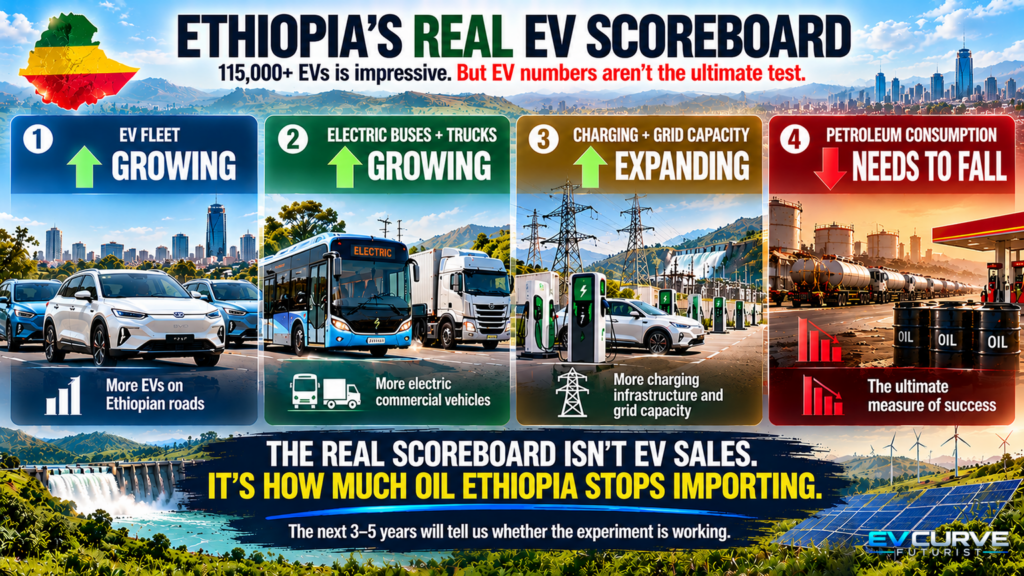
THE REAL SCOREBOARD: EV sales tell us how quickly the technology is spreading. Petroleum consumption tells us how successfully Ethiopia is replacing imported energy with domestic electricity.
Not EV sales.
Not headlines about import bans.
Not even the size of the electric fleet.
Petroleum displaced.
That means comparing actual fuel use with a credible no-EV baseline. Total petroleum consumption could still rise as the economy grows, even while EVs displace some of it.
As Ethiopia’s economy and vehicle fleet grow, an increasing share of those new kilometres could be powered by electricity rather than imported petroleum.
Its vehicle fleet can grow dramatically without oil demand following the trajectory experienced by today’s wealthy economies during their own motorisation.
And that has implications far beyond Ethiopia.
Beyond Ethiopia
Across Africa, Asia and Latin America are countries facing the same basic equation:
Large petroleum-import bills. Abundant renewable resources. Growing transport demand. Increasingly affordable EVs.
For decades, the assumed development pathway was:
More wealth → more cars → more oil → more petroleum infrastructure.
That relationship is breaking.
EVs separate transport from petroleum. Renewable electricity allows countries to produce transport energy domestically. China’s enormous EV and battery industry has driven down the cost of accessing that alternative.
Countries that haven’t yet built enormous combustion fleets don’t have to repeat the path followed by the United States, Europe, Japan or Australia.
They can skip it.
And the argument isn’t only climate change.
It’s economics, trade, energy security and national sovereignty.
A different development path
When I wrote about Ethiopia in 2025, I saw an unlikely EV underdog racing towards the future.
A year later, the much bigger story is visible.
Ethiopia is skipping the oil age.
It will still consume petroleum for years. Existing combustion vehicles won’t disappear overnight.
But the development pathway has changed.
Most of Ethiopia’s future vehicle fleet hasn’t been purchased yet, and increasingly it could be electric.
The energy powering that fleet won’t need to arrive continuously in tankers or be purchased endlessly with scarce foreign currency.
An increasing share could come from Ethiopia’s own rivers, sun, wind and geothermal resources.
Instead of:
Earn foreign currency → import fuel → burn it → repeat.
The pathway becomes:
Build renewable generation → build the grid → buy electric vehicles → power them domestically for years.
That’s the leapfrog.
And it leads to a remarkably simple question:
Why build an oil-dependent transport system if you don’t already have one?
The first EV revolution was about electric cars replacing combustion cars.
The next revolution is bigger: countries skipping the petroleum-dependent development stage altogether.
Ethiopia is already doing it.
For a system-wide assessment, the IEA’s October 2026 Ethiopia policy review covers electricity access, hydro dependence, investment and petroleum exposure.