

My wife is sick to death of hearing me talk about electric cars. A few of my friends probably are too. And I can’t really blame them. If you spend enough time around me, you’d be forgiven for thinking I’m some sort of lifelong car nut.
Nothing could be further from the truth. I’ve never been a car guy. For most of my life, cars have been utilitarian objects, four wheels, an engine and a means of getting from A to B. I’ve never particularly cared what was under the bonnet, never dreamed about owning a Ferrari and never spent my weekends lovingly polishing some mechanical pride and joy. Motorbikes were different. Those I had some affinity for. But I digress.
The strange thing is that I’ve probably talked more about cars over the past five years than I did during the previous five decades. More specifically, I’ve talked about electric cars. Constantly. Or, as my poor wife might describe it, to death.
But here’s the thing. I’m not really talking about cars. I’m talking about what they represent.
EVs are simply the most visible manifestation of something vastly bigger happening underneath the surface. They sit at the leading edge of the convergence of electrification, batteries, solar, artificial intelligence, robotics, autonomy, advanced manufacturing and increasingly intelligent machines.
Taken individually, each of these technologies is disruptive. Taken together, I believe they are beginning to form something far more consequential: a new industrial system capable of transforming how we produce energy, move people and goods, manufacture things and, increasingly, perform work itself.
The Industrial Revolution mechanised human labour. Electricity transformed how we powered civilisation. The automobile transformed transportation. Computing transformed information. What we’re watching now increasingly brings elements of all of them together.
Energy is being electrified. Machines are becoming intelligent. Transportation is becoming autonomous. Factories are becoming automated. And technologies that once developed largely independently are beginning to accelerate one another through falling costs, increasing scale and rapidly improving capability.
I believe the convergence now underway has the potential to become one of the largest economic and technological disruptions in human history.
And the electric vehicle is where much of it first became visible to ordinary people. It’s something you can see on the road, experience from the driver’s seat and park in your driveway.
The EV is the tip. Everything behind it is the spear.
The Revolution You Can Park in Your Driveway
Think about everything contained inside a modern electric vehicle: batteries, power electronics, semiconductors, software, artificial intelligence, autonomous driving, advanced manufacturing, robotics, renewable electricity, distributed energy and critical minerals. Behind almost all of them are learning curves.
As production scales, costs fall. As costs fall, demand increases. Factories get bigger, supply chains mature, technology improves and competition intensifies. Costs fall again. Round and round the flywheel goes. That’s what fascinates me. The car is almost incidental.
That’s not to say the cars themselves don’t matter. Part of the reason EVs have become such an effective tip of the spear is that they’re increasingly bloody good cars. They’re quiet, smooth, brutally responsive and mechanically simple. Instant torque is something you understand approximately three seconds after pressing the accelerator. You don’t need a lecture about battery economics to appreciate it.
In fact, there’s a certain irony in all this. After spending most of my life not particularly caring about cars, electrification has finally made them interesting to me.
An EV is one of the first mass-market physical products where ordinary consumers can experience this convergence of technologies for themselves. You don’t need to understand battery chemistry or experience curves to notice that the car you can buy today goes further, charges faster and offers more technology for your dollar than the one sitting in the showroom five years ago. You don’t need to understand energy economics to plug your car into rooftop solar and realise you’re effectively producing some of your own transport fuel. And you don’t need to study industrial history to recognise something profound is happening when a battery-powered vehicle becomes cheaper to own and operate than the combustion technology that dominated the previous century.
Follow the Spear Backwards
But if EVs are the tip, follow the spear backwards and things become much more interesting. Behind the EV revolution sits the battery revolution. Behind batteries sits an enormous expansion of mining, refining, chemistry and manufacturing. Alongside batteries sits the extraordinary scaling of solar and wind.
Then add AI, robotics and autonomy. Add increasingly automated factories, mines, ports, warehouses, farms, trucks and energy systems. These aren’t isolated technologies developing independently. Their learning curves are beginning to collide and reinforce one another.
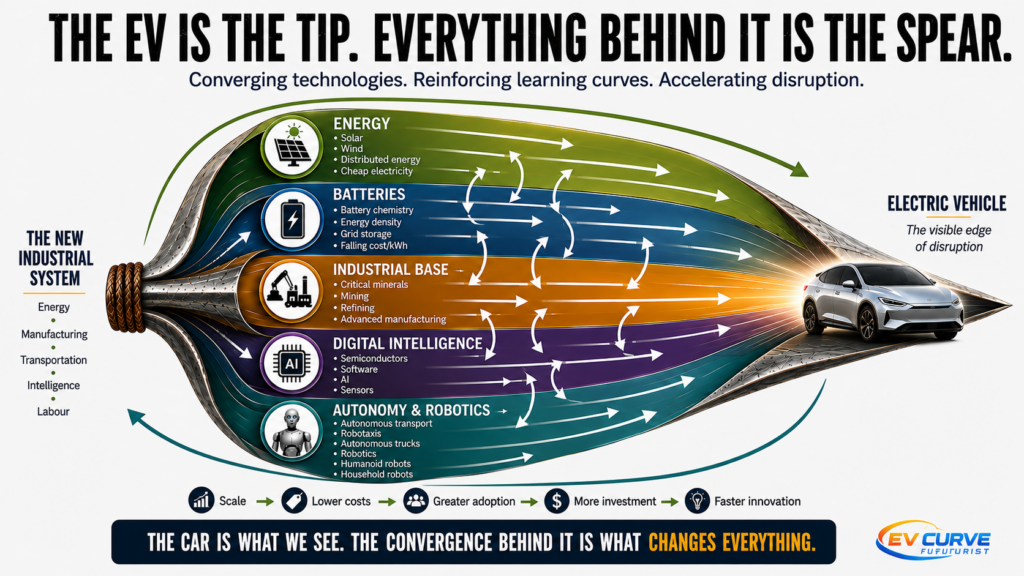
Cheaper batteries don’t just make EVs cheaper, they make grid storage and mobile robots cheaper. Cheaper storage makes renewable electricity more useful. Cheaper electricity makes electrification more attractive. Electrification creates more demand for batteries, semiconductors and power electronics. AI gives vehicles and robots increasingly sophisticated perception and reasoning. Robotics makes factories more productive, while those factories in turn manufacture cheaper robots, batteries, vehicles and electronics.
The individual curves begin pushing on one another. The tip of the spear is what everyone sees. The enormous industrial system behind it is what gives it momentum. When multiple rapidly improving technologies converge, disruption can move much faster than our linear intuition expects.
None of this means the transition will be smooth, clean or inevitable. Scaling these technologies requires enormous quantities of minerals, new mines, transmission, charging infrastructure and factories. Supply chains are concentrated, grids need upgrading, permitting can take years and incumbents controlling trillions of dollars of existing assets aren’t going to quietly step aside. Every industrial revolution creates bottlenecks, environmental costs, political resistance and unintended consequences. This one will be no different.
Individual technologies will fail. Companies will disappear. Countries will make terrible policy decisions. Supply shortages will emerge, prices will spike and adoption curves will periodically disappoint everyone trying to draw a neat exponential line through them. The direction of travel can be clear without the path being predictable. What matters is that the underlying economic pressures don’t disappear because the journey gets messy.
The Cost Curves Are the Story
This is where the numbers start becoming almost ridiculous. Lithium-ion battery pack prices have fallen from more than US$1,100 per kilowatt-hour in 2010 to just US$108 in 2025, a decline of more than 90%. At the same time, energy density has improved, manufacturing scale has exploded and new chemistries have moved from laboratories into mass production.
Solar has travelled a remarkably similar path. The global weighted-average cost of electricity from utility-scale solar PV fell from around US$417 per megawatt-hour in 2010 to just US$44 per megawatt-hour in 2025, a decline of roughly 90%. What was once one of the world’s most expensive ways to generate electricity has become one of the cheapest sources of new electricity across much of the planet. Now batteries are increasingly being attached to it.
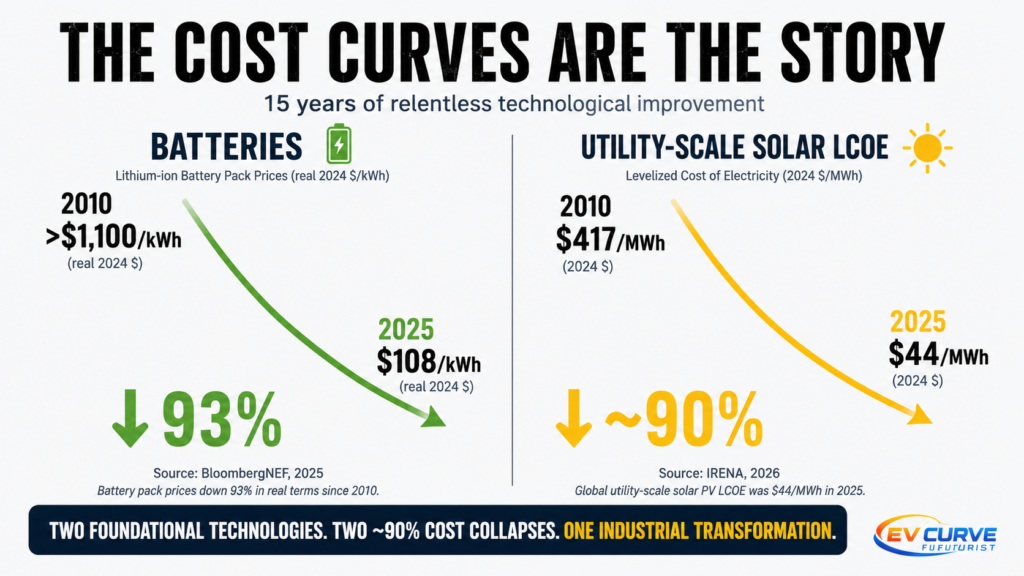
Think about that for a moment. Two of the foundational technologies behind electrification, solar generation and battery storage, have each experienced roughly 90% cost declines in around fifteen years. That’s not a marginal improvement to the existing industrial system. That’s the economics underneath the system itself changing.
The result is not simply “cleaner energy”. It is the emergence of a different industrial system, one increasingly built around technologies whose economics improve as we manufacture more of them.
That’s an important distinction. Oil doesn’t become dramatically cheaper because we burn twice as much of it. A solar panel, battery, semiconductor or robot can become cheaper because we manufacture twice as many. One system consumes resources to produce energy. The other manufactures technology to harvest, store and use it.
Cars Just Made It Obvious
This is why arguments about whether someone personally likes EVs often miss the point. You don’t have to like them. You don’t have to buy one tomorrow. You don’t even have to care about cars.
Industrial transitions aren’t decided by enthusiasm alone. They’re shaped by economics, capability, scale, policy, infrastructure and politics. Governments can accelerate them, incumbents can slow them and bad policy can distort them for years. But over the longer term, economics has an irritating habit of asserting itself.
The steam engine didn’t require everyone to become a steam-engine enthusiast. Smartphones didn’t win because everyone suddenly became obsessed with semiconductor architecture. Technologies spread because eventually they become good enough, cheap enough and useful enough that the old way increasingly stops making economic sense.
EVs are reaching that point in more and more markets. But they’re not alone. Solar is doing it. Batteries are doing it. AI is doing it. Robotics is beginning to do it. Autonomy is beginning to do it.
That’s why I don’t think of the EV transition as simply the replacement of petrol cars with electric ones. It’s one visible front in a much larger industrial transformation.
When the Machine No Longer Needs a Driver
And this is where the story starts becoming much bigger than energy or cars.
For most of industrial history, machines amplified human labour but still required humans to operate them. Cars replaced horses, but they still needed drivers. Trucks needed truck drivers. Tractors needed farmers. Forklifts needed operators. Excavators needed operators. Factories needed armies of people performing repetitive physical tasks.
That assumption is beginning to break.
The automobile largely removed the horse from its economic role in transportation, not because horses stopped working, but because machines became dramatically better at doing the job. Now we’re approaching another potentially profound transition: machines themselves increasingly won’t require humans to operate them.
Fully autonomous driving is the obvious example because, once again, the car makes the technology visible. But the implications extend far beyond whether your personal car can drive you to the shops. Robotaxis, road freight, delivery vehicles, mining equipment, agricultural machinery, ports, warehouses and eventually many other forms of transportation are moving toward increasing levels of autonomy.

At the same time, robotics is beginning to escape the highly controlled environment of the traditional factory. Humanoid robots are particularly interesting because our physical world was built for the human form. Stairs, doors, shelves, tools, kitchens, warehouses and factories were designed around us. A sufficiently capable general-purpose robot doesn’t necessarily require us to rebuild that world around the machine. The machine can increasingly learn to operate in the world we’ve already built.
That opens the door to something potentially enormous. Household robots capable of cleaning, carrying, fetching, organising and eventually performing increasingly complex physical tasks are moving from science fiction towards an engineering and economics problem. The same is happening in warehouses, factories, construction, agriculture, logistics and healthcare.
And once again, the convergence matters more than any single technology. Better batteries give mobile robots more endurance. Falling battery costs make them cheaper. AI gives them perception, language, reasoning and the ability to learn. Cameras and sensors allow them to understand their surroundings. Semiconductor advances provide increasingly powerful computing. Massive fleets generate data that can improve the next generation. Automated factories can eventually manufacture more of the machines doing the automation.
The flywheel starts turning again.
The comparison with the horse is uncomfortable, but economically it’s worth thinking about. The car didn’t make horses extinct. It made horse labour largely unnecessary for transportation. Autonomous machines could begin doing something similar to human labour across an expanding range of specific tasks.
That doesn’t mean humans become obsolete. It means the economic value of paying a human to physically operate a machine, drive a vehicle, move an object or perform a repetitive task begins to change when a machine can increasingly perform that task itself, potentially around the clock and at falling cost.
This may ultimately prove far more consequential than the transition from petrol cars to electric ones. We’re potentially approaching a world where economic output becomes progressively less constrained by the availability of human labour.
First we electrified the machine. Then we connected it. Then we taught it to see, communicate, reason and learn. Now we’re teaching it to operate itself.
From Molecules to Technology
For more than a century, much of the global economy has been built around extracting and consuming molecules: coal, oil and gas. Extract them, refine them, transport them, burn them, then go back and buy some more. It’s an extraordinarily powerful economic model because the customer must keep returning for fuel.
Electrification begins changing that relationship. Solar panels harvest energy. Wind turbines harvest energy. Batteries store it. Electric motors convert it into motion. Increasingly, households, businesses and entire countries can own more of the productive infrastructure required to generate the energy they consume.
The equipment eventually needs replacing, of course, but the underlying economic relationship is fundamentally different. Instead of continuously purchasing fuel, you increasingly purchase productive capital.
That shift has implications far beyond electricity prices. It changes trade flows, geopolitics, which resources become strategically important, where industrial power sits and ultimately who captures the value.
And when that productive capital increasingly includes autonomous machines capable of performing physical work, the transformation becomes larger still. We’re not simply changing where machines get their energy. We’re changing what machines can do, how independently they can do it and how much human labour is required to produce a unit of economic output.
Which brings us straight back to EVs. A petrol car sits at the end of an enormous recurring fuel supply chain and requires a human operator. An autonomous electric vehicle potentially sits at the intersection of renewable electricity, batteries, semiconductors, AI, robotics and automation.
Those are very different economic architectures.
The Tip of the Spear
So when I post another EV sales chart, talk about another Chinese electric car, obsess over another battery chemistry or point excitedly at another collapsing cost curve, I’m not really talking about cars. I’m watching the front edge of a much larger transformation move through the global economy.
The transition from combustion to electrification. From fuel extraction to energy harvesting. From mechanical systems to software-defined systems. From human-operated machines toward increasingly autonomous ones. From industries constrained by recurring fuel consumption and human labour toward systems increasingly built around long-lived productive capital and intelligent machines.
EVs are where much of this became visible to ordinary people. They’re something we can drive, something we can park in our driveway, something millions of people can experience for themselves, and something whose progress we can watch as market after market moves along the adoption curve.
But increasingly, look behind the EV and you can see what is following it: the battery factory, the solar farm, the mine, the refinery, the semiconductor fab, the AI model, the autonomous truck, the robotaxi, the automated factory and, perhaps soon, the general-purpose robot walking through our workplaces and eventually our homes.
This is why I find the electric vehicle so fascinating despite never really being interested in cars. It isn’t the revolution. It’s the first visible edge of a much larger revolution that millions of ordinary people can already see, touch, buy and experience.
The EV is the tip. Everything behind it is the spear.
So yes, I’m probably going to keep talking about EVs.
Sorry, Wendy.
But it’s never really been about the cars.
It’s about everything coming behind them.
