
Where gravity, not opinion, decides outcomes
The world doesn’t change because narratives shift.
Narratives shift after the forces have already done their work.
Those forces are simple and repeatable: cost curves, S-curves, and physical limits.
They behave less like politics and more like gravity.
You can resist them.
You can delay them.
You cannot stop them.
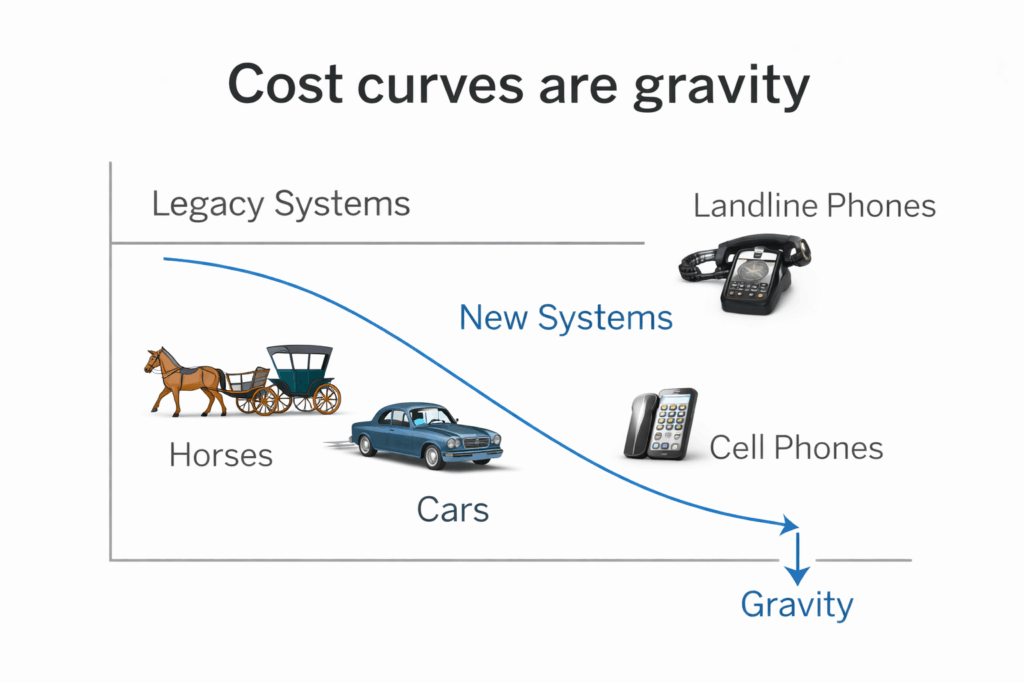
Cost curves are gravity
When something gets cheaper:
- adoption accelerates
- scale compounds
- incumbents lose footing
This isn’t preference or policy.
It’s economics obeying physics.
Once a system undercuts the old one, gravity takes over — and the direction is locked in.
S-curves explain why change feels sudden
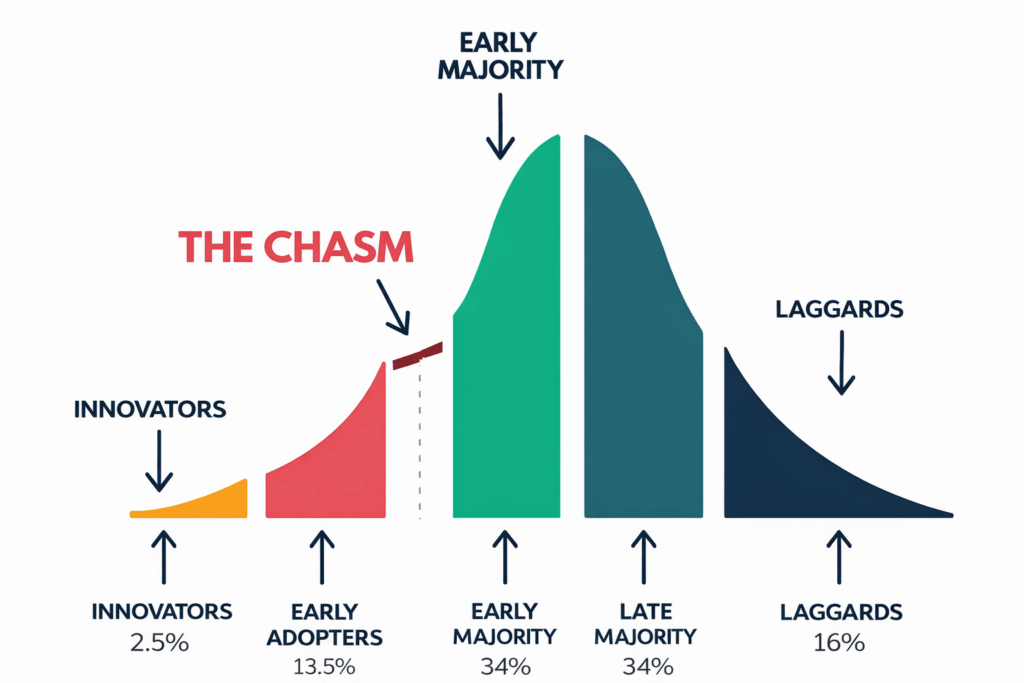
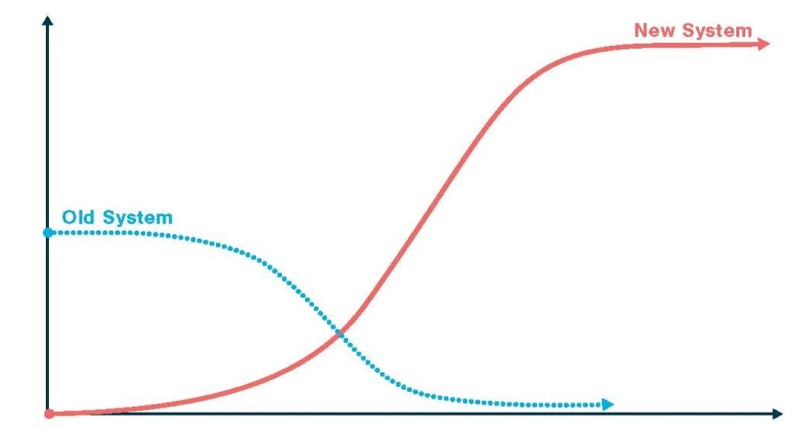
Disruption always looks slow — until it isn’t.
Adoption follows S-curves:
slow → steep → dominant.
Most analysis fails because it assumes linear change.
Forces focuses on where we are on the curve, not the story being told about it.
By the time consensus agrees, the steep part is already underway.
The Five Forces reshaping everything
Energy Transformation
Energy has been the core constraint of human civilisation for over 10,000 years.
Every society, empire, and economy was built around scarce, controllable energy — muscle, wood, coal, oil. Scarcity wasn’t accidental.
It was designed into the system.
Electrification breaks that constraint.
Solar, wind, batteries, and storage collapse energy costs and remove fuel as a gating factor. Once electrons are cheaper than extraction, transport, and combustion, the old model loses its grip.
That’s gravity.
But electrification is only the first step.
Bettrification — the layering of software, intelligence, automation, and optimisation on top of electric systems — is what turns cheap energy into systemic advantage.
Energy shifts from scarcity to abundance.
From centralized control to distributed intelligence.
From volatile inputs to predictable, optimised flows.
This isn’t an upgrade to civilisation.
It’s a rewrite of its foundation.
Transportation & Mobility
Mobility is crossing a cost and capability threshold.
Electrification collapses mechanical complexity.
Software replaces hardware differentiation.
Automation turns vehicles into networked systems.
Once electric drivetrains undercut combustion on total cost, the outcome stops being optional. Maintenance falls. Energy costs drop. Lifespans extend. Scale accelerates.
That cost curve acts like gravity.
This is why the transition feels sudden.
Adoption follows an S-curve — slow at first, then steep, then unavoidable.
Mobility doesn’t evolve in isolation.
Electrified transport reshapes energy demand, infrastructure, cities, and logistics.
It’s not a product upgrade.
It’s a system rewrite.
Information & Intelligence
This is the multiplier force.
Computation, AI, and automation compress time, reduce friction, and steepen every other curve.
Costs fall. Capability rises. Feedback loops tighten.
What once took years now happens in months.
What required scale now starts small — then spreads fast.
That’s why change feels compressed.
Information doesn’t move linearly; it cascades.
As intelligence becomes embedded across systems, decision cycles shorten and productivity compounds.
This force doesn’t replace the others.
It accelerates them.
Food & Agriculture
Food is entering its own S-curve — quietly.
Electrification, automation, and precision fermentation are bending food production toward lower inputs, higher control, and radically different cost structures.
At first, these systems look niche and uneconomic.
Then costs fall, yields improve, and scale compounds.
That’s the cost curve at work.
As production decouples from land, weather, and long supply chains, food shifts from scarcity management to industrial optimisation.
The change feels slow — until it isn’t.
This isn’t a lifestyle trend.
It’s a structural rewrite of how food is produced, distributed, and priced.
Materials & Capital Equity
In the Bettrification Age, disruption is no longer constrained by ideas or ambition, but by access to materials and the allocation of capital. As energy systems electrify and technologies scale, materials such as lithium, copper, silicon, graphite, and advanced battery chemistries stop behaving like passive commodities and become system-defining assets.
This shift is driving a broader materials megatrend. Capital is rotating away from purely paper-based, illiquid, and abstract claims toward hard, physical systems that enable energy, mobility, storage, and computation. Assets once treated as inputs increasingly behave like strategic infrastructure.
At the same time, capital ceases to be neutral. Investment flows follow scale, learning curves, and manufacturing advantage. Gold reasserts its role as a hedge against monetary dilution. Digital assets begin to firm as parallel stores of value and settlement layers. Equity concentrates where materials, energy, and throughput converge.
This force determines how fast the transition unfolds, who captures its value, and how resilient the new system becomes. Materials set the physical speed limits of the Bettrification Age. Capital decides whether those limits are reached — or missed.
How to read this section
Forces is curve literacy, not headline chasing.
Expect:
- cost curves over opinions
- inevitability over reassurance
- direction before consensus
From Forces → Predict
Prediction isn’t guessing.
It’s recognising gravity early.