
By EV Curve Futurist
Electricity, batteries and intelligence powering a better system.
BETTRIFICATION / FRAMEWORK
Bettrification: The New Industrial System
Bettrification connects electric machines, batteries and software so homes, businesses and industries can use energy more intelligently and reduce their dependence on fuel. I created this framework to explain how productive assets, storage, automation and intelligence can work together to deliver useful services at lower cost and with greater flexibility.
THE IDEA IN 20 SECONDS
Build productive assets.
Connect them. Improve the useful work they deliver.
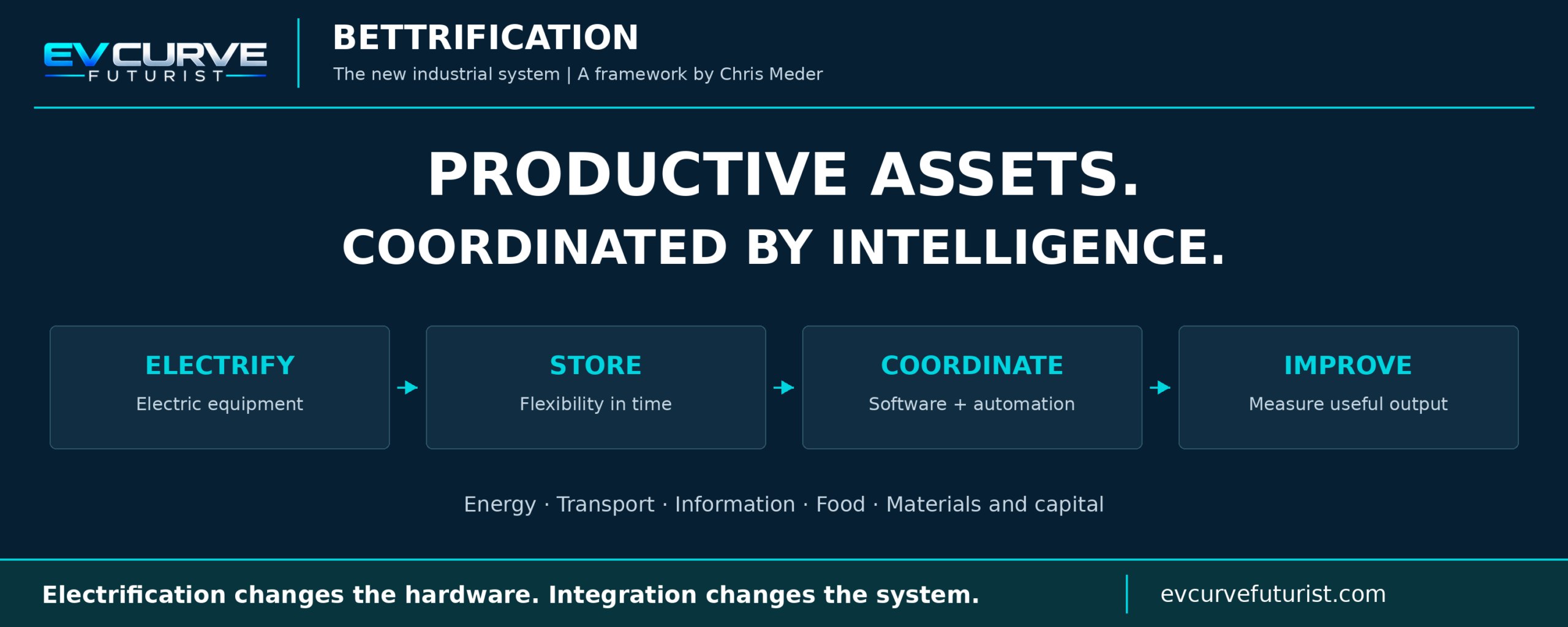
Electric hardware + storage + software + automation + intelligence.
The economic shift
From fuel purchases to productive assets
Many electrified systems shift some spending from repeatedly buying fuel towards equipment and infrastructure that deliver useful services over time.
Fuel-dependent system
- Invest in equipment and infrastructure.
- Buy fuel repeatedly to operate it.
- Maintain the equipment and eventually replace it.
Electrified system
- Invest in electric equipment and supporting infrastructure.
- Use electricity from the grid, on-site generation or both.
- Maintain and eventually replace equipment; controls can coordinate its use.
Both systems use energy and materials. Compare the full cost of the same service, including equipment, energy, networks, maintenance and replacement. The result depends on the circumstances.
Why I use this name
I began using Bettrification publicly in 2024. The spelling combines the idea of systems becoming better with the enabling role of batteries. It gives me one word for the connection between electric hardware and the software that coordinates it. The gains still have to be demonstrated in the real system.
01 · How the layers work
Electrification changes the equipment. Storage changes when energy can be used. Software connects the pieces; automation acts on measurements; intelligence can improve forecasts and decisions. The value comes from how these capabilities work together.
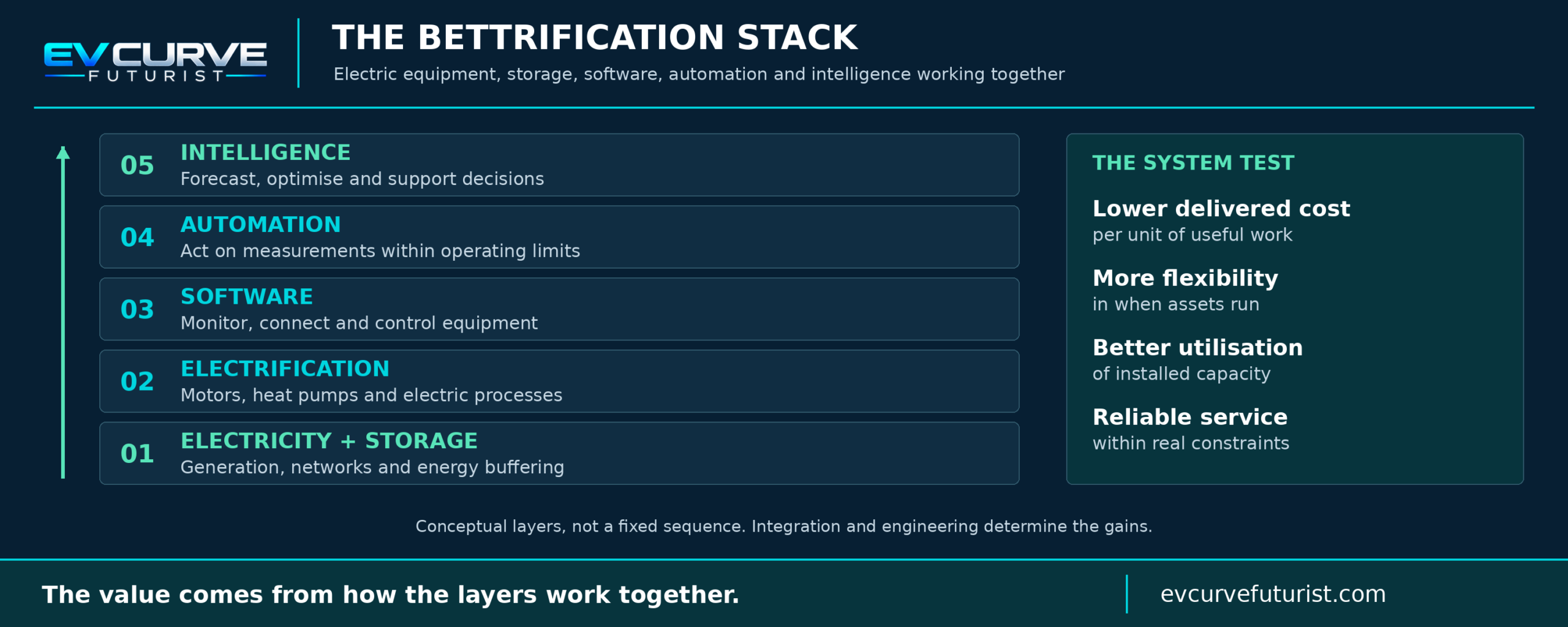
A charger can follow a simple timer. A more capable system can also account for solar output, electricity prices, the battery’s state of charge and the next departure time. AI adds value where it improves the decision; many useful controls need no AI.
02 · Flows, stocks and useful work
A fuel supply is a flow: once burned, it must be replaced. Panels, turbines, batteries, networks and electric machines form a stock of productive assets that can provide services over many years.
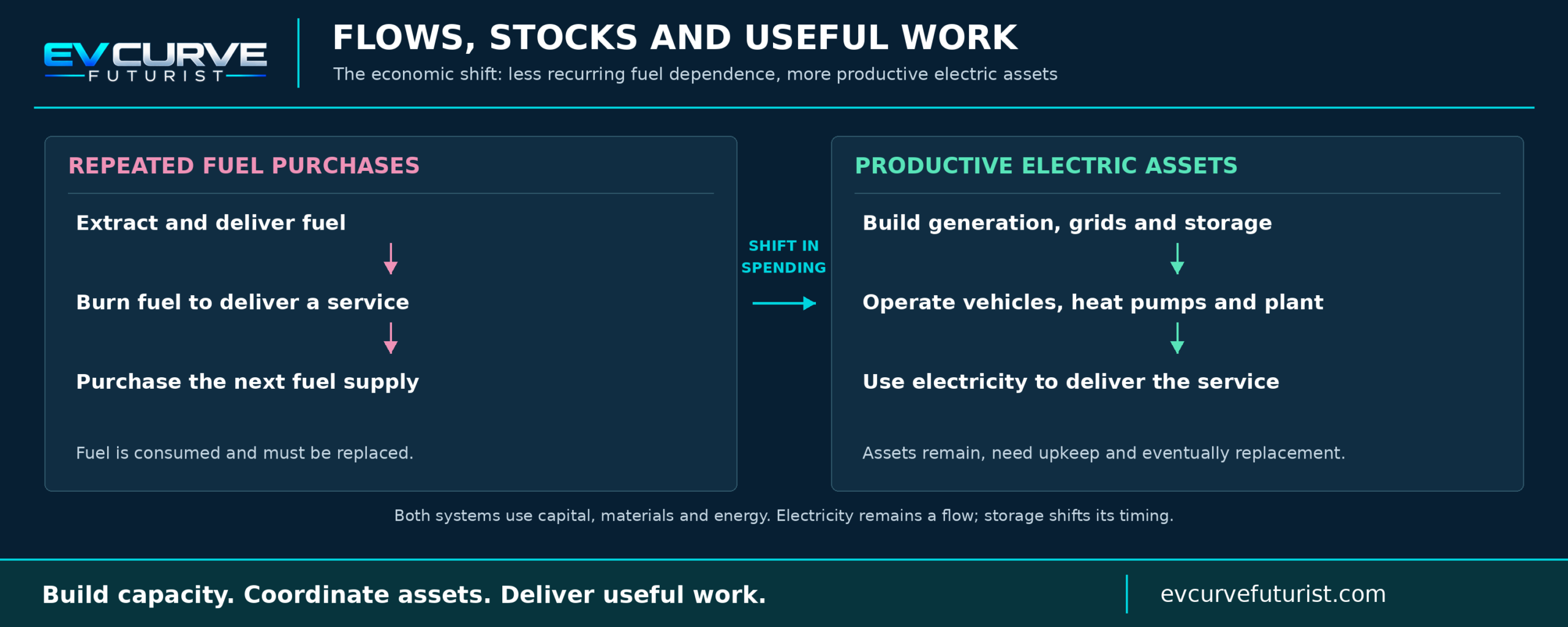
This does not make electricity or materials free. It changes the economics: more of the cost can sit in building and financing capacity, while fuel exposure falls. Compare the full cost of the service, including networks, storage, losses, maintenance and replacement.
Bettrification in practice
My solar-powered driving example
My own experience helped me see how electric assets can work together. In April 2025, I reported that my then-current 2023 Model Y had travelled about 26,000 km in roughly a year. I estimated that around 20,000 km of that distance was powered by daytime charging from our home’s 10 kW rooftop solar system.
That is approximately 77% of the distance, an estimate from my reported experience, not a metered share of charging electricity. The car battery stores energy for driving; this example does not assume a home battery.
Solar has upfront and maintenance costs, and using solar at home can mean giving up an export credit. This example is not a full ownership-cost calculation or a claim that everyone will achieve the same result. Read my original account and its corrections →
03 · What it looks like in practice
Select an example to expand it. Each example shows how connected assets can reduce costs, improve flexibility and deliver useful services.
A home: coordinate solar, charging and heating
Solar generates electricity, a battery can shift some of it to later, and controls schedule flexible loads around household needs. The practical test is the bill and the service delivered, including comfort and vehicle readiness.
A fleet: manage vehicles and depot power together
Electric vehicles, chargers, depot capacity and route schedules become one operating system. Software can manage charging around departures and power limits. Measure energy cost per kilometre, vehicle availability and charging downtime.
Industry: match controllable processes to available power
Electric equipment, storage and process controls can shift suitable work in time and improve asset use. Production requirements set the limits. Measure cost per unit of output, throughput and unplanned downtime.
04 · Follow the five forces
The Five Forces describe the sectors being reshaped. Bettrification explains how their physical assets and digital capabilities can connect.
| Force | Role in the system |
|---|---|
| Energy Transformation | Generation, storage and networks supply power and flexibility. |
| Transportation & Mobility | Vehicles, charging and logistics become connected electric systems. |
| Information & Intelligence | Software, compute and automation coordinate physical assets. |
| Food and Agriculture | Selected processes combine biology, controlled production and electric infrastructure. |
| Materials & Capital Equity | Minerals, processing, equipment and finance determine what can be built. |
05 · What to measure
Compare the same service over the same period. These are the five tests I use:
| Test | What to track |
|---|---|
| Delivered cost | Full cost per kilometre, unit of heat or unit of production. |
| Useful output | Service actually delivered over a defined period, alongside installed capacity. |
| Utilisation | How effectively equipment is used, including downtime and availability. |
| Reliability and flexibility | Service maintained when supply, demand or operating conditions change. |
| Buildability | Available power, materials, connections, skills, finance and delivery time. |
Connections, processing capacity, financing costs and equipment replacement can slow deployment. Data quality, interoperability and secure controls determine how much coordination is possible. Software cannot remove a physical bottleneck by itself.
The IEA’s 2026 work on electricity-system flexibility and grid monitoring and control provides evidence for the roles of storage, flexible demand and responsive control. Bettrification is my framework for connecting these developments.
The transition in six signals
These 2025 snapshots show changes in batteries, electricity and transport. Each measures a different part of the transition.
Average battery pack price across surveyed applications.
BloombergNEF · 2025 data →New cars sold globally were plug-ins, including battery electric and plug-in hybrid vehicles.
IEA · 2025 sales →Of new utility-scale renewable capacity generated power more cheaply than the cheapest new fossil alternative.
IRENA · 2025 capacity →Of global electricity was generated by solar and wind.
Ember · 2025 generation →Of battery storage power capacity was added globally. GW measures power, not stored energy.
IEA · 2025 additions →Of global medium and heavy freight truck sales were electric.
IEA · 2025 sales →Scope matters: Battery pack prices are not installed-system costs. IRENA compares generation costs, not the full cost of a reliable electricity system. Vehicle sales are a flow, not the existing fleet. Sources checked 18 November 2026; these are published snapshots, not a live feed. Explore more in the Data Hub and Energy Atlas.
Explore the Bettrification hub
Explore the tools below and see The Disruption Decade for the wider outlook.
How I assess the evidence: Compare full costs and reliability for the same service, and check each figure’s source, period and boundaries. See what to measure and sources and resources.
06 · Go deeper
- The Disruption Decade, 2025–2035: the wider five-force thesis.
- Data Hub: follow the evidence.
- Materials & Energy: The Full Picture: compare systems and their physical constraints.
- Future Insights: the signals and scenarios I watch next.
Foundations and original video
The original essays develop the idea in more depth: Dawn of the Age of Bettrification and Materials for a Bettrified World.
The Bettrification opportunity
Bettrification is about building productive assets, connecting them intelligently and getting more useful work from the energy we already produce.
Sources and further reading
The data, research and original articles behind this page, with further reading on electricity systems, batteries, industry and materials. Report publication dates and the years their data covers may differ.
Sources & resources
Evidence behind the six signals
- BloombergNEF (2025): Lithium-ion battery pack prices fall to US$108/kWh. Summary of the 2025 battery price survey across applications.
- International Energy Agency (2026): Global Energy Review 2026: Electric vehicles. Global electric car sales and market share in 2025.
- International Energy Agency (2026): Global EV Outlook 2026: Trends in other EV modes. Medium and heavy electric truck sales in 2025.
- International Energy Agency (2026): Global Energy Review 2026: Battery storage. Global battery storage capacity additions in 2025.
- Ember (2026): Global Electricity Review 2026: Electricity demand and supply trends. Wind and solar shares of global electricity generation in 2025.
- International Renewable Energy Agency (2026): Renewable Power Generation Costs in 2025. Generation costs for newly commissioned utility-scale renewables compared with new fossil alternatives.
Electricity systems, batteries and industry
- CSIRO and AEMO (2026): GenCost 2025–26: Final report. Australian generation, storage and electricity system cost analysis.
- International Renewable Energy Agency (2026): 24/7 Renewables: The Economics of Firm Solar and Wind. An asset-level analysis of firm renewable power; it is not a whole-grid cost model.
- International Energy Agency (2026): Electricity 2026: Flexibility. Storage, flexible demand and the changing needs of power systems.
- International Energy Agency (2026): Modernising Grids in the Age of Electricity: Monitoring and control systems. The role of data, visibility and control in electricity networks.
- International Energy Agency (2024): Batteries and Secure Energy Transitions. Battery applications, supply chains and energy security.
- International Energy Agency (2026): Global Critical Minerals Outlook 2026. Mineral markets, supply chains, investment and security.
- International Energy Agency (2025): Energy Efficiency 2025: Industry. Industrial energy use, efficiency and electrification.
Perspectives and original Bettrification work
- Adam Dorr and Tony Seba, RethinkX (2020): Rethinking Energy 2020–2030. A scenario-based perspective on solar, wind and batteries; its projections are not observations.
- Christopher Meder, EV Curve Futurist (2026): The Bettrification Age. The original explanation of the wider systems framework.
- Christopher Meder, EV Curve Futurist (2026): Materials for a Bettrified World. The materials and supply chains behind electric and digital systems.
- Christopher Meder, EV Curve Futurist (2025; updated 2026): Tesla Model Y: Carbon Payback. The original personal driving and rooftop solar account, including its later corrections.
Bettrification is Christopher Meder’s framework. The independent sources above provide data and research context; their inclusion does not imply that their authors endorse the framework.