
We’re used to thinking of transport as a vehicle story: new models, better specs, incremental upgrades. But what’s unfolding now is a system replacement. One system moves energy by shipping fuel and burning it at the point of use. The other uses electricity, charging infrastructure and, increasingly, locally generated and stored energy.
Updated 15 November 2026 with refreshed graphics and freight data.
The shift is already well advanced in some Chinese city bus fleets. It didn’t start with cars alone. High-utilisation fleets with predictable routes were a natural starting point, and their experience is now feeding into heavy freight.
China’s bus lead
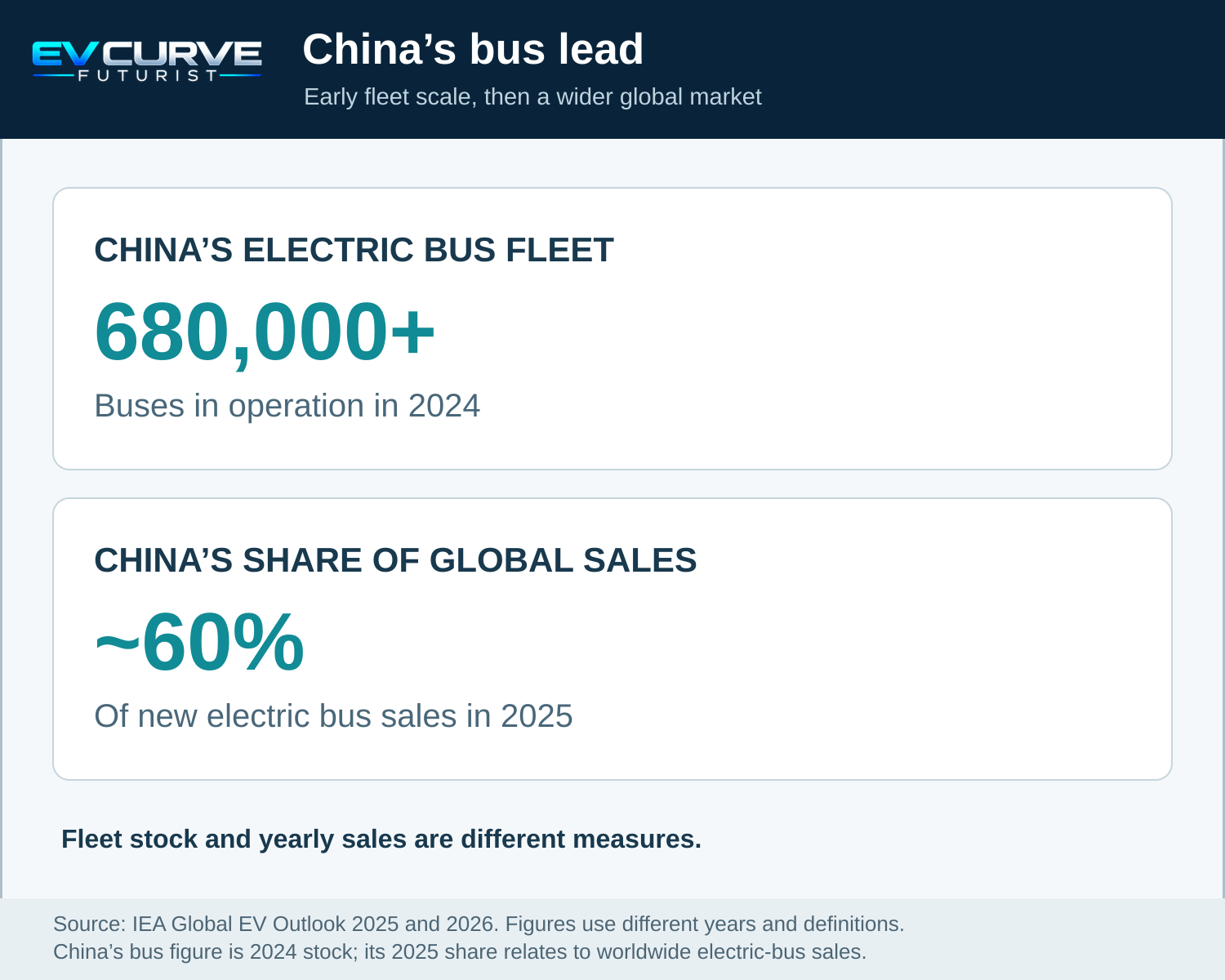
China built an early lead at scale. The IEA reported more than 680,000 electric buses in the country in its 2025 outlook, using the latest available fleet data. In 2025, China accounted for around 60% of global electric bus sales, and nearly all new city buses sold in China were electric. Fleet stock and annual sales are different measures. To me, this is Bettrification: the shift from fuel logistics towards energy infrastructure.
Why buses came first
What makes this so important isn’t just the vehicles, but why buses went first. This wasn’t a coincidence or a policy experiment; it was a strategic entry point into a much larger system shift. Buses are high‑utilisation assets with predictable routes that return to central depots, perfect conditions for electrification. But once deployed at scale, something more interesting happened: they stopped being just vehicles and became infrastructure.
Some fleets pair electric buses with depot charging, solar and stationary batteries. Managed charging can shift electricity demand to cheaper or less congested periods. Vehicle-to-grid services are possible where vehicles, chargers and market rules support them, but they are not automatic. The wider gains can include cleaner local air, less diesel consumption and reduced exposure to oil imports.
The global freight shift
Outside China the transition is growing at different speeds. For example, the IEA reports that battery-electric buses exceeded 55% of new city-bus sales in the European Union in 2025. China’s early lead also helped build battery production, manufacturing scale and deployment experience that can carry into freight.
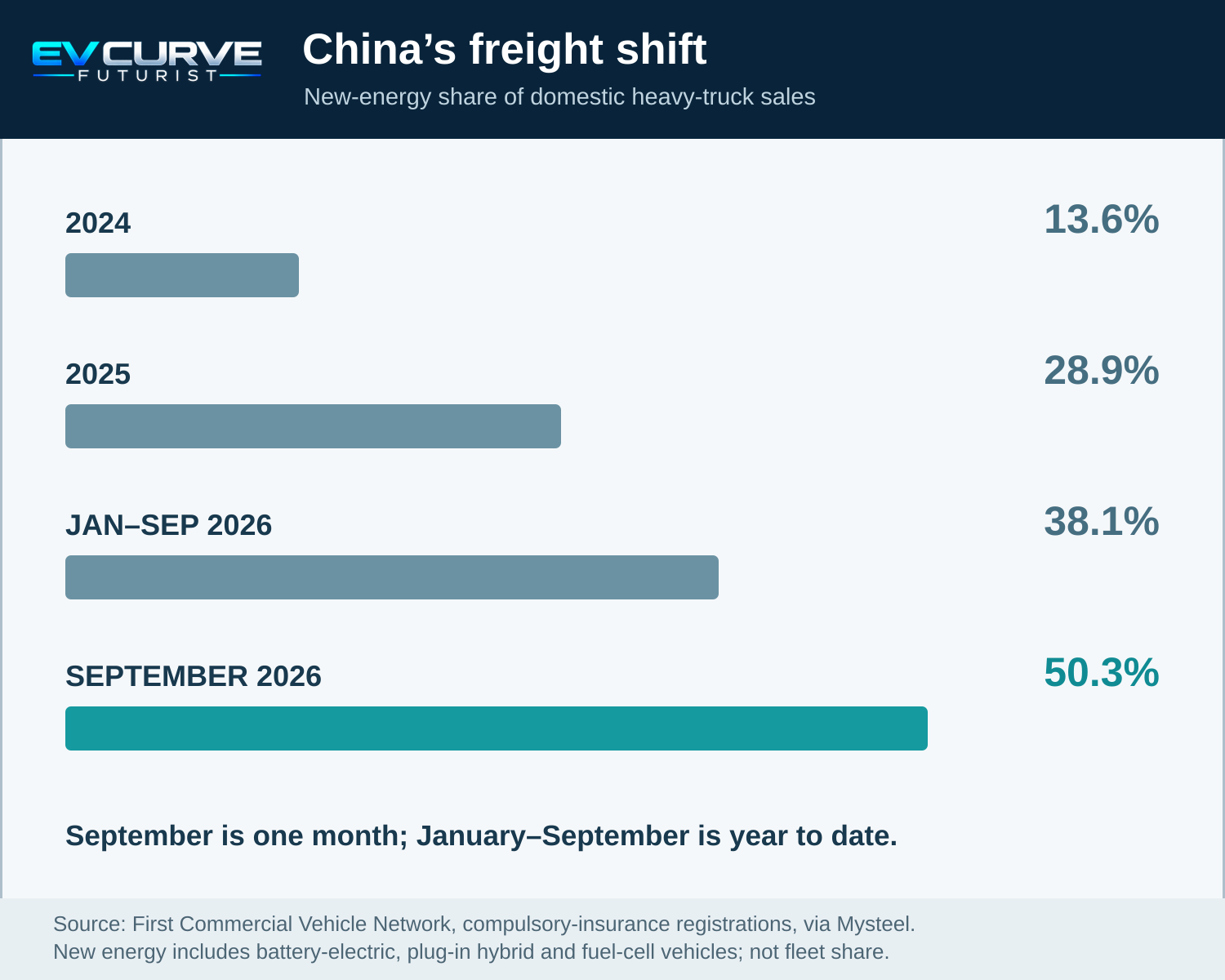
The shift is also visible in heavy freight. China’s new-energy heavy trucks reached 53.9% of domestic monthly sales in December 2025, according to industry data. The year-end spike was affected by policy timing. By September 2026, the share was 50.3% for the month and 38.1% for January to September. These are shares of new sales, not the share of trucks already on the road. The new-energy category includes battery-electric, plug-in hybrid and fuel-cell vehicles.
More production can support lower costs, and lower costs can encourage adoption: a familiar industrial flywheel. The pace still depends on policy, charging access and fleet economics.
That’s the pipeline most people miss: passenger EVs created battery scale; battery scale enabled buses; buses proved the system, and now that system is moving into freight.
The grid question
Before it does, it’s worth acknowledging what still has to be built outside China. Megawatt charging corridors are sparse, grid connections at scale take time, and fleet operators need confidence in uptime, servicing, and residual values. This is where a common concern comes in: will electric freight break the grid? At first glance, it seems obvious, more trucks, more electricity, more strain. But that assumption is already being challenged in the real world.
Some charging hubs combine grid connections with onsite solar and batteries, storing energy when it is cheaper or more abundant and releasing it during charging peaks. Managed charging can reduce or shift demand at the connection. These measures can make infrastructure more useful, though they do not remove the need for grid upgrades where capacity is constrained.
That creates an opportunity for more flexibility as fleets scale. Vehicle-to-grid services may eventually allow suitably equipped trucks and chargers to support the grid, subject to operational needs and market rules. The Megawatt Charging System standard is being developed for higher-power heavy-vehicle charging, alongside the connection and depot infrastructure fleets will need.
There is also the question of cost and the time needed to upgrade. Both matter. Charging, grid connections and vehicles require capital, and the result depends on utilisation. Where trucks run enough kilometres and charging is well planned, lower energy costs can help repay that investment.
The economics can improve as utilisation rises and the infrastructure is shared across more vehicles. But a route-by-route assessment still matters: electricity tariffs, diesel prices, charging availability and vehicle costs all affect the payback.
Electric truck economics
- Purchase price: the IEA reports electric trucks can cost roughly two to three times as much as diesel trucks in some markets.
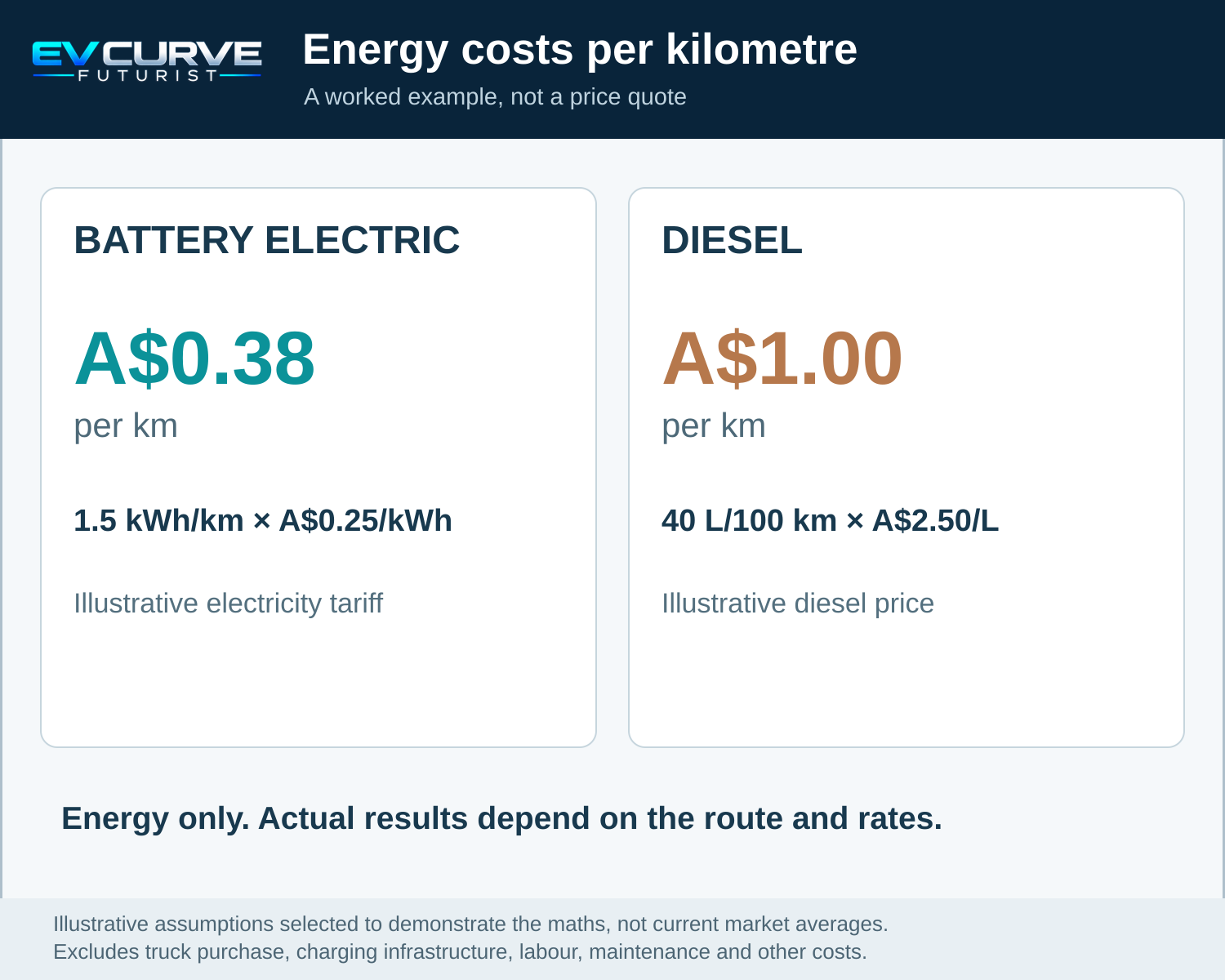
- Illustrative energy cost: 1.5 kWh/km at A$0.25/kWh is about A$0.38/km; 40 L/100 km at A$2.50/L is A$1.00/km. These are example inputs, not current averages.
- High-utilisation example: at 200,000 km a year over ten years, A$1/km of diesel would add up to A$2 million in fuel alone. Actual distance and fuel prices vary.
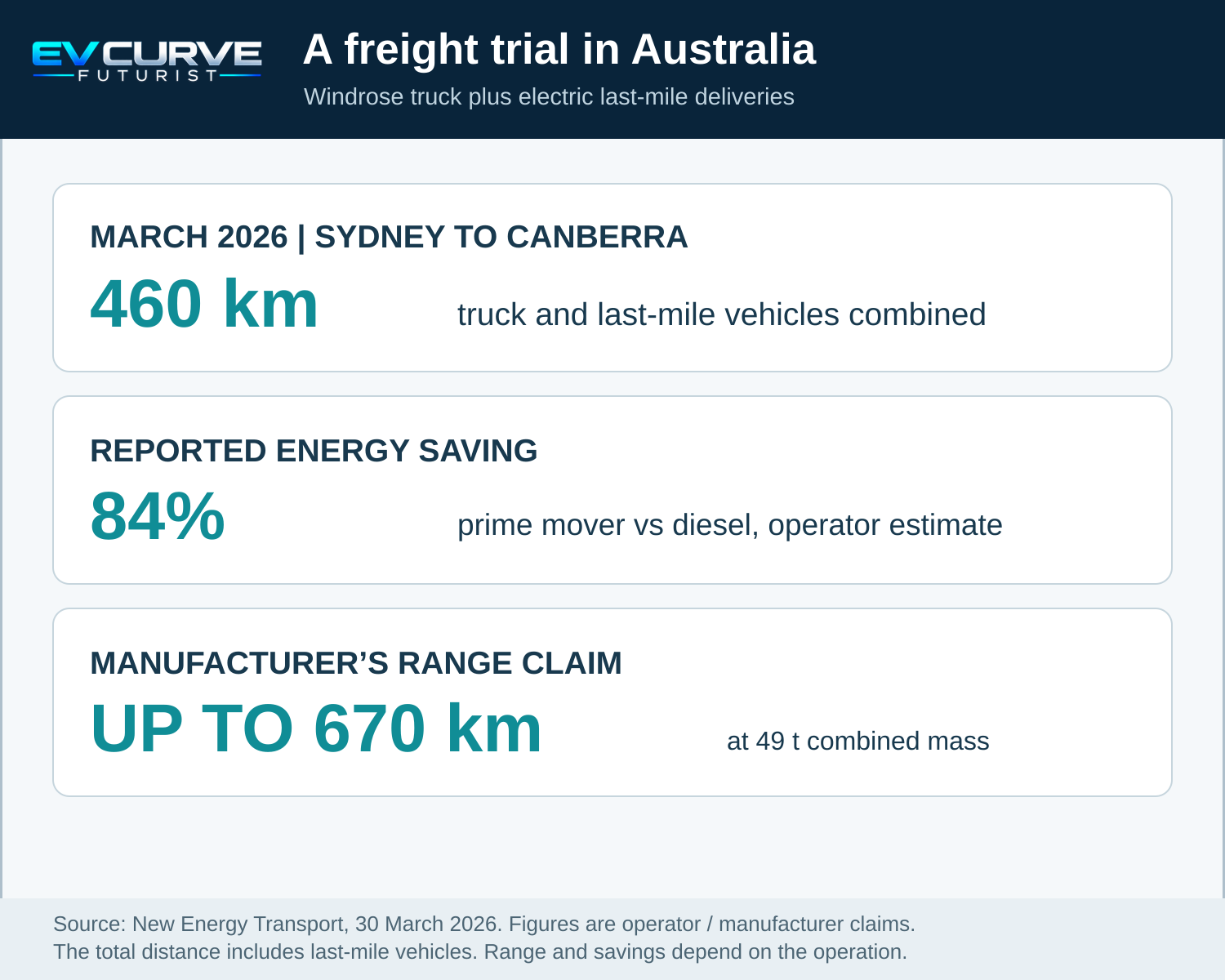
- Windrose E700: a 705 kWh battery and charging at up to 870 kW are manufacturer specifications; available configurations vary. Windrose has claimed up to 670 km at 49 tonnes combined mass.
- Australian trial: New Energy Transport reported an 84% lower energy cost for its electric prime mover compared with diesel on the trial route. This was not a complete ownership-cost comparison.
What this means
Freight decisions are not made on purchase price alone. They depend on total cost per kilometre over time: the truck, financing, energy, charging, maintenance, uptime and residual value. Falling battery costs and higher utilisation can narrow the gap, but the outcome will differ by fleet and route.
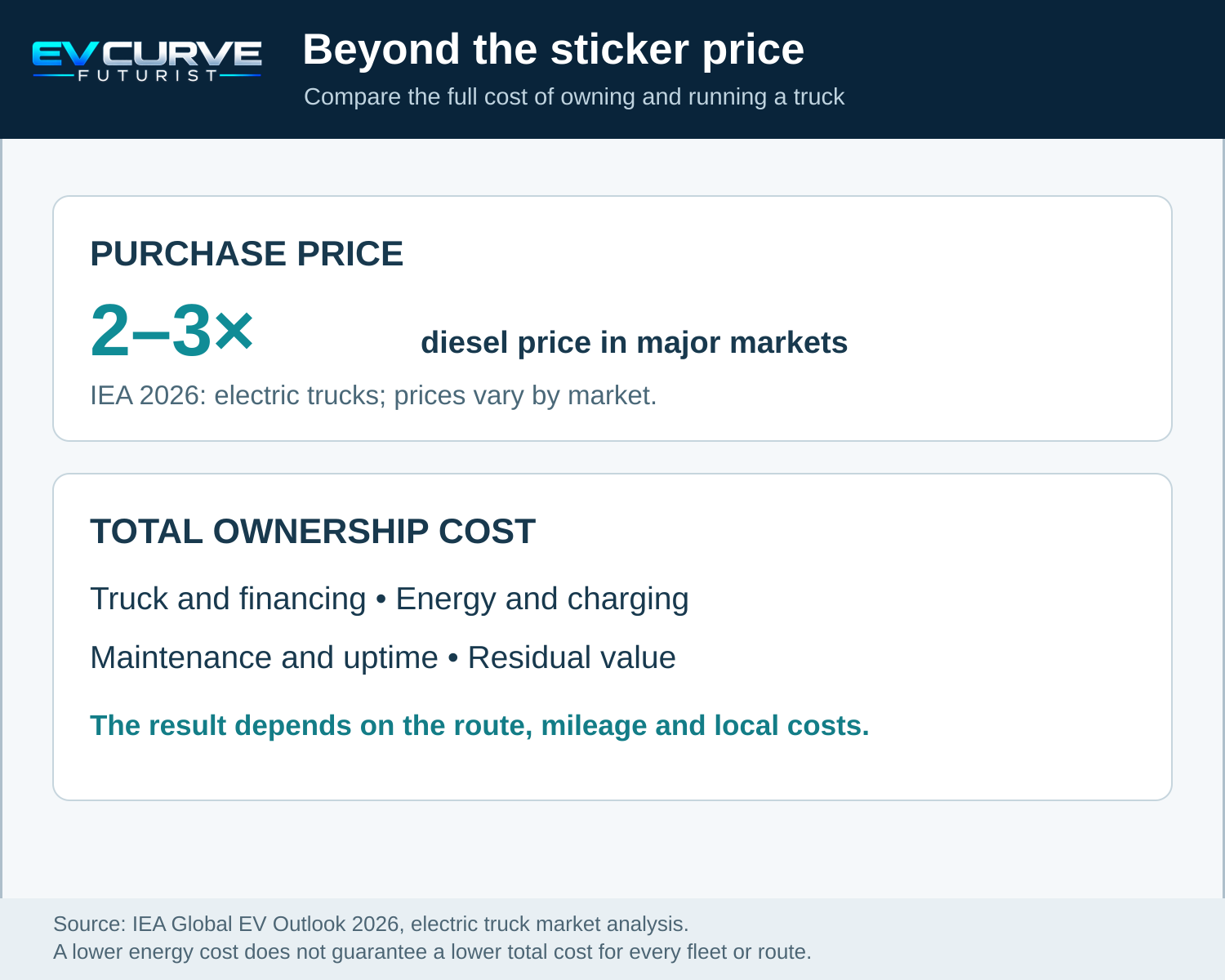
Takeaway
Diesel: often a lower upfront price, with ongoing exposure to fuel costs.
Electric: often a higher upfront price, with potential energy and maintenance savings.
Where lifetime savings outweigh the upfront premium and charging works for the route, the economics can flip before purchase-price parity.
The cost that matters
That brings us to total cost of ownership. The IEA finds battery-electric heavy trucks have reached cost parity with diesel in certain Chinese applications after five years. Elsewhere, the answer varies. Operators also need reliable service, parts, charging, uptime and confidence in the truck’s eventual resale value.
Windrose goes global
Long-haul trucking has been viewed as one of the harder parts of the transition. The Windrose E700 is one example of how manufacturers are moving beyond prototypes into trials and early customer deployments across different markets.
Windrose specifies a 705 kWh battery and charging at up to 870 kW for its long-range platform. In the Australian demonstration, a company representative claimed up to 670 km at 49 tonnes combined mass. Range, charging speed, payload and permitted combination weight vary with the vehicle configuration, route and conditions. These are manufacturer claims, not a guarantee for every trip. (Windrose technology; New Energy Transport)
Specs alone miss the wider point. Building a truck is one challenge; deploying and supporting it across markets, with charging and servicing, is another. Windrose draws on China’s battery and manufacturing ecosystem, but its long-term success will depend on operational performance, support and economics in each market.
In March 2026, New Energy Transport, ANC and Who Gives A Crap completed an all-electric delivery from Sydney to customers in Canberra. The 460 km total included the prime mover and electric last-mile vehicles. The operator reported an 84% reduction in the prime mover’s energy cost compared with diesel on the route. That is a reported trial result, not a universal saving or a complete cost comparison. As more operators publish route-level data, the picture will become clearer. (New Energy Transport)
The system expands
Manufacturers are approaching the transition in different ways. Windrose is drawing on Chinese supply chains and developing a platform for international freight, while established truckmakers are also bringing electric models to market. All will need to demonstrate charging, servicing, uptime and viable costs as they scale.
The bus experience offers a useful playbook: start with routes and depots where charging can be planned, build operational confidence, then extend to more demanding freight corridors. The pace will vary, but each deployment adds practical experience.
Oil shocks accelerate change
Past oil shocks hurt transport margins while leaving a large diesel-dependent fleet in place. Today there is an additional option: some fleets can invest in electric vehicles and charging to reduce future diesel exposure.
This time looks different.
The March 2026 disruption around Iran and the Strait of Hormuz brought fuel security back into focus. Historically, fleets had few immediate alternatives to higher diesel prices. Electric freight gives suitable routes another pathway, although vehicles and infrastructure still take time and capital to deploy.
Battery-electric trucks are operating on growing numbers of routes, especially in China. Depot charging, battery swapping and higher-power charging can reduce diesel dependence, while infrastructure availability and vehicle suitability still limit where fleets can switch.
Diesel fleets remain exposed to fuel-price volatility. Electric fleets face electricity costs too, but depot contracts, managed charging and onsite generation can offer more control in some cases. For large fleets the calculation can be compelling; for owner-operators, upfront costs and access to charging can be tougher barriers.
An oil shock can therefore strengthen the incentive to move away from diesel. As I explored in Why Oil Volatility Now Accelerates Its Replacement, electrification and changing demand could reshape the longer-term market.
The Chinese sales figures show the direction of travel, even though individual months are volatile. New-energy trucks accounted for 50.3% of heavy-truck sales in September 2026 and 38.1% over the first nine months. It will take longer for those new sales to change the composition of the existing fleet.
If higher diesel prices persist and suitable electric options keep improving, more operators may have reason to switch. That could reduce future oil demand relative to a world where they kept buying diesel.
One possible feedback loop follows: higher oil prices encourage substitution; electric trucks displace future diesel use; and oil suppliers adjust investment and production to changing expectations. Those responses could affect future prices and volatility, but the outcome is not predetermined.
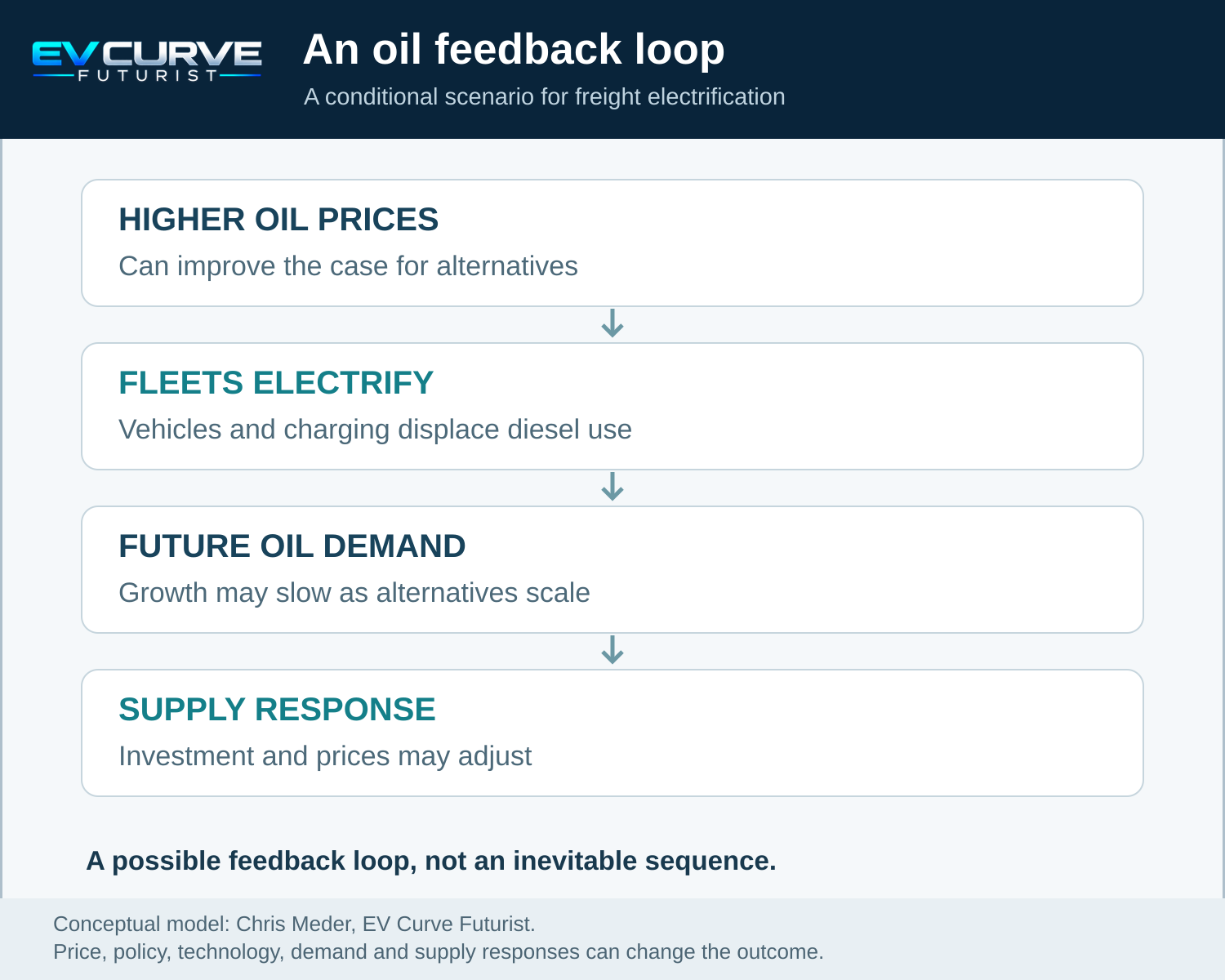
It is a possible reinforcing cycle, not a guaranteed sequence.
The question is how quickly cost, infrastructure and fleet replacement turn that possibility into a lasting shift.
Oil versus electricity
The oil system extracts, ships and burns fuel, depending on continuous supplies and long logistics chains. An electric fleet still needs generation, the grid and maintained infrastructure, but more of its energy can be produced and stored locally. One burns; the other earns.
Freight is an important source of oil demand. Electrifying suitable routes can reduce diesel use and imports over time, although the effect depends on the pace of fleet turnover and the electricity system supplying it.
From buses to trucks
China’s buses demonstrated a model: electrify high-utilisation fleets, build charging around their operations and use the scale to improve manufacturing. That experience is now moving into trucks, with Windrose among the companies taking Chinese electric freight technology into global markets.
The story started with buses, thousands returning to depots, plugging in, quietly replacing diesel one route at a time. That same pattern is now extending into freight. If buses were the proof, trucks are the scale.
Final thought
This is bigger than one vehicle replacing another. It is the gradual replacement of fuel logistics with electricity infrastructure, route by route. Decarbonisation is a benefit; energy security is part of the architecture.
Sources
View sources
- IEA: Global EV Outlook 2025, heavy-duty vehicles
- IEA: Global EV Outlook 2026, electric trucks and buses
- First Commercial Vehicle Network via Mysteel: China’s September 2026 heavy-truck market
- CNEVPost: China’s December 2025 heavy-truck sales
- New Energy Transport: Australian electric freight trial
- Windrose: Technology and vehicle specifications