For more than a decade, I’ve argued that the global system would eventually collide with physics, energy, and materials — not narratives, not financial engineering, not central‑bank storytelling.
The charts now make that collision unmistakable.
Gold, silver, copper, lithium, platinum — five very different commodities, five very different markets — are telling the same story. This is not coincidence. It is capital rotating out of abstraction and back into the physical world.
Central banks can’t save narratives. They can’t print copper. They can’t conjure lithium. They can’t manufacture energy.
And the market knows it.
January 2026 Snapshot: The Numbers That Matter
As of early January 2026, prices sit roughly here:
Gold: ~USD $4,330/oz (+65% YoY)
Silver: ~USD $72/oz (+145% YoY)
Platinum: ~USD $2,140/oz (+130% YoY)
Copper: ~USD $5.65/lb (+40% YoY)
Lithium carbonate: ~118,500 CNY/t (+58% YoY)
This is not a one‑commodity story. It’s a system‑wide repricing.
Precious Metals: Trust Is Leaving the Room
Gold moving from ~$1,200 in 2018 to over $4,300 today is no longer an “inflation hedge” narrative.
It’s a confidence hedge.
Debt is unmanageable. Currencies are politicised. Institutions are over‑levered.
Gold is what remains when trust erodes.
But silver is where the signal turns structural.
Silver + Solar = Non‑Negotiable Demand
Silver isn’t just money — it’s infrastructure.
Every solar panel requires silver. And solar deployment has crossed from linear growth into exponential expansion.
This is why silver isn’t merely following gold — it’s outperforming it.
Silver now sits at the intersection of:
Monetary stress
Industrial scarcity
Exponential solar deployment
Panels don’t get uninstalled. This demand doesn’t reverse.
“Solar is a compounding flow. Silver price is a delayed signal.”
Indexed to 2015, solar deployment has already gone exponential while silver prices lag. This divergence is the signal — not a contradiction. Deployment compounds first; price follows once inventories, substitution, and supply elasticity fail. Panels don’t get uninstalled. Silver demand is cumulative.
Silver’s breakout follows a decade of underinvestment colliding with exponential solar growth. Structural demand doesn’t reverse.
Copper: The Quiet, Relentless Signal
Copper never screams.
It tightens.
From ~$2.50/lb in 2018 to ~$5.65/lb today, copper has delivered a single message: electrification is inevitable, and grids are behind.
EVs, charging infrastructure, transmission, transformers, AI data centres — none of it works without copper.
AI didn’t replace copper. It multiplied demand.
Copper doesn’t blow off early. It grinds higher until something breaks.
Lithium: Not Spiking — Re‑Anchoring
Lithium is the most misunderstood chart on the page.
Yes, prices exploded in 2022. Yes, they collapsed brutally in 2023–24.
That wasn’t failure. It was cycle completion.
Lithium vs Past Cycles (Log‑Scale Thinking, Not Price Nostalgia)
Forget nominal prices for a moment. On a log scale, lithium has already completed a classic multi‑act commodity cycle:
Act I — Discovery & Disbelief (pre‑2021)
Lithium was niche, underpriced, largely ignored
Demand growth existed, but supply appeared plentiful
Capital stayed away
Act II — Narrative Overshoot (2021–2022)
EV adoption accelerated faster than forecasts
Spot prices exploded vertically
Straight‑line extrapolation took over
Marginal projects and financial speculation flooded in
Act III — Reality Reset (2023–2024)
Supply finally responded
Inventories rebuilt
Prices over‑corrected downward
Capital fled even as demand kept compounding
Where we are now (early Act IV): Re‑Anchoring
On a log‑scale view:
The crash did not break the secular trend
2024 lows held well above pre‑EV‑S‑curve pricing
The current move marks the first higher low after capitulation
That matters enormously.
This is not euphoria. This is demand reasserting itself after supply caught up.
EVs didn’t slow. Grid‑scale BESS didn’t pause. AI data‑centre power demand didn’t vanish.
Lithium isn’t back because of hype. It’s back because physics never left.
Why This Isn’t a Fake Bounce
Three confirmations matter:
No leverage frenzy — no retail mania, no parabolic juniors, no “lithium is the new oil” headlines
Demand-led, not narrative-led — EV volumes rising, grid BESS accelerating, AI/data centres pulling storage forward; none of this is optional demand
Market structure matters. On 11 June 2025, I called 26 May 2025 as the grand bottom in lithium. At the time, sentiment was still dominated by “oversupply” narratives.
Price told a different story.
Since that call, GFEX lithium has doubled — from ~60,000 CNY/t to ~120,000 CNY/t. The structure was textbook:
Base formation
Trend flip
Breakout
While commentary stayed bearish, price was quietly coiling. Momentum carried into year‑end, and 2026 starts with lithium in-trend, not in recovery.
Lithium isn’t spiking — it’s re-anchoring. After capitulation in 2024, price forms higher lows as demand reasserts and sentiment stays absent.
Bonds: The Silent Casualty
The commodity megatrend is a gravity event for capital. When money is pulled back into energy, materials, and throughput, it must come out of abstractions — and bonds sit directly in the crosshairs.
Bonds are claims on future purchasing power in a world where:
Energy is structurally repricing upward
Materials are tighter and more volatile
Infrastructure costs are rising
Government debt loads are already extreme
That is a toxic mix.
Long‑duration bonds don’t fail spectacularly in this regime — they decay quietly. Inflation volatility lifts term premiums, real yields struggle to stay positive, and central banks find themselves trapped:
Cut rates → weaken currencies → fuel commodities
Hold rates → destabilise growth and debt markets
Either way, bonds lose their role as “risk‑free.” They revert to cash management tools, not wealth preservation.
In a commodity megatrend, bonds don’t crash dramatically. They bleed relevance.
Crypto: From Escape Valve to Stress Test
Crypto sits on the opposite side of the same rotation.
It is not a commodity hedge. It embeds no energy, no materials, no throughput. It is a monetary abstraction — a liquidity reflex rather than a production asset.
Crypto tends to move through three phases in commodity‑driven regimes:
Phase 1 — Liquidity optimism (past) Cheap money, narrative dominance, reflexive upside. This peaked in 2021–22.
Phase 2 — Reality collision (now) As energy and materials reprice:
Mining costs rise
Regulation tightens under fiscal stress
Capital prioritises cash‑flowing reality
Crypto doesn’t implode. It underperforms.
Phase 3 — Survivorship (later) Crypto doesn’t disappear — but it consolidates brutally. Bitcoin survives as optionality, not digital gold. Everything else compresses as energy scarcity collides with token abundance.
In this regime, crypto becomes smaller, noisier, and less central to portfolios — a residual hedge, not a foundation.
Sodium‑Ion: Segmentation, Not Substitution
Sodium‑ion is not a lithium replacement. It is market segmentation.
It targets use‑cases where cost, safety, and cold‑weather performance matter more than energy density:
Entry‑level EVs
Fleets (high‑utilisation, cost‑driven)
Two‑ and three‑wheelers
Some stationary storage
Those were never the core drivers of lithium demand.
Counter‑intuitive truth: sodium can increase lithium demand.
Cheaper entry EVs widen adoption, steepen the S‑curve, and expand total deployed battery energy. Lithium demand is driven by energy throughput, not unit count.
Sodium trims the edges. Lithium owns the core.
NMC Is Dying — And 2026 Is the Inflection
This is the part many still won’t say out loud:
2026 is the year NMC effectively dies as a mass‑market chemistry.
Not overnight. Not everywhere. But structurally.
NMC’s advantages — higher energy density — are no longer decisive, while its disadvantages are becoming fatal:
Higher cost
Supply‑chain fragility (nickel, cobalt)
Thermal risk and complexity
Poor suitability for large, fast‑charging packs
Meanwhile:
LFP has closed the energy‑density gap enough to dominate volume
LMFP / LFP variants are extending range without cost blowouts
Sodium‑ion is eating the low‑end
That leaves NMC stranded in the middle — too expensive for mass market, too fragile for grid and AI, and increasingly unjustifiable for OEMs under margin pressure.
NMC won’t disappear. But its era as the default EV chemistry is ending.
That transition matters for commodities:
Less cobalt
Slower nickel intensity growth
Lithium demand remains intact — and shifts toward LFP‑heavy throughput
The chemistry mix is changing. The lithium thesis is not.
Platinum: The Sleeper Metal
Platinum’s surge reflects more than autocatalysts.
It sits at the junction of:
Hydrogen infrastructure
Industrial catalysts
Structural supply deficits
Renewed investor interest
Like silver, platinum is being pulled into the energy transition — quietly, and late.
By the time a reactor is approved, the grid has already changed.
That doesn’t make nuclear wrong. It makes it too slow for a phase change.
From Energy Transition to Commodity Megatrend
This is the missing link:
The energy transition is the commodity megatrend.
Not ideology. Not speculation. Not politics.
Physics. Economics. Time.
The old system was built for scarcity and control. The new one scales on abundance and speed.
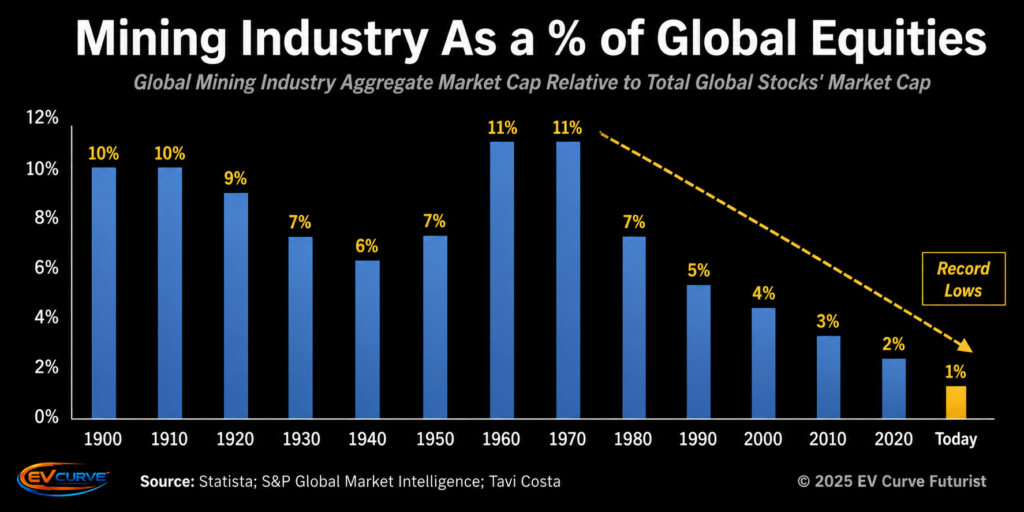
One statistic captures just how disconnected markets remain from the physical transformation already underway. Mining now represents roughly 1% of global equity market capitalisation, down from around 10–11% through much of the last century. The market spent decades rewarding software, platforms and asset-light businesses. The next decade may reward the companies that own the physical resources needed to build the AI and electrified economy. If that shift continues, mining’s share of global equities could rise substantially from today’s historically low levels. But investors will still need to be selective. Plenty of roaches will thrive too.
Exponential growth on the way up. Exponential irrelevance on the way down.
The widening gap between forecasts and reality is the clearest signal of how unprepared the old guard is.
Final Word
This is not a smooth transition layered onto the old world.
It is a structural break.
The curve doesn’t negotiate. It doesn’t pause for politics. It doesn’t wait for institutions to update spreadsheets.
It accelerates.
The commodities now repricing — silver, copper, lithium, gold — are simply the material witnesses.
I’ve been calling this for a decade. The charts have finally caught up.