
The strange aesthetic double standard surrounding wind energy, and the technological revolution moving far faster than its critics realise.
After decades of digging enormous holes in the Australian landscape, flattening mountains, clearing forests and covering entire regions with coal mines, gas wells and industrial infrastructure, it seems we’ve suddenly developed an extraordinary sensitivity to the aesthetics of energy production.
And the great offender? Wind turbines.
Apparently, white turbines turning on the horizon are “industrialising the countryside”, “destroying pristine landscapes”, “scarring the horizon” and “ruining our natural heritage”.
Yet enormous open-cut coal mines, complete with excavated landscapes, waste rock, dust, haul roads and heavy machinery, are more likely to be celebrated as jobs, investment and economic development.
Funny how the vocabulary changes depending on what’s being built.
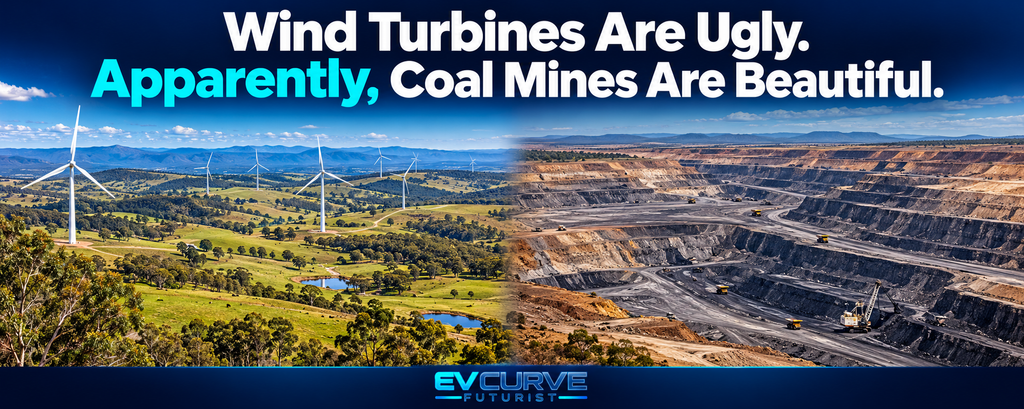
Apparently, wind turbines scar the landscape, while enormous open-cut coal mines represent progress. Both have environmental impacts, but only one seems to attract endless outrage over how it looks.
Now, I don’t dismiss genuine concerns about wind farms. Noise, wildlife impacts, habitat disruption, transmission corridors and proximity to homes are legitimate planning considerations. Some opponents consistently object to industrial development in natural landscapes, whether that’s turbines, coal mines or highways. That’s a legitimate conservation position, even when I disagree with their conclusions.
I also understand why people become attached to familiar landscapes. A turbine visible from someone’s home changes a view they’ve perhaps enjoyed for generations. Its height, movement and proximity can make that change feel intrusive. Those feelings are real, and communities deserve to be heard.
But there’s a difference between assessing those impacts honestly and treating the mere sight of a turbine as an environmental catastrophe, particularly while overlooking the consequences of the energy systems it would replace: air pollution, CO₂ emissions, extensive land disturbance from mining and the ongoing extraction and combustion of fossil fuels.
Meanwhile, the technology is advancing at an extraordinary pace.
The Wind Revolution Is Already Here
According to the World Wind Energy Association’s October 2026 report, global installed wind capacity reached approximately 1,407 GW by mid-2026, with another 58.9 GW added during the first six months. That was 18% below the same period in 2025, but approximately 159 GW was installed over the preceding twelve months.
According to Ember’s Global Electricity Review 2026, wind generated 2,715 TWh of electricity in 2025, supplying 8.5% of global electricity. That’s more than double the electricity generated from wind in 2018.
China alone generated approximately 1,135 TWh from wind, more than the entire G7 combined. Denmark generated 58% of its electricity from wind, while fifteen countries generated more than 20%.
Here in Australia, government electricity statistics show wind supplied approximately 40 TWh in 2025, around 14% of our electricity, an increase of roughly 21% over the previous year, partly reflecting better wind conditions.
This is no longer experimental technology. It’s an established global industry generating enormous amounts of electricity without continually extracting and burning fuel.
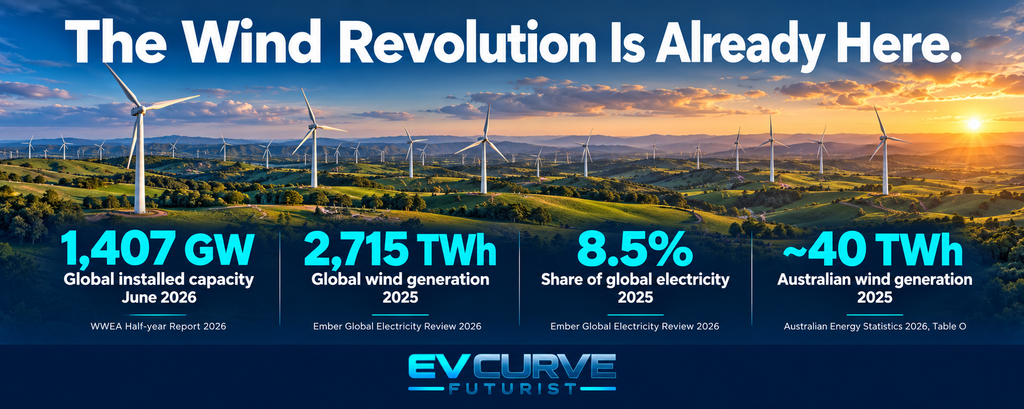
More than 1.4 terawatts of installed wind capacity worldwide by mid-2026, generating 2,715 TWh in 2025. Wind now supplies 8.5% of global electricity, including around 40 TWh annually in Australia.
Thirty Years of Progress, and We’re Still Accelerating
What fascinates me most is how quickly the technology itself is improving.
Consider Scotland’s Hagshaw Hill wind farm. When it opened in 1995, it had 26 turbines with approximately 16 MW of combined installed capacity. Thirty years later, those machines have been replaced with just 14 modern turbines providing around 79 MW.
46% fewer turbines. Nearly FIVE TIMES the installed capacity.
That’s not five times the actual generation, which depends on wind conditions and capacity factors, but it demonstrates how dramatically turbine engineering has progressed.
ScottishPower also reported that 99.9% of assessed decommissioned materials were recovered, with 79.5% recycled and 20.4% reused. These figures come from a company-commissioned assessment whose full underlying report isn’t publicly available, so they shouldn’t be assumed to represent every wind farm.
Not every ageing wind farm can be repowered so dramatically. Larger turbines require suitable sites, planning approvals, grid capacity and community acceptance. They’re also taller and more visible, even when fewer machines are needed.
But the technological direction is unmistakable. Better aerodynamics, larger rotors, improved generators, smarter controls and advanced forecasting are extracting more electricity from available wind resources. Thirty years ago, turbines were commonly measured in hundreds of kilowatts. Today, the largest offshore machines exceed 15 MW.
Imagine what another thirty years of engineering progress might deliver.
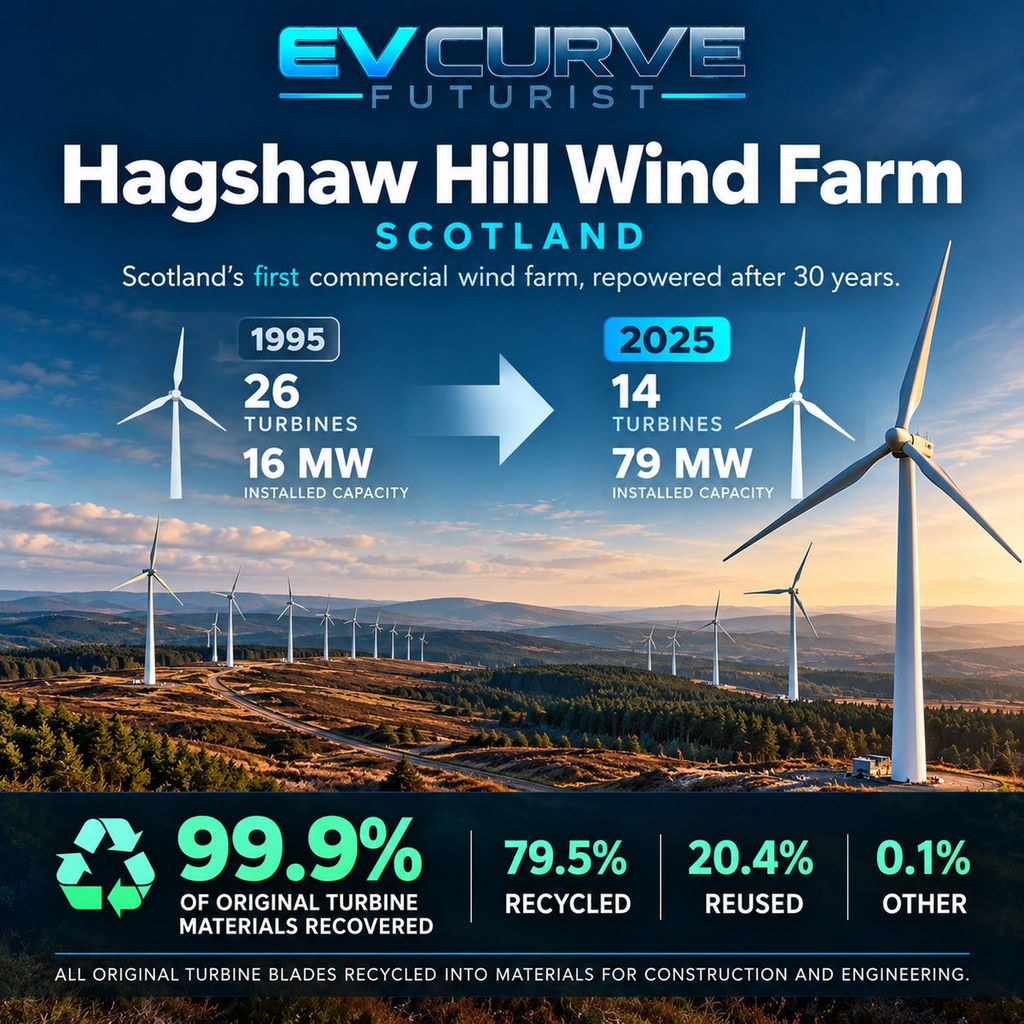
Scotland’s Hagshaw Hill wind farm went from 26 turbines and 16 MW in 1995 to just 14 turbines and 79 MW in 2025. That’s 46% fewer machines with nearly five times the installed capacity.
Land Use: Two Very Different Footprints
Wind farms can coexist with agriculture, allowing farmers to continue grazing livestock while earning additional income. Turbines can eventually be dismantled and much of their infrastructure footprint rehabilitated, although foundations, roads and ecological impacts still require management.
Open-cut mining fundamentally excavates the landscape itself. Rehabilitation is possible, but restoring the original landform and ecology is an entirely different challenge.
Neither technology is impact-free, and both deserve proper environmental scrutiny. But their impacts differ substantially in nature, duration and scale.
Economics Will Ultimately Shape the Transition
Wind farms require substantial upfront investment, maintenance, grid connections and eventual replacement. Coal and gas generation also require infrastructure investment, but depend on continuous fuel supplies, exposing them to extraction costs, commodity prices and geopolitical disruptions.
Of course, wind is variable. Electricity systems need storage, flexible generation, transmission and demand management to balance supply and demand. Those costs are real and must be included in any credible comparison.
But variability is not the same as unreliability. Nobody builds a modern electricity grid around a single generator operating continuously. Wind, solar, hydro, storage and other dispatchable resources complement one another. The relevant measure is the reliability and total cost of the entire system, not whether the wind blows every hour.
And as turbines improve, storage becomes cheaper and grids become more flexible, those economics continue to evolve.
That’s the fundamental distinction. Fossil fuel generation requires a continuing supply of extracted fuel. Wind generation invests in infrastructure to harvest an energy resource nature continually replenishes.
Both have costs, but only one carries an ongoing fuel bill.
I’ve followed the electrification revolution for more than two decades, and one lesson keeps repeating: technological progress moves considerably faster than public perceptions.
That doesn’t mean every wind farm is a good project, or that communities should accept whatever developers propose. It means judging energy infrastructure consistently, on environmental impacts, community interests, reliability, economics and what it actually delivers.
Not simply whether someone finds a turbine prettier or uglier than a coal mine.
Because the future of electricity isn’t going to be decided by an aesthetic competition.
It will be decided by engineering, economics and the relentless pace of technological improvement.